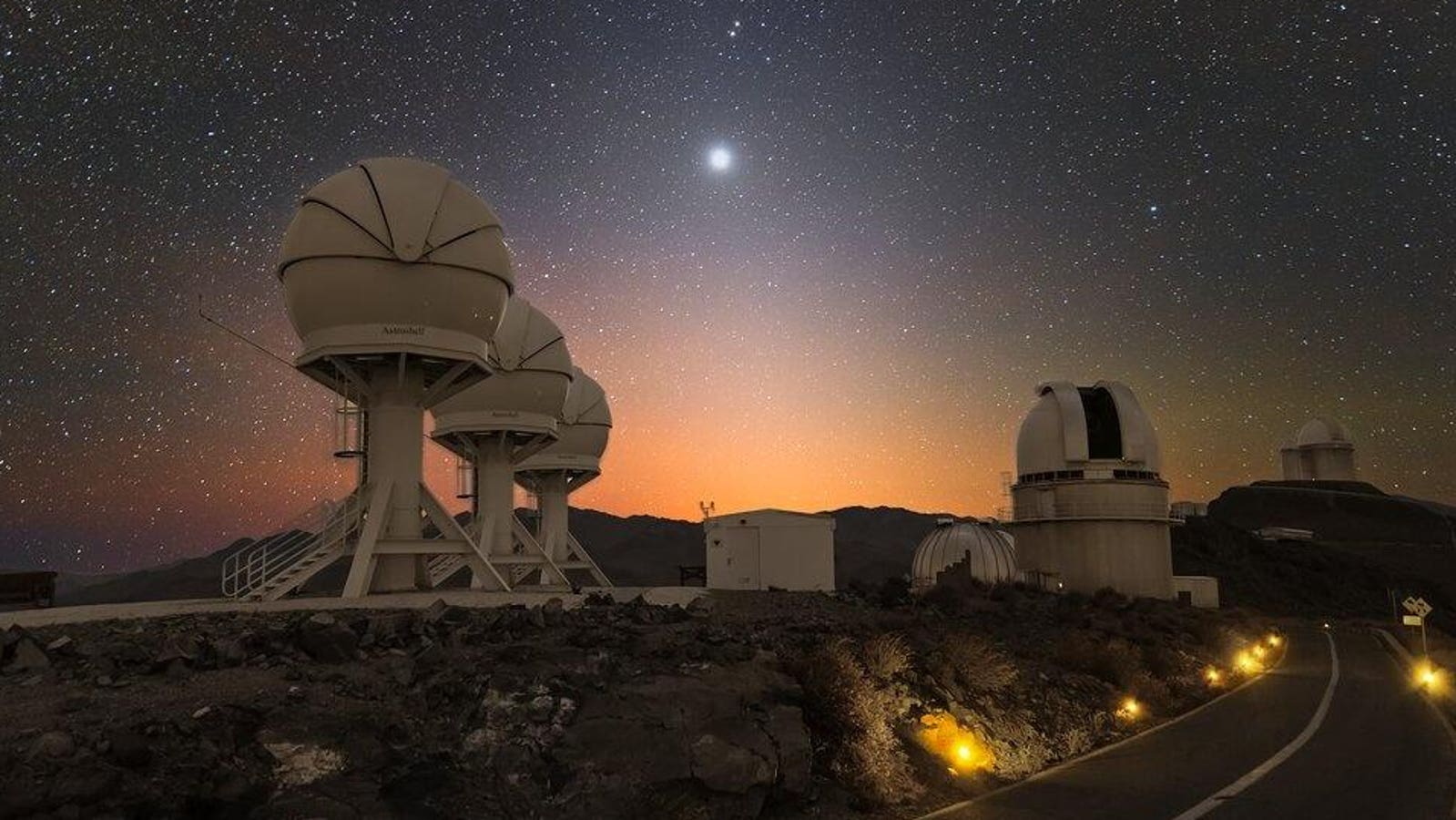
What is that bright white star in the sky? Whether you’re an early riser or you’ve been driving after dark in recent weeks there have been two very bright “stars” shining in the east.
Could it be the North Star, Polaris? Definitely not—it might be famous, but it’s actually only the 48th brightest star in the sky.
They are, of course, not stars at all, but planets—and two of the most famous planets of all.
The Bright ‘Star’ In The East In The Morning
It’s Venus. From January through September the closest planet to Earth dominated the post-sunset night western sky as the “Evening Star,” becoming ever-brighter, before sinking back into the sun’s glare.
Then it did the opposite, appearing to rise higher into the pre-dawn sky in the east during a dazzling “Morning Star” phase.
Venus, now shining at a magnitude of -4.5 in the constellation Leo, reaches its “greatest elongation west” tomorrow. That’s how astronomers describe its farthest distance from the sun in the morning sky—about 46°, so about half-way up the sky—something that logically makes it more easily seen by more people.
It will remain relatively high for a few months, dropping back into the sun’s glare next spring to re-emerge in the post-sunset sky in the west next summer.
Understanding The Orbit Of Venus
As an inner planet to Earth it can never be seen moving across the entire night sky, as the outer planets do. In fact, from Earth, Venus appears to have an eight-year cycle in which it orbits the sun 13 times and waxes and wanes between being a “Morning Star” and “Evening Star” every 19 months, according to Timeanddate.com.
It’s partly a line-of-sight thing. From where we are in our orbit of the sun the closest planet to us, Venus, appears to move back and forth from the sun’s glare into the post-sunset or pre-sunrise night sky.
The Bright ‘Star’ In The East In The Evening
Go outside a couple of hours after sunset this month and you’ll see a bright planet rising in the eastern sky. That’s Jupiter, which is now shining at a magnitude of -2.9 in the constellation Aries.
NASA’s Juno spacecraft is currently buzzing around it taking incredible images of the giant planet and its moon Io while the European Space Agency just launched its JUICE mission to take a closer look at the three other giant moons Europa, Callisto and Ganymede.
Point any pair of binoculars at Jupiter and you’ll see all four moons (unless one of them is in front of behind the giant planet).
Understanding The Orbit Of Jupiter
As an outer planet to Earth, Jupiter orbits the sun much more slowly. In fact, it takes Jupiter 12 years to complete one orbit. So it can be seen moving across the entire night sky, and it’s Earth’s position that is the biggest factor is when and where Jupiter is seen.
Once each Earth-year out planet gets between the sun and the Earth. This moment, called opposition, sees the outer planet at its biggest, brightest and best of the year. It’s when we can see 100% of the planet, and when it rises in the east at sunrset and sets in the west at sunset. Jupiter’s opposition this year takes place on November 3—and that is why it’s already so big and bright in the early evening night sky!
Wishing you clear skies and eyes.
Read the full article here