


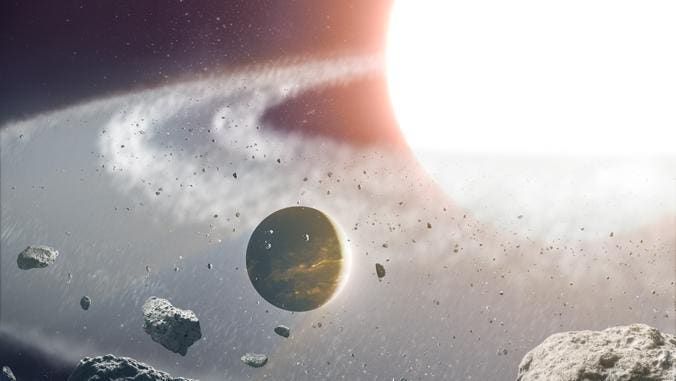
Astronomers have found a planet that should not exist orbiting a red giant star.
Called Halla, the Jupiter-sized planet orbits a star called Baekdu about 520 light-years away from the solar system in the constellation Ursa Minor (the Little Bear).
As studied by NASA’s Transiting Exoplanet Survey Satellite (TESS), Baekdu appears to be burning helium in its core, meaning that the nuclear fusion in its core must have ceased long ago, causing the inevitable expansion into a red giant star. It should have expanded to 1.5 times the distance of Halla’s orbit, and engulfed the planet, before shrinking.
That Halla still appears to exist is, therefore, a mystery. It should have been destroyed long ago.
“The fact that Halla has managed to persist in the immediate vicinity of a giant star that would have otherwise engulfed it highlights the planet as an extraordinary survivor,” said Marc Hon, a NASA Hubble Fellow at the University of Hawaiʻi Institute for Astronomy, the lead author of the study published in Nature this week.
Halla, discovered in 2015, orbits its sun every 93 Earth-days from around half the Earth-Sun distance.
Hella’s survival is a mystery, but there are three possible causes:
- It could have started on a larger orbit before migrating inward (rated very unlikely).
- Baekdu may have originally been two stars, which merged, an event that would have prevented either from expanding.
- Halla may have been formed very recently from a dust cloud produced from a merger between the two stars.
If the latter is the case then Halla is in a class of its own—a ‘second generation’ planet. “Most stars are in binary systems, but we don’t yet fully grasp how planets may form around them,” said Hon. “It’s plausible that more planets may actually exist around highly evolved stars thanks to binary interactions.”
Wishing you clear skies and wide eyes.
Read the full article here