


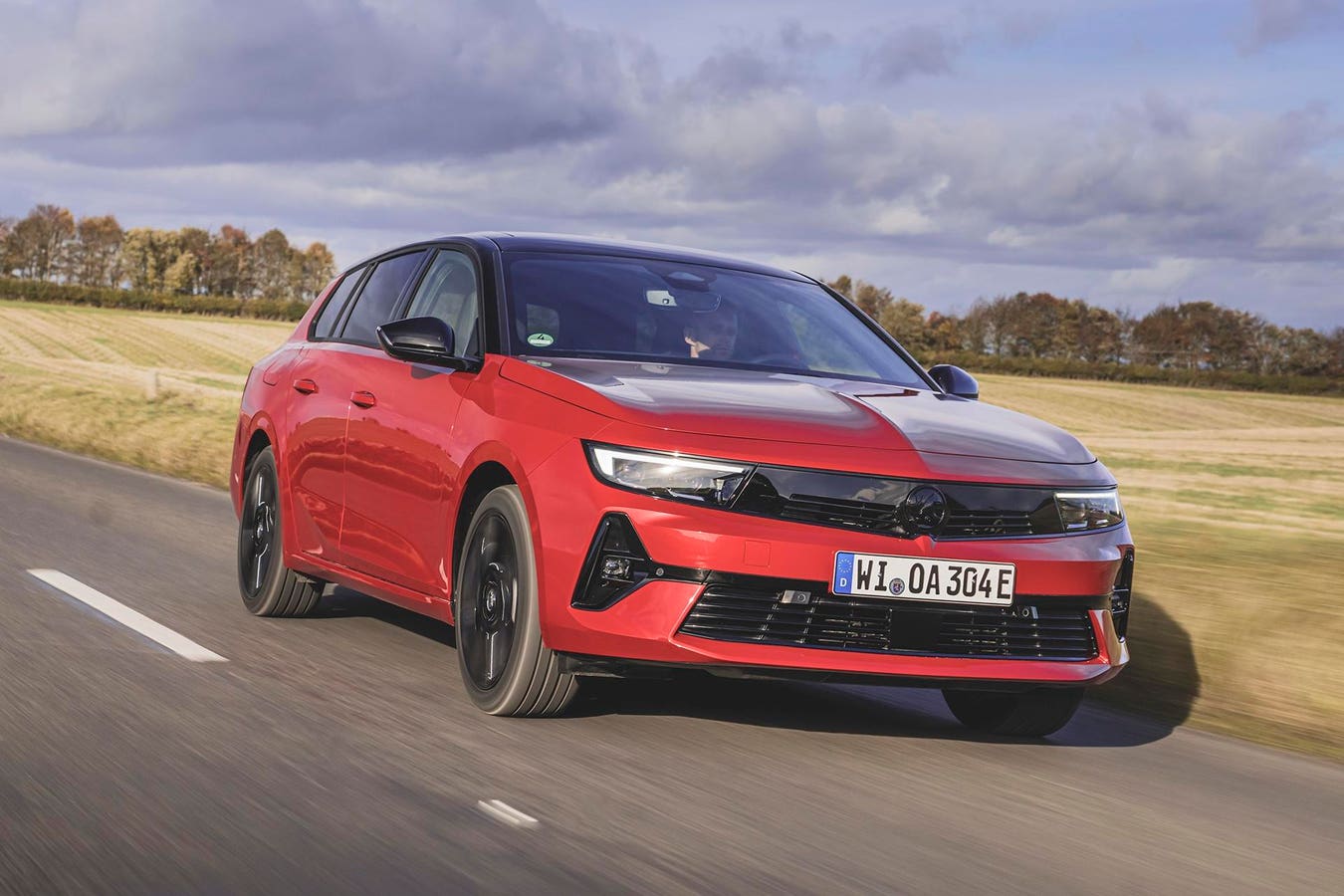
The variety of vehicle types available in electric form has expanded a lot over the last three years, but one format that is massively underrepresented is the estate car (aka station wagon in America). The public penchant for SUVs has made them the dominant form instead. But now Stellantis has a new wagon option at the lower end of the price range, marketed under the Vauxhall brand in the UK and Opel elsewhere. It’s called the Astra Sports Tourer Electric. Is this the luggage lugger the masses have been waiting for? I took the new car for a test drive.
Before electric car aficionados get excited that this is our first taste of one of the new Stellantis STLA Medium platform as found in the Peugeot e-3008, it isn’t. The Astra Sports Tourer Electric uses the mildly updated second version of the company’s workhorse Common Modular Platform called e-CMP2, also called EMP2 and STLA Small. This now offers 115kW (154hp) instead of 100kW (134hp) and a 54kWh (51kWh usable) battery instead of 50kWh (46.3kWh usable).
Thanks to the larger battery and efficiency improvements, the new drivetrain can deliver a WLTP range of 256 miles even in the larger Astra Sports Tourer, where the original Vauxhall Corsa-e only managed 209 miles. This is a significant improvement for Stellantis vehicles, but hardly state-of-the-art when so many competitors now offer over 300 miles. DC charging is still only 100kW, taking 26 minutes to replenish from 20 to 80%, although that’s going to be adequately quick for long-distance travel.
During my testing, mostly on A-roads with a 60mph limit and in a mixture of normal and sport modes, I achieved an average of 2.9 miles per kWh. This would imply a real-world range of 148 miles. The outside temperature was 11C (52F), so you’d probably get bit more in warmer weather. But that’s below par for an EV aimed at sales in 2024, and only just lifts the Tourer beyond just being suitable for urban use. There is at least a heat pump as standard, reducing the range loss in cold weather.
The Tourer is comfortable for the driver and front passenger, and there’s plenty of room in the back for rear-seat passengers too. They also benefit from their own air vents (but not separate control over air conditioning), plus a single USB port for devices. The middle seat back folds forward to make an armrest with integrated cupholders. As family transportation, this Astra is well appointed.
Stellantis hasn’t followed the trend towards using the infotainment screen for most functions. There are still discrete buttons to operate the primary air conditioning features, including fan speed and temperature. You also get buttons for the heated seats and steering wheel on models that have these, which include the GS and the Ultimate version that I was driving.
However, there’s a 10in screen driving a digital instrument cluster, plus another 10in screen for the infotainment. The Apple CarPlay and Android Auto support are wireless, so you can just place your phone on the pad to use these systems, once set up. There’s even a Head-Up Display on the Ultimate trim level. Adaptive cruise control is included on the GS and above, and the Ultimate offers Intelli-Drive 2.0, which also provides some lane positioning assistance and departure prevention, plus semi-automated lane change capabilities.
The key thing about the Tourer is of course the luggage space in the rear. With the rear seats up, the capacity is a healthy 516 liters, which expands to 1,553 liters with them down. The floor is also quite flat with the rear seats forward, making this a capacious car. The space is comfortably more than the MG5 Long Range offers, which is the Tourer’s only direct competitor currently. If you want a load lugger that isn’t an SUV, the Astra Sports Tourer Electric has plenty to offer. The top-spec Ultimate version I drove also has release levers near the rear of the luggage area, so you can drop the seats forward easily without having to go around to the rear passenger doors. There’s no kick-release on the rear door, but apart from that this is a very capable cargo carrier.
According to the specifications, the Touring takes 9.2 seconds to reach 62mph, which isn’t particularly quick, especially for an EV. However, in practice this car feels faster than that number would imply. During my A-road testing, in Sport mode it nipped past slow traffic with ease. You still get near-instant throttle response, so you can grab opportunities more easily than with an internal combustion car where you need to be sure you’re in the right gear first or hope your auto box kicks down quickly enough.
Overall, though, this is a family cruiser rather than any kind of engaging driver’s car. It’s perfectly happy at highway speeds and not too large to navigate tight town or village streets. Essentially, it’s a comfortable everyday vehicle, which is what most Astras are meant to be.
Alongside the Astra Sports Tourer Electric, Vauxhall has also launched an Astra Electric Hatchback and updated Corsa-e (now just called Corsa Electric) with the improved STLA Small powertrain, although the Corsa Electric has a smaller 51kWh battery.
The Vauxhall Astra Sports Tourer Electric is a quality vehicle and a welcome addition to the EV market. But it has a drawback. Even the basic Design trim costs £39,995 ($51,000), and there are some great alternatives for this much or less, such as the Highland Tesla Model 3 Rear-Wheel Drive, or the MG4 Extended Range. Neither of these have the luggage capacity of the Astra, but both offer much better range and performance. The MG5 has a little less range and luggage capacity, but costs considerably less too.
So while this is a solid car with some great everyday capabilities, the price is questionable given the direction of the market and the increasing competition from Chinese vendors such as MG. With BYD now on sale in the UK as well, and other Chinese brands gaining strong footholds in continental Europe, the Astra Sports Tourer Electric has its work cut out for it. Even though it is reassuringly not an SUV, the time is fast approaching when it will no longer be possible to charge the EV premium it still represents.
Read the full article here



