I’m the world’s only “eclipse journalist.” For the very latest on the “ring of fire” solar eclipse—including the latest travel and lodging options—please press the big blue “follow” button above or check my main feed for new articles each day.
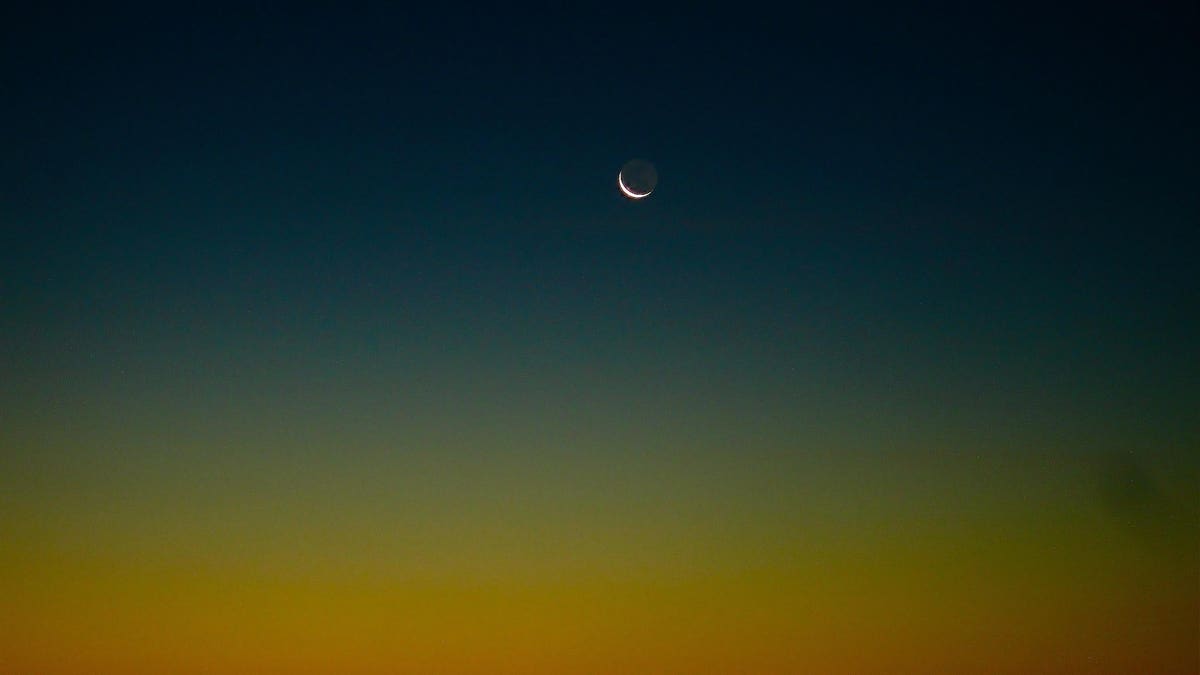
When is the new moon in September 2023? The moon is today impossible to see from Earth. With our natural satellite between Earth and the sun the latter illuminates only the moon’s far side.
The new moon in September 2023 will be on Friday, Sept. 15, 2023 at 1:40 a.m. UTC, which translates to Thursday Sept. 14 at 9:40 p.m. EDT.
However, there’s something very special about this ninth new moon of the year—it’s soon to cause both a solar eclipse and a lunar eclipse. In fact, the next new moon on Oct. 14 will cross the sun’s disk to create an annular, or ring-shaped solar eclipse during which solar eclipse glasses must be worn at all times.
The general reason why eclipses can occur is a line-of-sight coincidence. The moon is about 400 times smaller than the sun, but the sun is about 400 times further away. That’s not always true—Earth’s orbit around the sun, and the moon’s around Earth, are slightly elliptical. So the actual figure varies, producing two different kinds of eclipses when conditions are perfect.
Saturday, Oct. 14 sees a “ring of fire” annular solar eclipse visible from nine U.S. states because the moon is close to its monthly apogee—the farthest it gets from Earth each month—at new moon.
However, eclipses occur because the moon’s orbital path intercepts what astronomers call the ecliptic—the apparent path the sun takes through our daytime sky. The moon’s orbital path is slightly inclined (by about 5º) to that ecliptic, intersecting it twice each month. These two points are called nodes.
Only if the timing is right can a new moon cover the sun exactly, but when it does, it’s followed (or preceded) by a lunar eclipse as full moon drifts into the Earth’s shadow. That’s what will happen in October when a “ring of fire” annular solar eclipse will be followed two weeks later by a “Hunter’s Moon Eclipse.”
‘Ring Of Fire’ Explained
On Oct. 14 a new moon will drift across the sun to cover about 90% of it, resulting in a “ring of fire” around the moon—but only as seen from a narrow strip of the Earth’s surface. This path of annularity will be narrow, around 125 miles wide, and stretch from the North Pacific to the South Atlantic.
It will make land at the Oregon coast and move through northern California, Nevada, southwestern Idaho, Utah, northeastern Arizona, southwestern Colorado, New Mexico and Texas. It will then be visible from Mexico’s Yucatan Peninsula, Belize, Honduras, Nicaragua, Panama, Colombia and Brazil.
‘Hunter’s Moon Eclipse’ Explained
On Oct. 28 a full “Hunter’s Moon” will drift into the Earth’s outer penumbral shadow. At its peak only 6% will enter its central shadow, the umbra, so technically a slither of the moon will turn red. However, this will be barely perceptible—it won’t be a bona fide “Blood Moon.”
It will be best viewed from the night-side of the world—Europe, Africa and Asia. It will only be visible in the eastern Americas during moonrise and in western Australia during moonset, according to Sky At Night magazine.
For eclipse-chasers, October’s eclipse season is much anticipated—but it’s really all and only about the “ring of fire.”
I am the editor of WhenIsTheNextEclipse.com and author of “The Complete Guide To The Great North American Eclipse of April 8, 2024.”
Wishing you clear skies and wide eyes.
Read the full article here