


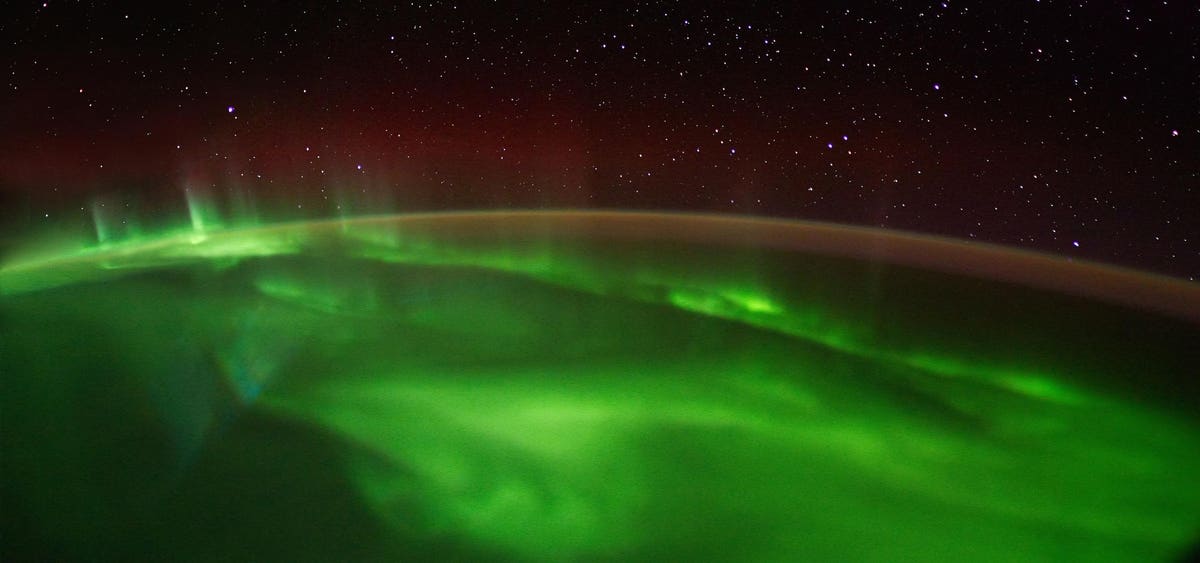
The night sky throughout the solar system may be full of color. From data gleaned from a joint European-Japanese spacecraft on its way to Mercury, scientists have concluded that aurora is present on the tiny planet.
It therefore follows that aurora—spectacular displays of greens, reds a and yellows often seen at the highest latitudes on Earth—could be present in some form throughout the solar system.
Aurorae the result of charged particles—electrons, protons or ions—being accelerated along a planet’s magnetic field lines.
The evidence for aurora on Mercury comes from a flyby of the BepiColumbo spacecraft, which is on its way to study the planet, but is performing several flybys to slow down enough to go into orbit around it in 2026.
‘Southern Lights’ on Mercury
In a paper published today in Nature Communications paper data is presented that suggest that “Southern Lights” are found around Mercury’s south pole.
The evidence comes from a flyby on October 1, 2021, during which BepiColumbo sent back images, but also took readings of Mercury’s magnetosphere—the region around a planet dominated by the planet’s magnetic field.
It looked something like this:
Magnetic Appeal
Mercury’s southern magnetosphere aurorae are similar to those seen on Earth and Mars, states the paper. Its magnetosphere is known to change according to the strength of the solar wind—a stream of charged particles from the sun—just as happens around Earth, Jupiter, Saturn and Uranus.
BepiColumbo found direct evidence of “X-ray aurorae,” energetic electrons being accelerated in the tail of Mercury’s magnetosphere on its night-side and drifting rapidly towards its dayside to appear as aurora.
The authors suggest that it’s therefore likely to be a universal mechanism observed throughout the solar system.
Aurora on Other Planets
Aurorae have been photographed shining in ultraviolet light on Jupiter, Saturn, Uranus and Neptune,. They’ve also been detected on Mars and on the night side of Venus as bright and diffuse patches—despite both planets lacking a magnetic field.
BepiColumbo, which launched in 2018, is two spacecraft carrying two orbiters—the ESA Mercury Planetary Orbiter (MPO) and the JAXA Mercury Magnetospheric Orbiter (MMO).
The MPO will mostly study Mercury’s surface and composition while the MMO will focus on Mercury’s magnetic environment and the chemical make-up its thin exosphere. Together the orbiters will simultaneously study how the solar wind affects both the planet’s exosphere and its surface.
Wishing you clear skies and wide eyes.
Read the full article here



