


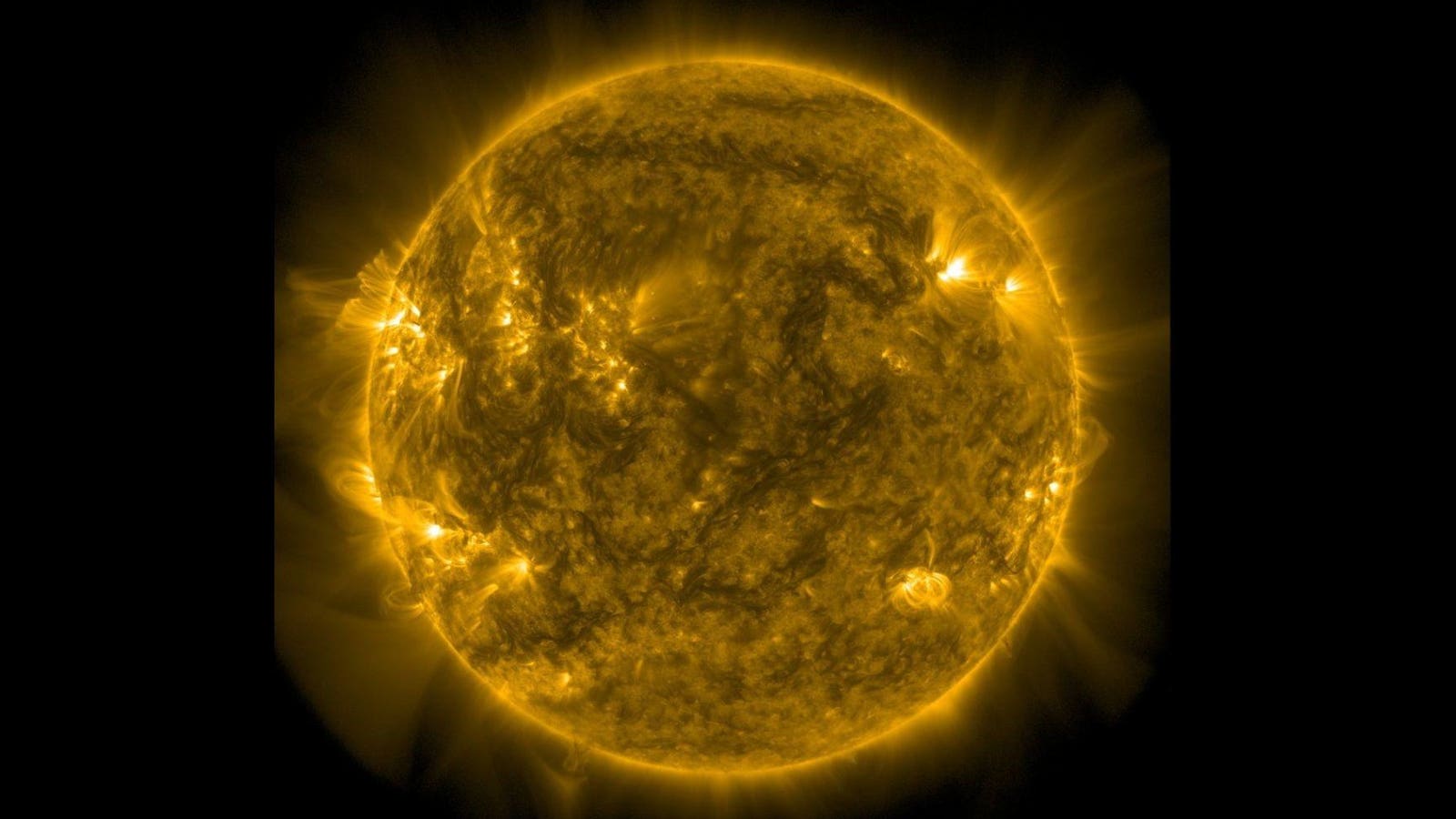
According to the Space Weather Prediction Center, the sun is becoming more active more quickly than anticipated and will peak earlier than predicted. That peak will also last longer and could even peak twice, but it likely won’t break records.
A service from the National Oceanic and Atmospheric Administration, the new testbed prediction from the SWPC is its first for the current Solar Cycle 25 since December 2019, when it predicted that solar maximum—the most active point in the sun’s roughly 11-year cycle—would occur during 2025. It also indicated that Solar Cycle 25 would be weak, which it has been anything but.
New window
The SWPC’s new window for solar maximum is between January and October 2024. It’s the result of observations of sunspots, which, although few and far between in recent weeks have been higher than expected during the last year or so.
The SWPC now predicts a maximum sunspot number of between 137 and 173 in the month of the solar maximum, the date of which is only apparent in retrospect. The 2019 prediction from the SWPC was for between 95 and 130 sunspots at a peak likely to occur between 2023 and 2026.
“We expect that our new experimental forecast will be much more accurate than the 2019 panel prediction and, unlike previous solar cycle predictions, it will be continuously updated on a monthly basis as new sunspot observations become available,” said Mark Miesch, a CIRES scientist who serves as the solar cycle lead at SWPC. “It’s a pretty significant change.”
Sunspots and the solar cycle
Sunspots are dark areas on the sun’s surface, typically on either side of its equator. They are caused by, and indicative of, changes in magnetic activity on the sun’s surface. A spike in sunspots tends to correlate with the sun being more active and emitting more radiation. That—and predictions of when it will occur—is crucial because a more active sun means more solar flares and coronal mass ejections, which affect Earth’s atmosphere and magnetic field. That causes an uptick in aurorae but also increases danger to satellites, airline crews, astronauts and potentially—via an uptick in solar storms—to electrical grids on Earth.
Good news for aurora-hunters
As well as underscoring a highly active Solar Cycle 25, the new prediction from SWPC suggests that the sun’s peak activity will last longer than previously thought. “The newly released forecast predicts a solar maximum between January and October 2024,” said Dr. Ryan French, a solar physicist at the National Solar Observatory (NSO) in Boulder, Colorado and the author of The Sun: Beginner’s Guide To Our Local Star, in an email.
However, the SWPC has also predicted that the sunspot decline will take longer than the rise. “There’s a possibility of a double-peak at solar maximum—and we can expect high solar activity, including more frequent aurora sightings, until at least 2027,” said French.
It now seems possible that solar maximum could coincide with the next total solar eclipse, which will be visible from within a narrow 115 miles wide path of totality across North America on April 8, 2024.
Overdue update
During summer, NOAA’s 2019 prediction appeared to have become outdated, with a higher-than-expected sunspot number between May and July (peaking at 163 in June). That suggested that a rival solar cycle model from National Center for Atmospheric Research could be more accurate. In 2020, NCAR predicted that Solar Cycle 25 could be one of the strongest since record-keeping began with a peak number of sunspots between 210 and 260.
Quieter sun
However, this new prediction from SWPC comes after a quiet October for the sun, which has dampened excitement around the possibility of a record-breaking solar cycle. “This quieter month comes after a period of unusually high solar activity earlier this year, which prompted some suggestions of a record-breaking solar cycle,” said French. “NOAA’s new forecast suggests that this is unlikely, but there is always some degree of uncertainty in the model that could make a record high cycle possible (albeit improbable).”
Moderate cycle
Although it had become evident that the SWPC’s 2019 prediction for Solar Cycle 25 was too low, its new data doesn’t suggest a record-breaker. We know that Solar Cycle 25 will be stronger than Solar Cycle 24. “The new prediction forecasts that the current solar cycle will continue to exceed the maximum of the previous solar max in 2014 but will likely fall shy of prior solar maximums between the late 1970s and early 2000s,” said French. That would rule out a repeat of the Halloween solar storms in 2003. “Looking over the past few centuries, this would make our current solar cycle moderate, but at least higher than the low and slow cycle from NOAA’s previous forecast in 2019.”
Note: never look at the sun with the naked eye or through binoculars or telescopes that aren’t fitted with solar filters.
Wishing you clear skies and wide eyes.
Read the full article here



