Each Monday I pick out the northern hemisphere’s celestial highlights (mid-northern latitudes) for the week ahead, but be sure to check my main feed for more in-depth articles on stargazing, astronomy, eclipses and more.
The Night Sky This Week: September 18-24, 2023
There’s nothing specifically to see on equinox and yet it has a powerful and profound effect on stargazers. Heralding the beginning of astronomical fall or autumn in the northern hemisphere and astronomical spring in the southern hemisphere, it’s a waymarker like no other for stargazers because it brings equal day, equal night.
Yes, it comes with a drop in temperatures that makes stargazing harder to bare, but as well as more hours of darkness until late December it also sees the return of some of the northern hemisphere’s most spectacular night sky sights—including the northern lights or aurora borealis.
Here’s everything you need to know about watching the moon, planets, stars and more this week:
Monday, September 18: Crescent Moon And ‘Earthshine’
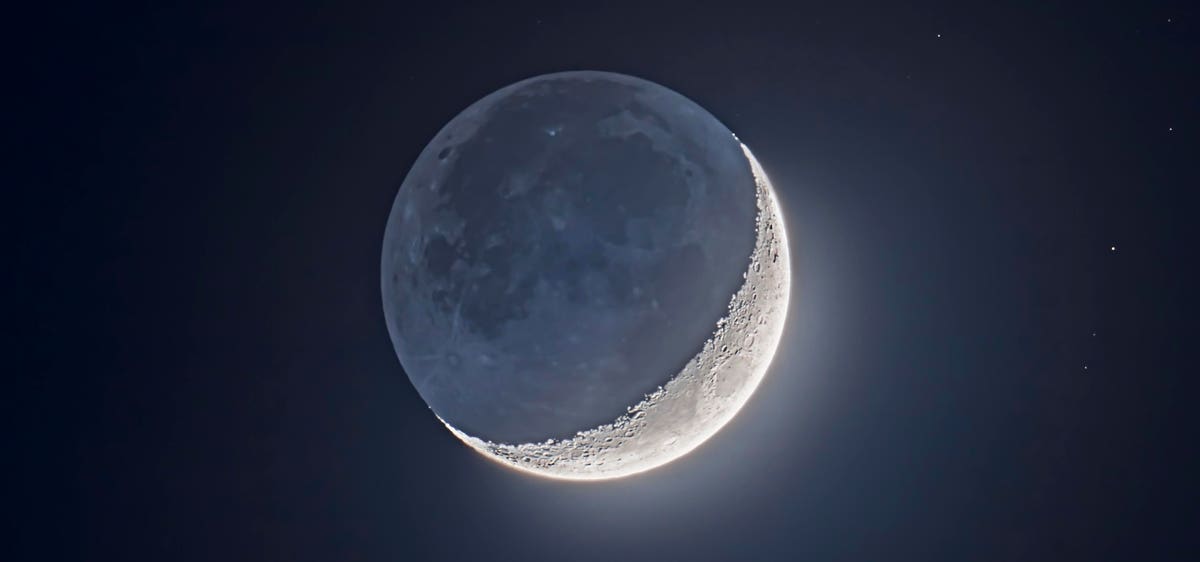
Look to the southwest after sunset tonight and you’ll see a 14%-lit crescent moon. There are no planets around it—as there have been for much of the year—so instead study the reflected light upon its dark limb. That’s “Earthshine”—light that’s traveled from the sun to reflect off Earth’s oceans and ice and on to the lunar surface.
Wednesday, September 20: Crescent Moon And Antares
A 31%-illuminated waxing crescent moon will tonight, after dark, be visible in the western sky close to Antares, a huge star 12 times the mass of the sun in the constellation of Scorpius. The fifteenth-brightest star in the night sky would, if in the solar system, almost reach the orbit of Jupiter.
Friday, September 22: First Quarter Moon And Mercury Rising
Tonight the moon reaches its First Quarter phase, when its near-side appears to us on Earth to be half-lit. It also marks the point in the stargazer’s month when the waxing gibbous moon’s glare increasingly bleaches the night sky, making it more difficult to see stars and faint deep-sky objects.
It’s also one of the best days of the 2023 to see Mercury, though you’ll need binoculars and an alarm clock. It will be visible about 10º above the horizon—which is very high, for the closest planet to the sun—about 30 minutes before sunrise.
Saturday, September 23: Autumnal Equinox
At 2:50 a.m. EDT it’s the moment equinox, which marks the precise time when the midday sun crosses the equator somewhere on Earth. Equinoxes occur twice per year, in late March and lat September. They’re global events occurring simultaneously for everyone on the planet. The “southward equinox”—known in the northern hemisphere as the fall or autumnal equinox—is an important “quarter day” in the Earth’s journey around the sun, signalling the end of summer and the beginning of astronmical autumn.
Object of the Week: Zodiacal Light
Equinox happens to the best time to photograph the zodiacal light, a cone of shimmering faint white light seen at this time of year in the eastern night sky just before dawn.
You’ll need a cloudless sky, but also an inky black night sky free from any kind of light pollution. It’s light reflecting off the dust along the plane of the solar system—and it’s quite the sight.
Times and dates given apply to mid-northern latitudes. For the most accurate location-specific information consult online planetariums like Stellarium and The Sky Live. Check planet-rise/planet-set, sunrise/sunset and moonrise/moonset times for where you are.
Wishing you clear skies and wide eyes.
Read the full article here