Each Monday I pick out the northern hemisphere’s celestial highlights (mid-northern latitudes) for the week ahead, but be sure to check my main feed for more in-depth articles on stargazing, astronomy, eclipses and more.
The Night Sky This Week: October 16-22, 2023
After last week’s excitement around the “ring of fire” annular solar eclipse this week might feel like a hangover. However, with a crescent moon emerging into the post-sunset sky after its antics last week it’s a fine time to get outside and look west in twilight. There’s also the smaller matter of the Orionid meteor shower, one of the best displays of the year of “shooting stars” from Halley’s comet.
Here’s everything you need to know about stargazing this week:
Monday, October 16: Spot A Slender Crescent Moon
Look southwest just after sunset and you’ll have a chance to find an impossibly slim crescent moon. Just 5%-lit, the best way to find the two-day old crescent moon will be to scan the horizon using binoculars.
Tuesday, October 17: Crescent Moon Approaches Antares
Look southwest after dark and you’ll see a 10%-lit waxing crescent moon approaching bright supergiant star Antares, the brightest star in the constellation Scorpius. It’s about 500 light-years from the solar system.
Wednesday, October 18: ‘Earthshine,’ Moon And Antares
Yet another view beckons of the crescent moon, now 18%-lit, but tonight it will be very close to Antares. This red supergiant star is about 500 light-years from the solar system. You should also be able to see “Earthshine” on the moon—sunlight reflected from Earth’s oceans and ice back into space.
Saturday, October 21: Orionid Meteor Shower Peaks
With the first quarter moon out of the sky by midnight, those willing to stay up all night from Friday through Saturday could see about 10-20 “shooting stars” per hour as the Orionids peak.
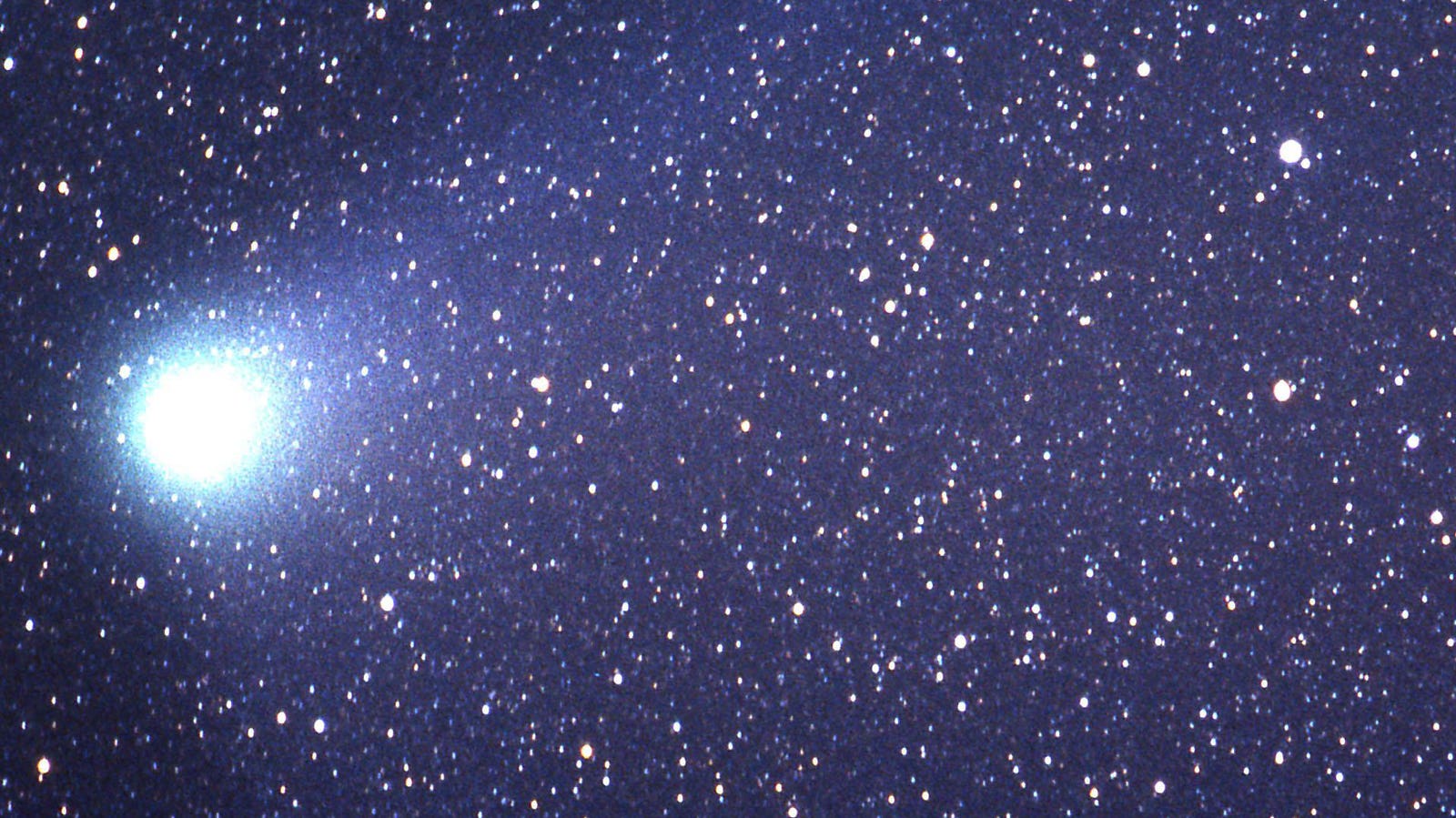
Caused by dust and debris left in the inner solar system by Halley’s comet, the Orionids are one of two annual meteor showers caused by the giant snowball.
Halley’s comet was last seen in the inner solar system in 1986 and in December this year will get to its farthest from Earth, beyond Neptune, before beginning its long journey back to loop around the sun in 2061.
Dwarf Planet Of The Week: Eris
Is Pluto a planet? No, it is not, and it hasn’t been since the early part of the century when more Pluto-sized bodies were found in the outer solar system. One of them is Eris, which this week reaches opposition in the constellation Cetus, the whale.
Opposition means that Earth has moved in between the sun and Eris, making the dwarf planet as bright as it ever gets from our point of view at night as we look out into the solar system. However, you will need a large telescope to se Eris. The other dwarf planets in the solar system, aside from Eris and Pluto, are Ceres, Haumea and Makemake.
Object Of The Week: The Magellanic Clouds
Go to the southern hemisphere and even in clear skies you might catch a couple of clouds. A pair of dwarf galaxies orbiting the Milky Way, the Large and Small Magellanic Clouds (LMC and SMC) and an incredible sight if you’ve never been south of the equator before.
This week has perfect conditions to see them shine brightly in the evening but you will need to be under as dark a sky as possible. If you are heading south, take some binoculars—there’s much to see in the LMC and SMC.
Times and dates given apply to mid-northern latitudes. For the most accurate location-specific information consult online planetariums like Stellarium and The Sky Live. Check planet-rise/planet-set, sunrise/sunset and moonrise/moonset times for where you are.
Wishing you clear skies and wide eyes.
Read the full article here