Qualcomm gave us an end-of-year update on the new Snapdragon X Elite, the company’s bold effort to create an Arm-based PC ecosystem. The future looks bright, especially if Qualcomm can incentivize ISVs to natively port to Arm.
Last September, Qualcomm focused its annual Snapdragon Summit not on mobile devices but on PCs. The idea is that there is an opportunity for the Arm-based platform due to always-on 5G connectivity, lengthy battery life, better performance, and far better AI than anything Intel and AMD can muster. While we think those things are all great, the battle for the laptop will come down to native support for applications.
Recapping Snapdragon X Elite
There is no doubt that this new chip, coming to a laptop near you in mid-2024, has a lot to offer. The cores are not from Arm nor the traditional Snapdragon Kryo Arm CPU, but from Qualcomm’s acquisition of Nuvia, which was developing an Arm core for the data center. Qualcomm named it Oryon, and added a 5G modem, an advanced HiDef camera controller, the 7th Gen Qualcomm AI Engine with the Hexagon Processor, the Adreno GPU and renowned power efficiency expertise to produce the X Elite.
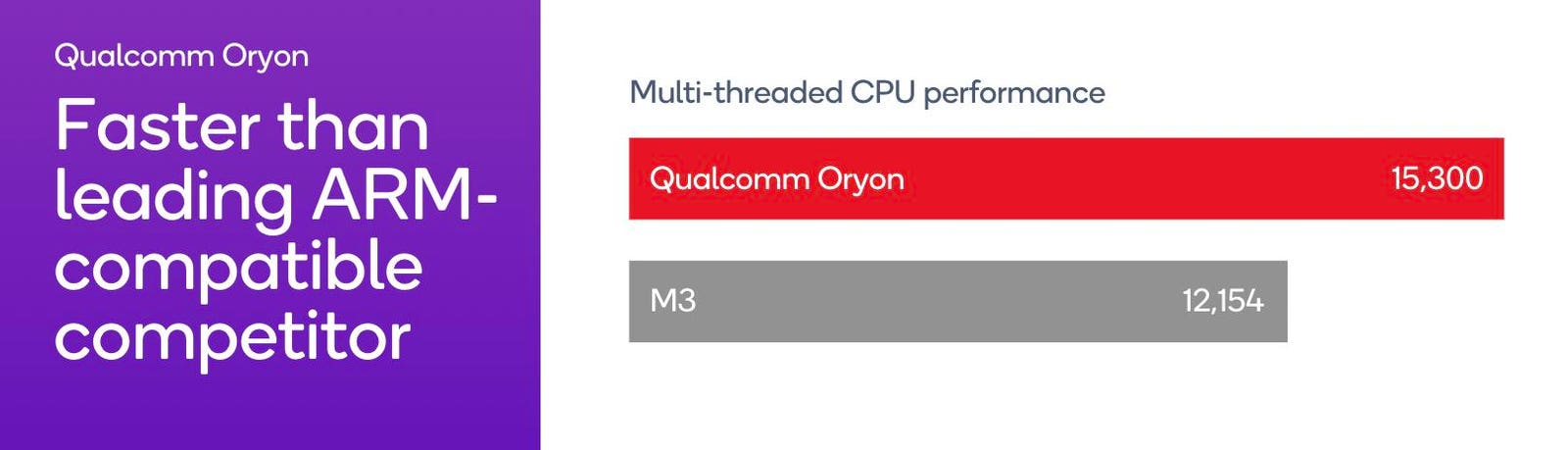
No existing x86 CPU can match its performance,
and neither can the new Apple M3.
The most important thing to us of course, is the AI performance. There isn’t an “AI PC” from Intel or AMD that even comes close.
So, what is stopping them?
The same thing that slowed down Arm in the data center for over ten years: software. Porting apps to Windows on Arm is additional work and cost for application developers, but where’s the additional revenue? Microsoft gets it, and has ported its massive software portfolio to the platform, sensing an opportunity to break the WinTel duopoly and perhaps gain some competitive advantage over the MacBook.
The Windows ISV applications that have recompiled to run on Arm are a pretty short list dominated by Microsoft. All other applications will need to run in emulation mode, where an emulator developed by Microsoft will run the x86 binaries on the Arm SoC.
So, what can Qualcomm do? First, they must continue to market the bejezus out of their amazing X Elite. Get the end users and enterprise decision maker excited about how this Windows platform will improve productivity.
Second, they must make it super easy and profitable for ISVs to port. The easy part is, well, easy: make hardware and tech support freely available to select ISVs. The second part us much harder. Qualcomm will need to invest in some sort of incentives that make a native port a no-brainer by essentially covering their porting costs, plus some market development funding to get past the break-even point. Intel showed us the way, and following their example will be critical to Qualcomm’s success in PCs.
That being said, it is clear from the list of laptop OEMs that Qualcomm has a great story and the support they had missed from earlier efforts.
Conclusions
Qualcomm has created a massive opportunity to join AMD and Intel in the PC space. They have a far better product, the AI performance people need, and Microsoft at their back, along with HP, Lenovo, and Dell.
Having both AI (Windows CoPilot) and a breakthrough CPU concurrently is a monumental fortune. Just don’t count on emulation as a permanent solution to getting performant software on board.
Disclosures: This article expresses the author’s opinions and
should not be taken as advice to purchase from or invest in the companies mentioned. Cambrian AI Research is fortunate to have many, if not most, semiconductor firms as our clients, including Blaize, BrainChip, CadenceDesign, Cerebras, D-Matrix, Eliyan, Esperanto, FuriosaAI, Graphcore, GML, IBM, Intel, Mythic, NVIDIA, Qualcomm Technologies, Si-Five, SiMa.ai, Synopsys, Ventana Microsystems, Tenstorrent and scores of investment clients. We have no investment positions in any of the companies mentioned in this article and do not plan to initiate any in the near future. For more information, please visit our website at https://cambrian-AI.com.
Read the full article here