


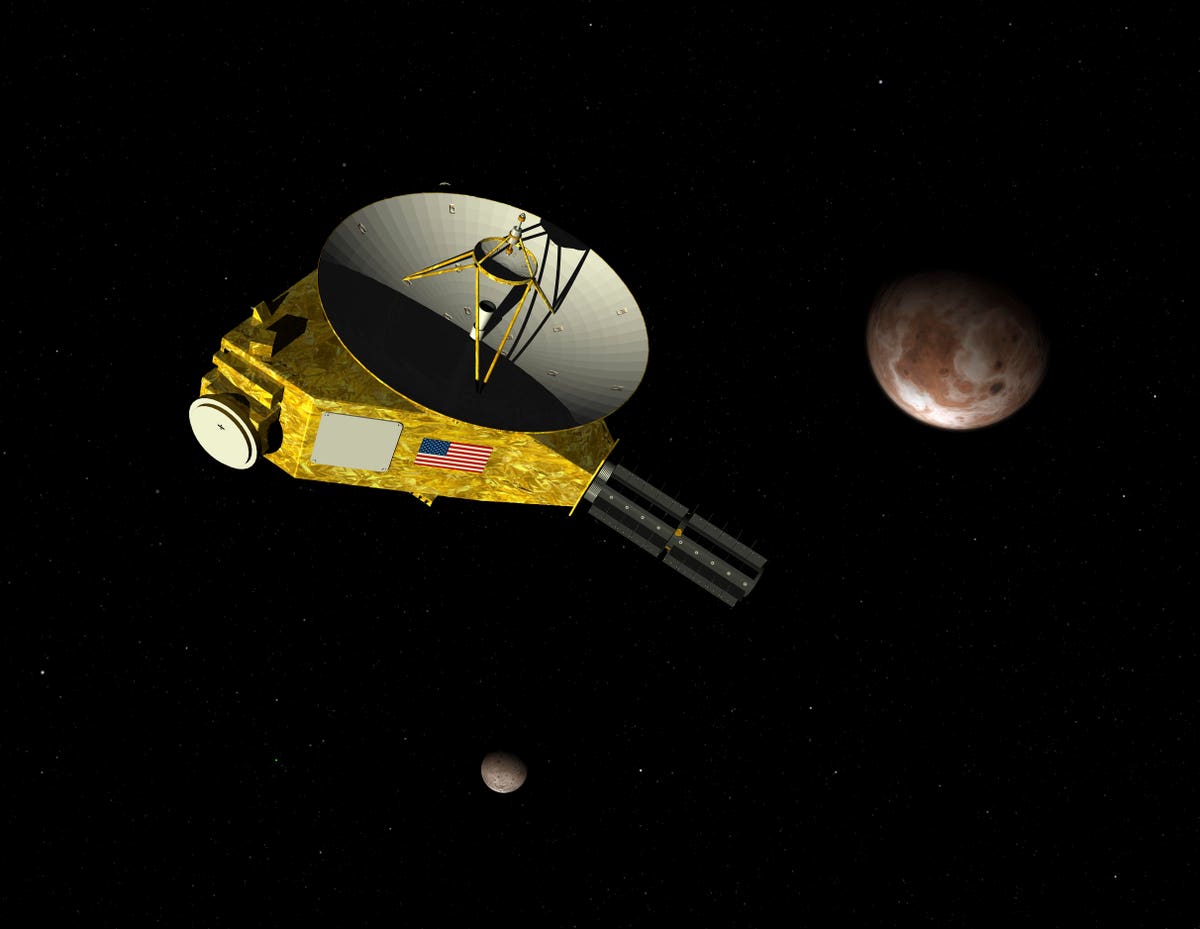
NASA has given a new lease of life to its New Horizons mission, which in 2015 got the first-ever close-ups images of dwarf planet Pluto.
Thought to be a target for cost savings, according to Space.com, the distant spacecraft will now become a heliophysics mission, studying the effect of the sun and its solar wind at the very edges of our solar system.
It’s currently in the Kuiper Belt, a disc-shaped region around the distant outer solar system. It’s thought to be populated by icy objects and comets, believed to be remnants left over from the formation of the solar system.
Unique Position
“The New Horizons mission has a unique position in our solar system to answer important questions about our heliosphere and provide extraordinary opportunities for multidisciplinary science for NASA and the scientific community,” said Nicola Fox, associate administrator for NASA’s Science Mission Directorate in Washington, in a press statement. “The agency decided that it was best to extend operations for New Horizons until the spacecraft exits the Kuiper Belt, which is expected in 2028 through 2029.”
After exiting the Kuiper Belt it will enter the Oort Cloud, a spherical shell surrounding the solar system. It will follow NASA’s 1970s-era Voyager 1 and 2 missions into interstellar space during the 2040s.
New Horizons is a nuclear-powered spacecraft, operating on energy from the heat of 24 pounds of plutonium-238. Although originally intended to last only 10 years, that energy source should last until about 2050. About the same size and shape as a grand piano, New Horizons travels 300,000 miles per year, faster than any other man-made object.
Beyond Pluto
Having launched from Earth in 2006 and photographed dwarf Pluto in 2015—the biggest Kuiper Belt Object—the spacecraft also photographed a double-lobed KBO in 2019, which was later named Arrokoth. The object is about four billion miles (6.4 billion kilometers) from Earth and the most distant object ever photographed.
It will, if possible, study other KBOs, though none are known near its trajectory, but from now on it’s expected to be focus on gathering unique heliophysics data—much like Voyager 1 and 2 are now doing.
Recent studies suggest that the solar system is a protective magnetic bubble that’s slanted, fluctuates in size and has a rippled surface as sun waxes and wanes during its 11 years solar cycle. This is referred the heliosphere, with the actual boundary called the heliopause. It’s poorly understood, but it’s what stops cosmic rays from striking Earth and mutating DNA, which would wipe out all life.
Pluto Revealed
Pluto, 40 times farther from the sun than the Earth and in an orbital dance with its slightly smaller moon Charon, was demoted to dwarf planet status in 2006 by astronomers—not planetary scientists.
The flyby of New Horizons nine years later revealed Pluto to be geologically active and complex, with nitrogen-ice plains, mountain ranges, dunes and ice volcanoes. It was shown to have its own complex atmosphere, organic compounds on its surface and faults in its crust, the latter suggesting plate tectonics.
Wishing you clear skies and wide eyes.
Read the full article here



