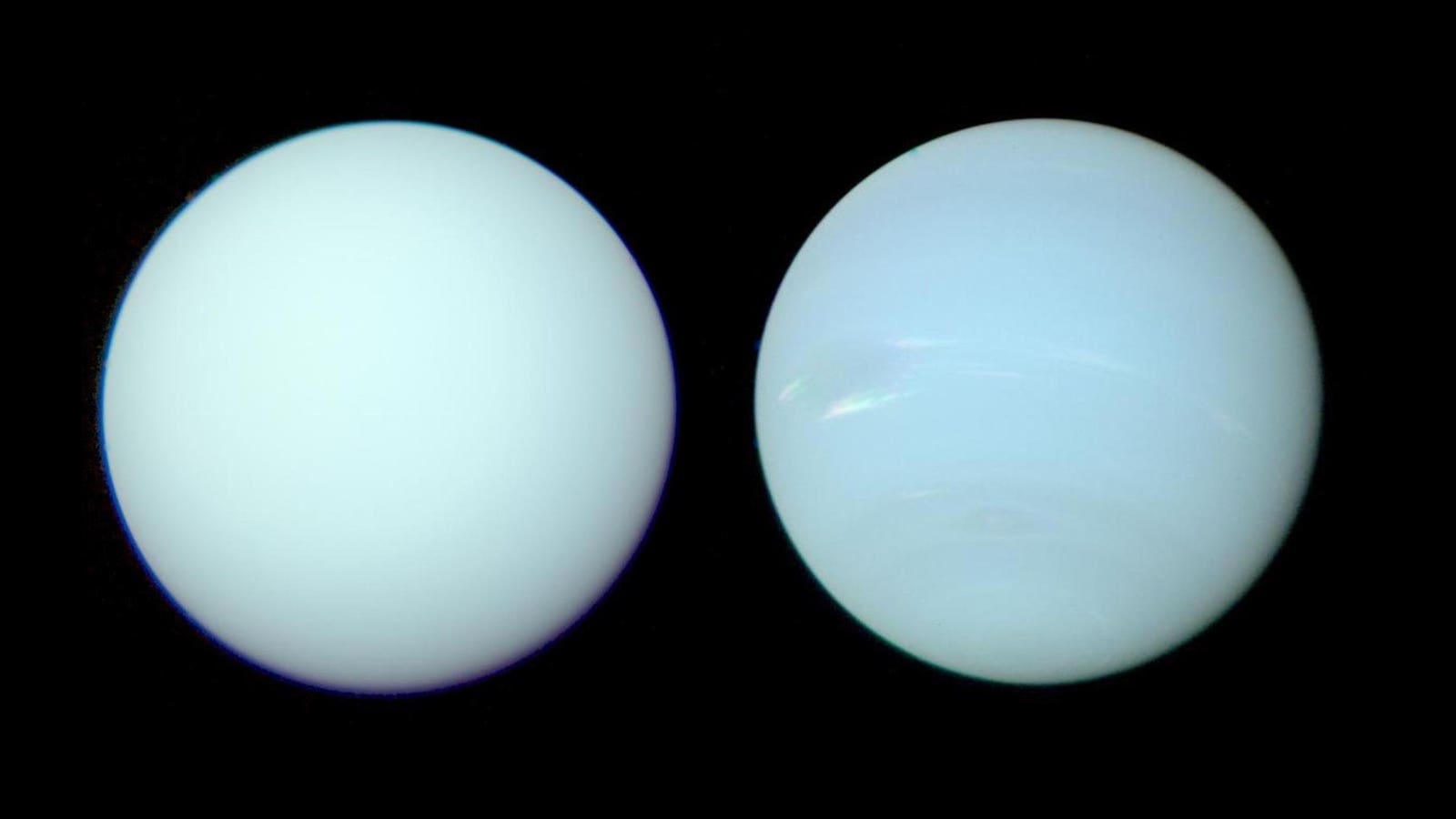
A new study suggests that Neptune and Uranus are a similar shade of greenish blue, contrary to the commonly held belief that the two outer planets are vastly different colors.
Traditionally, Uranus is depicted as pale cyan and Neptune as deep azure blue, largely because that’s what the first images of both planets showed, as captured by NASA’s Voyager 2 mission in 1986 and 1989, respectively.
True Colors
However, according to a new paper published today in the Monthly Notices of the Royal Astronomical Society, that misconception arose due to the inaccurate composite color in Voyager 2’s images. Using data from the Hubble Space Telescope and the European Southern Observatory’s Very Large Telescope, researchers have now re-balanced the composite color images to reveal the true colors of the two planets.
Lost In Time
“Although the familiar Voyager 2 images of Uranus were published in a form closer to ‘true’ colour, those of Neptune was, in fact, stretched and enhanced, and therefore made artificially too blue,” said lead author Patrick Irwin, a professor at the University of Oxford. “Even though the artificially-saturated colour was known at the time amongst planetary scientists—and the images were released with captions explaining it—that distinction had become lost over time.” Blue Planet
Irwin believes that his team has been able to reconstitute the most accurate representation yet of the color of both Neptune and Uranus, with Neptune judged to have a slight hint of additional blue due to a thinner haze layer on that planet.
The model used to correct the data from Voyager 2’s camera can also be used to restore data from the Hubble Space Telescope’s Wide Field Camera 3 (WFC3).
Seasonal Differences
As well as determining that Uranus, like Neptune, is greenish blue, the study also explains why its color changes slightly during its 84-year orbit of the sun. Uranus appears a little greener at its solstices —when one of the planet’s poles is pointed towards the sun—but it has a bluer tinge during its equinoxes. It’s due to the differences in reflectivity between its polar and equatorial regions, said the researchers, and a gradually thickening icy haze observed over the summer, sunlit pole as the planet moves from equinox to solstice.
Planetary Misperceptions
“The misperception of Neptune’s colour, as well as the unusual colour changes of Uranus, have bedevilled us for decades,” said Dr Heidi Hammel, of the Association of Universities for Research in Astronomy (AURA), who has spent decades studying Neptune and Uranus but was not involved in the study. “This comprehensive study should finally put both issues to rest.”
Wishing you clear skies and wide eyes.
Read the full article here