


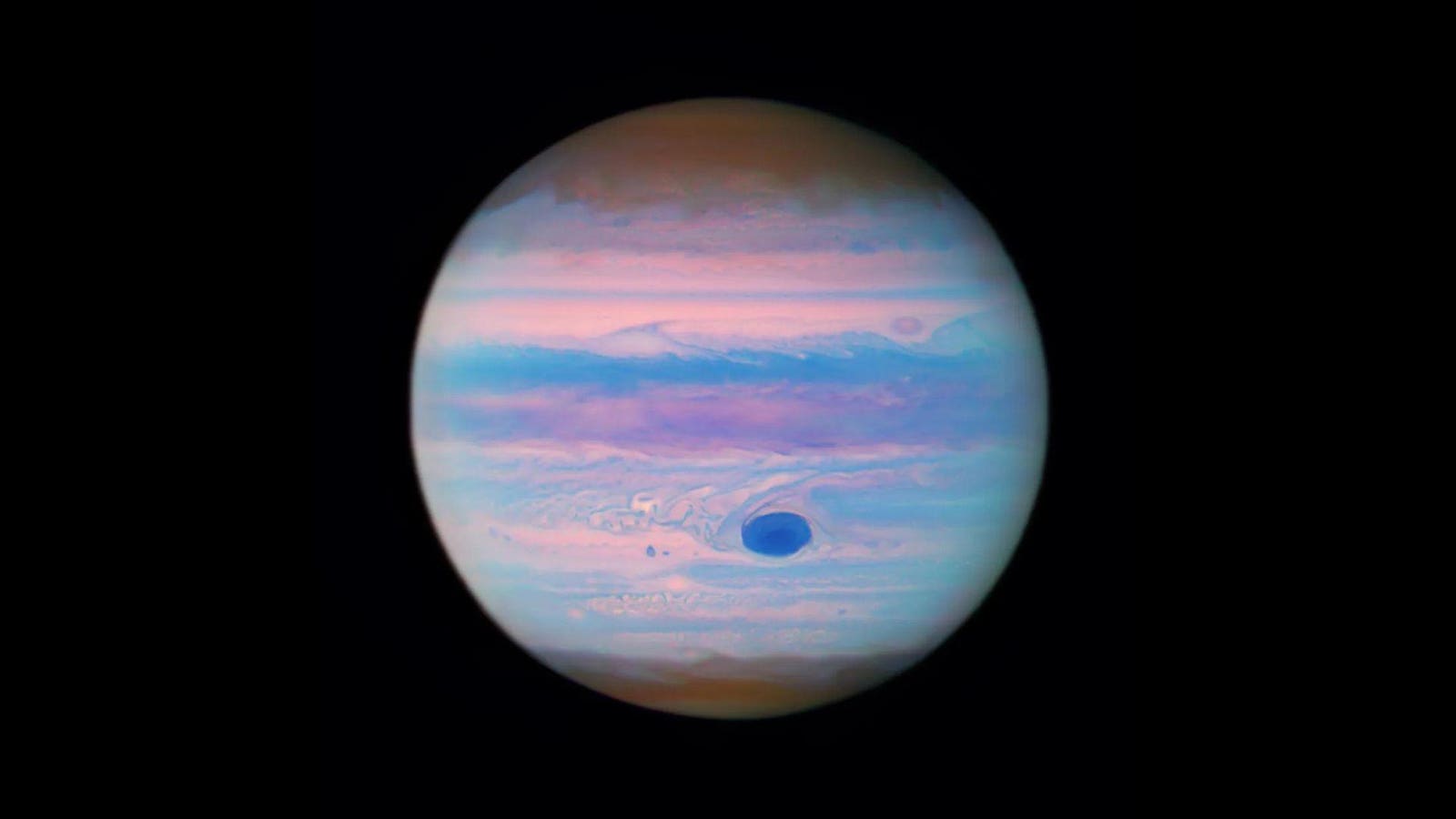
NASA has just published a new image of the giant planet, Jupiter to coincide with its annual opposition this week. However, there is something extraordinary about this photo—taken by the Hubble space telescope, orbiting Earth—that makes it unique. So unique, in fact, that Jupiter’s giant storm, known as the Great Red Spot, in this image, looks blue.
It comes in the wake of a fabulous infrared image of Jupiter from the James Webb Space Telescope.
The image comprises only ultraviolet light, which has a much shorter wavelength than visible light. We humans cannot see ultraviolet light, but the Hubble Space Telescope is sensitive to it. It’s also uniquely able to see it because it is positioned outside of that atmosphere, which blocks most ultraviolet light from entering.
The image therefore makes use of false color. Three different wavelengths of ultraviolet light were captured by Hubble, each of which was then assigned a different colour—blue, green, and red—so that it makes sense to us.
Great ‘Blue’ Spot
Beneath the center of the image is the planet’s famous Great Red Spot, an anticyclonic storm roughly the diameter of Earth. It appears dark blue in Hubble’s new image because high-altitude haze particles absorb light at ultraviolet wavelengths, according to NASA.
Believed to have been raging for at least 150 and possibly as long as 400 years, its 425 miles per hour winds swirl counterclockwise between two bands of clouds that are moving in opposite directions toward it.
Shrinking Target
Although it’s by far the most significant storm in the solar system, another image taken by Hubble in 2019 confirmed that the Great Red Spot is shrinking. Planetary scientists don’t know why.
It’s one of the reasons Hubble looks at Jupiter close to its annual opposition—occurring this week—when Earth gets in between the sun and the planet. It’s only then that astronomers and Hubble can get a view of 100% of Jupiter’s disk. It’s also when the planet is at its brightest.
The new ultraviolet image is part of research into Jupiter’s superstorm system. The next task is to use the data to map deep water clouds and define 3D cloud structures in Jupiter’s atmosphere.
How To See Jupiter In Visible Light
Another handy consequence of opposition is that for a few weeks on either side Jupiter rises in the east at dusk and sets in the west at dawn, making it possible to observe the giant planet at any time of night.
Currently, the brightest object in the early evening sky—only Venus, which rises long after midnight, is more radiant—it’s worth putting a pair of binoculars on Jupiter. Although a telescope is required to see its Great Red Spot, binoculars will reveal four dots of light in a line around it—Callisto, Ganymede, Europe and Io, the planet’s four largest moons.
Wishing you clear skies and wide eyes.
Read the full article here



