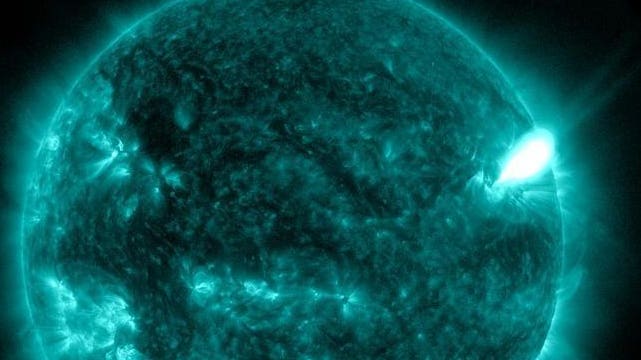
The sun produced a powerful “X1-class” solar flare Sunday through Monday, according to NASA. It caused a radio blackout for 30 minutes in the Pacific Ocean and the western US, according to Spaceweather.com.
The 18th of the current Solar Cycle 25—which began in 2019 and is expected to last through 2030—a solar flare is a powerful bursts of energy coming from the release of magnetic energy associated with sunspots, says NASA. X-class is one of the most intense kinds of flares.
This solar flare, which came from sunspot AR3354, was seen and imaged (above) by NASA’s Solar Dynamics Observatory, which studies the sun constantly.
Solar Maximum Is Coming
The flare comes as the sun is approaching solar maximum, a heightened period of activity every 9-14 years. Although it was predicted to occur in 2024 or 2025, some scientists think solar maximum could occur in 2023.
The evidence is mounting, with 163 sunspots—areas of intense magnetic activity on the surface of the sun—counted on the sun, on average, during June 2023. It’s the highest value since September 2002, according to the Royal Observatory of Belgium’s Solar Influences Data Analysis Center.
At solar maximum, the sun produces more electrons and protons as huge solar flares and coronal mass ejections.
Wax and Wane
It comes just a few years after a very low sunspot count in 2020, which came in the wake of the last solar maximum in 2013/2014, which was ranked among the weakest on record.
Sunspots have been continuously counted each day since 1838, which has allowed solar scientists to look for a repeating pattern in the wax and wane of solar activity. Some predict that the current solar cycle could be the strongest since records began.
Either way, the solar corona—which can only be glimpsed by the naked eye during a total solar eclipse—looks set to be an incredible sight during the next total solar eclipse on April 8, 2024.
Wishing you clear skies and wide eyes.
Read the full article here