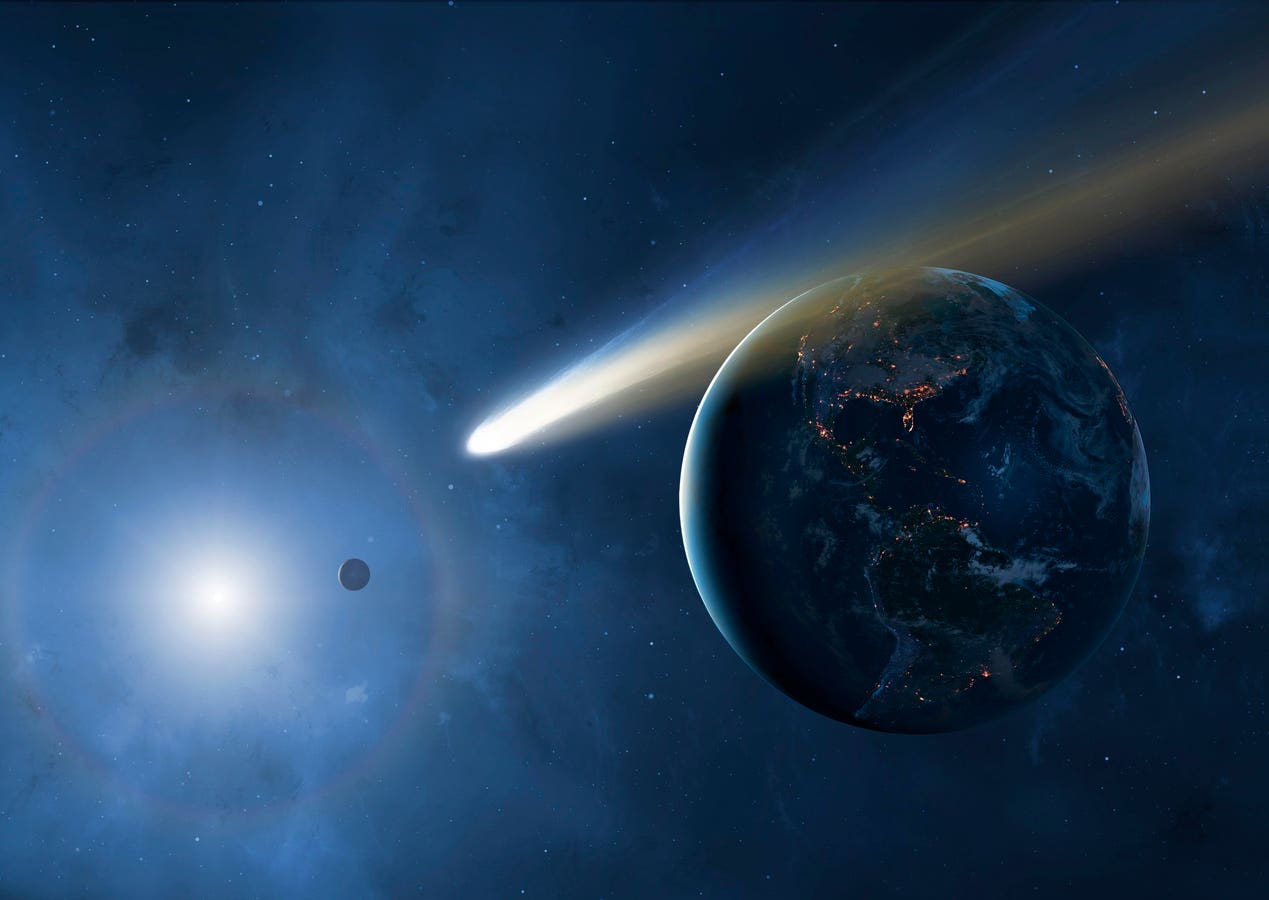
A new study has revealed a way that comets and asteroids may spread the essentials for life around the galaxy. A longstanding theory exists has all of Earth’s water being delivered via multiple impacts over millions of year.
However, this is the first time the mechanics have been closely studied for comets/asteroids and planets in general. It’s well-timed research because intact amino acids and vitamin B3 were last year found on asteroid Ryugu while comets are thought to host hydrogen cyanide. All are building blocks for life.
Origins Of Life
The researchers, from the University of Cambridge in the U.K., do not claim that comets are the origin of life. In a new paper published today in the Proceedings of the Royal Society they explore how it could happen—and where—using mathematical modelling techniques.
Firstly, the comet has to be traveling slowly. A fast-moving comet or asteroid will impact a planet with such force that the heat produced would be enough heat for life-essential molecules to break apart. About 15 kilometres per second is the limit, say the researchers, which seems fairly unlikely.
‘Bouncing’ Comets
Comets could only slow down enough if they “bounced” from one planet to another before, slowing down until ultimately, impacting one., say the researchers. That could only happen in star systems where multiple planets existed close to each other.
“In these tightly-packed systems, each planet has a chance to interact with and trap a comet,” said Richard Anslow, first author, from Cambridge University’s Institute of Astronomy. “It’s possible that this mechanism could be how prebiotic molecules end up on planets.”
Search For ‘Earth 2.0’
It’s important research for exoplanet-hunters looking for possible “Earth 2.0” planets, who should—according to the research—look at star systems with low mass planets in close orbit to other planets in the system.
“It’s possible that the molecules that led to life on Earth came from comets, so the same could be true for planets elsewhere in the galaxy,” said Anslow. “It’s an exciting time, being able to combine advances in astronomy and chemistry to study some of the most fundamental questions of all.”
Wishing you clear skies and wide eyes.
Read the full article here