


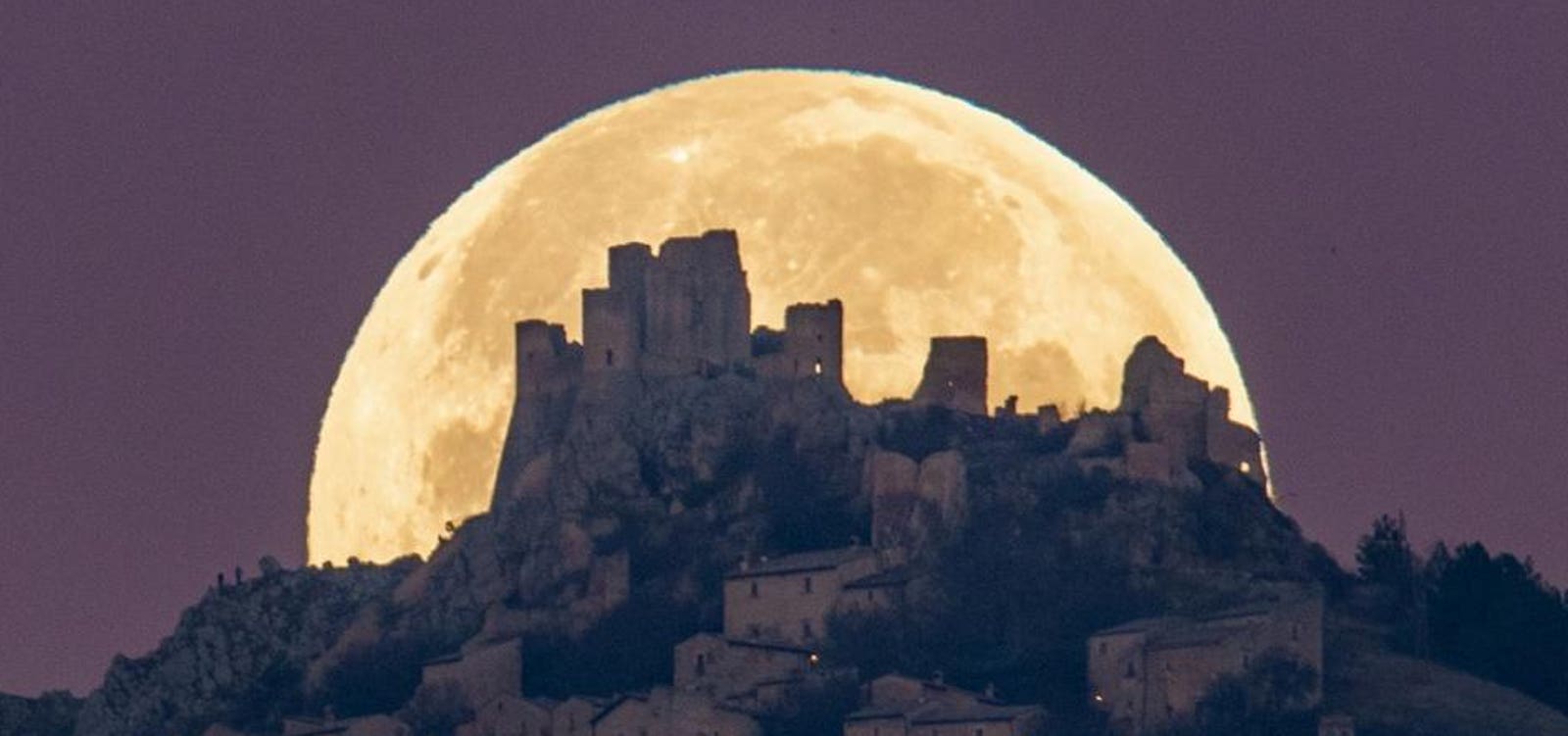
December’s full moon, the “Cold Moon,” rose during dusk on Tuesday as Boxing Day—the day after Christmas Day—was celebrated. The final full moon of 2023 and the first of winter, it also reached higher into the night sky than any other.
Here are the best images of the full moon from around the globe:
The full moon is the lunar phase when the moon appears fully illuminated by the sun, from Earth’s perspective.
Since it’s opposite the sun in the sky, December’s full moon reaches higher into the night sky than any other—as seen from the northern hemisphere—because it mirrors the sun, which is now at its lowest in the daytime sky.
It’s called the “Cold Moon” because it occurs during the beginning of winter, which began on December 21 with the solstice—the longest night of the year north of the equator.
Other names for December’s full moon include “Long Nights Moon,” the “Moon After Yule” and the “Wolf Moon.”
A full moon has not occurred on Christmas Day for North Americans since 2015 and won’t again until 2034, according to NASA.
The “Cold Moon” is the 13th full moon of 2023 because a lunar year (12 orbits of the moon around Earth) lasts 354 days. Since Earth’s solar year lasts 365 days, any year where the first full moon occurs before January 11 will feature 13 full moons. 2024 will have only 12 full moons.
Full moons look their best as they appear on the eastern horizon during dusk. They appear orange because they’re seen through the densest part of Earth’s atmosphere—just like a sunrise and sunset.
Long-wavelength red and orange light travels more easily through the atmosphere than short-wavelength blue light, which strikes more particles and gets scattered.
At 3,474 km in diameter, Earth’s moon is the fifth largest in the solar system behind Ganymede (largest), Titan, Callisto and Io. Aside from Titan at Saturn, they all orbit Jupiter.
The next full moon after the “Cold Moon” will be the full “Wolf Moon” on Thursday, January 25, 2023—the first full moon of 2024.
Wishing you clear skies and wide eyes.
Read the full article here



