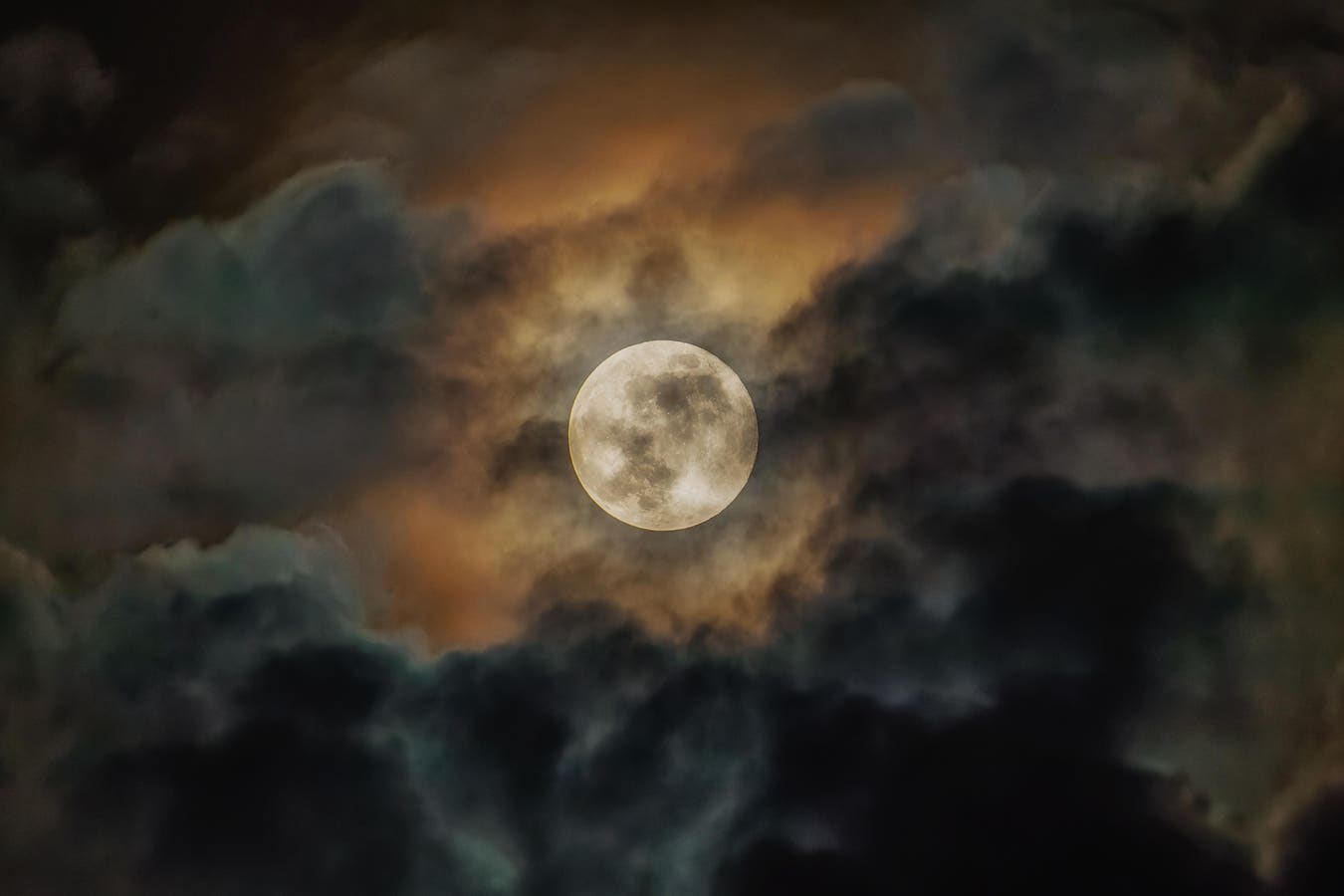
November’s full moon, the “Beaver Moon,” rose on Monday night in a blaze of color, lighting up the night sky.
Here are the best images of the full moon from around the globe:
The full moon is the lunar phase when the moon appears fully illuminated by the sun, from Earth’s perspective. However, it’s always 50% lit by the sun—it’s just that we can only see one face of the moon.
The moon shows only one face to us because it is tidally locked to Earth, rotating just once during its 27.3-day orbit. That’s the length of one day on the moon. However, because Earth and the moon are also orbiting the sun the length of time between two full moons is 29.5 days.
Although it shows only one face, the moon wobbles throughout its orbit, showing us 59% of its surface in total. So only 41% goes unseen on the moon’s far side. Although a full moon night is cherished by moon-gazers, it’s not a good night to go stargazing. The full moon’s brightness bleaches the night sky and makes stars, galaxies and nebula hard to see. However, planets are not affected.
It’s impossible to see the far side of the moon from Earth. The first humans ever to see it were the three crew members of NASA’s Apollo 8 mission in 1968—the first to go to the moon—though it had been photographed before by probes.
The moon’s orbital plane is tilted by 5% with respect to the plane of Earth’s orbit (the ecliptic), so it’s rarely in the correct position to move through Earth’s shadow (lunar eclipse) or block the sun (solar eclipse).
The only night the full moon is perfectly 100% lit by the sun is during a lunar eclipse. That will next happen on March 25 when a slight penumbral lunar eclipse is visible from the Americas just two weeks before a total solar eclipse on April 8.
The next full moon after the “Beaver Moon” will be the full “Cold Moon” on Tuesday, December 26, 2023—Boxing Day. The final full moon of 2023, it will reach higher into the sky than any other full moon of the year.
Wishing you clear skies and wide eyes.
Read the full article here