


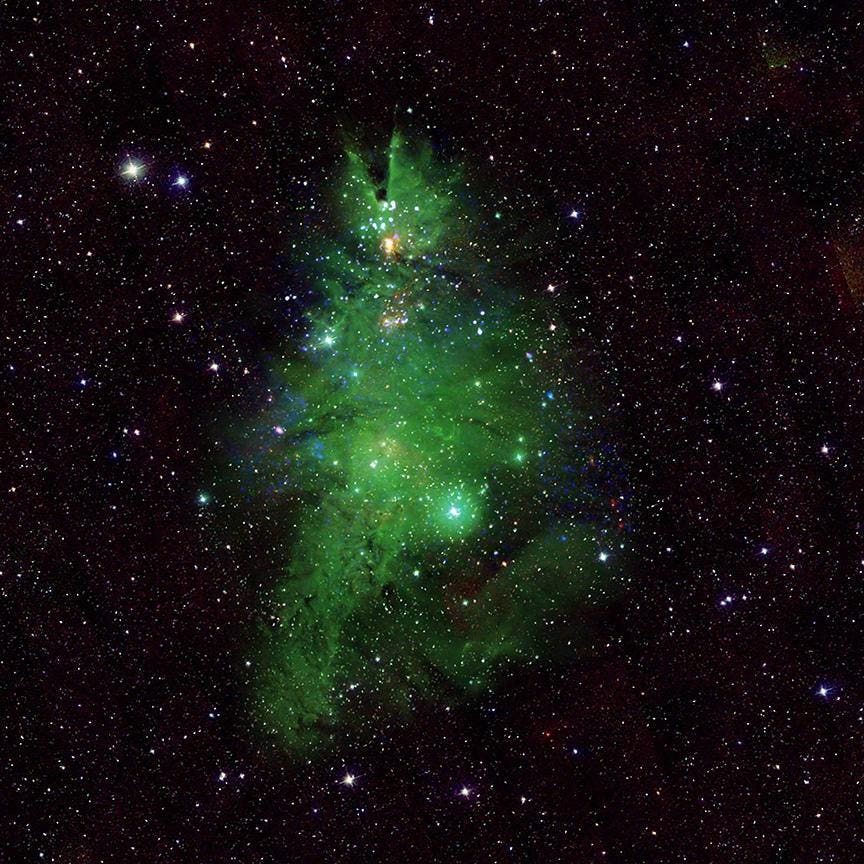
Astronomers have released new “Christmas Tree Cluster” images using NASA’s Chandra X-ray Observatory.
Arriving just in time for the holidays, they show the shape of a cosmic tree within an open cluster of stars called NGC 2264, which is about 2,500 light-years away from the solar system in the constellation of Monoceros, within the Milky Way galaxy.
This composite image, below, shows an animated version of the Christmas Tree Cluster where its blue and white X-ray lights blink:
Dark Skies
Bright and well-placed in December, NGC 2264 is roughly between the bright reddish star Betelgeuse in Orion and blue Procyon in Canis Minor in an otherwise empty patch of the night sky. That’s because there is a lot of interstellar dust here. It’s possible to see around 80 stars in NGC 2264 in binoculars—all of them a mere one to five million years old—but you’ll need very dark skies.
In the cluster, there are stars of different sizes. Some are smaller than our sun, while others are much larger. The mass of these stars ranges from one-tenth to seven times the mass of our sun.
Christmas Composites
All the images here are purposely enhanced, with the image’s coloring and rotation altered to make it look most like a Christmas Tree. It is rotated by 160 degrees to put the peak of the conical tree shape near the top of the image.
Optical data is green for the boughs and needles of the tree, infrared data is the stars and X-ray data is the blue and white lights that resemble glowing dots of light on the tree. If you go to the Chandra website, you can swap between the four wavelengths of light comprising the composite image.
The X-ray (blue and white) data came from Chandra and took five days, 17 hours, and 26 minutes to collect. Chandra launched in 1999 from Space Shuttle Columbia.
Wishing you clear skies and wide eyes.
Read the full article here



