


On Saturday, October 14 an annular “ring of fire” solar eclipse will come to America.
All across the U.S.—as well as Canada, Mexico and Central and South America—a partial solar eclipse will be visible. Only from some parts of nine U.S. states (Oregon, California, Idaho, Nevada, Utah, New Mexico, Arizona, Colorado and Texas) a beautiful “ring of fire” will be visible for a few minutes.
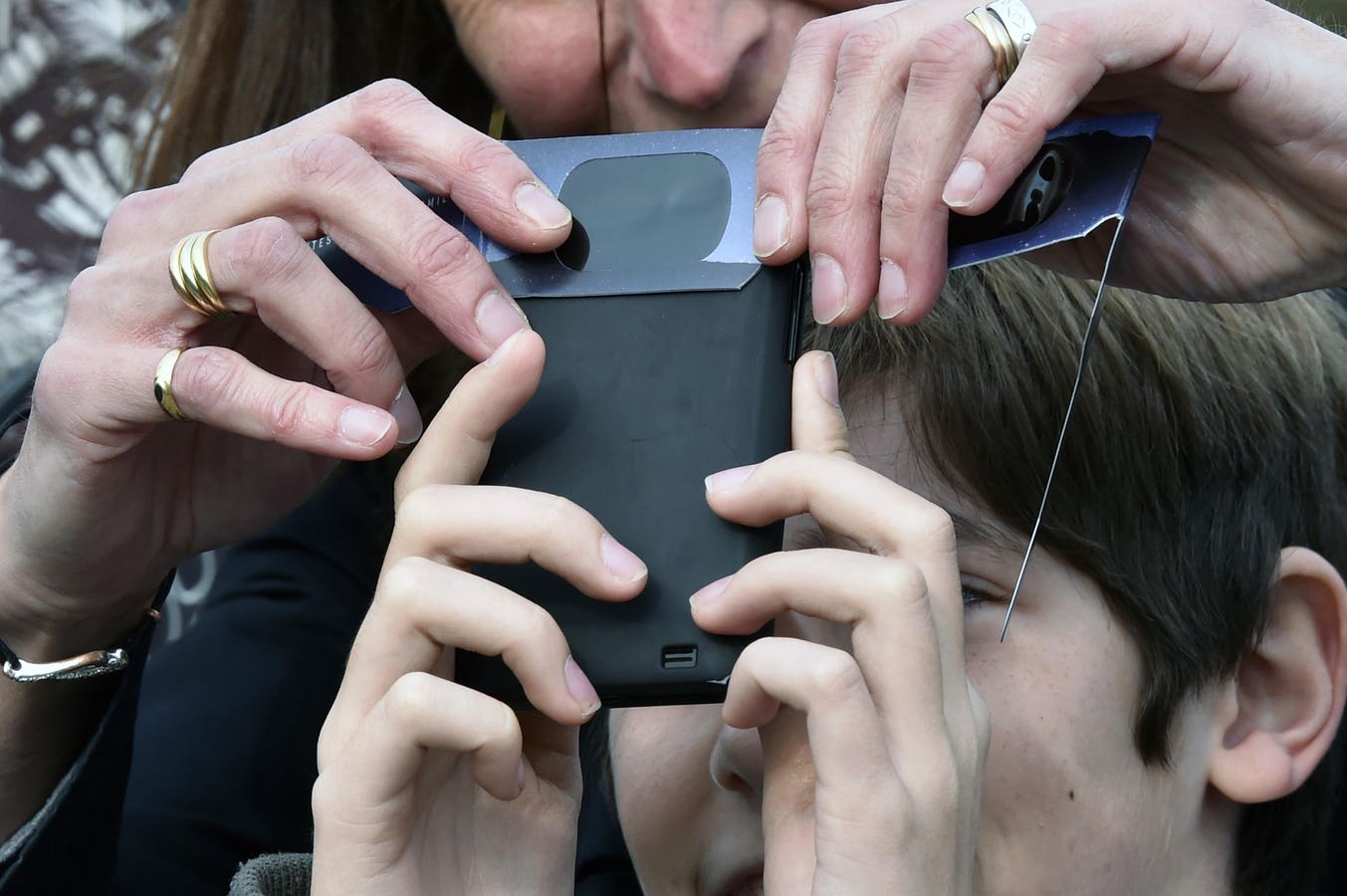
From everywhere the eclipse must be observed using solar filters—that applies to eyes, cameras and smartphones.
Everyone knows that only a “proper” camera can take that ultimate close-up shot of the moon eclipsing the sun, but there are ways you can get involved using just a smartphone.
Here’s how to photograph Saturday’s solar eclipse using a smartphone:
How To Plan Your Shot
It’s important to know what you’re going to see in advance. Use an interactive map for inspect at the path of the eclipse and use this “eclipse lookup” search engine for your location’s eclipse schedule. The check this simulation engine, which will give you a preview of exactly what you’ll see.
The Eclipsed Sun Through A Pair Of Eclipse Glasses
To get an image of the eclipse sun, cut up a pair of solar eclipse glasses and tape one of the lenses across the camera on your smartphone. Rudimentary, yes, but it’s the only easy way. However, keep your expectations low—images of a partial solar eclipse captured this way tend to have an extreme souvenir feel about them.
The Eclipsed Sun Using A Tripod
If you put your phone on a tripod (using a universal smartphone holder) you’ll get something a little better. Once you’ve composed your image use the timer feature to set a short shutter delay—say three or 10 seconds—which will reduce the blur you introduce each time you touch the screen.
The Eclipsed Sun Using A Clip-On Telephoto Lens
Given that optical zoom is minimal on flagship smartphones and non-existent on most, pinching the touchscreen to zoom-in only degrades your image. So try adding a clip-on lens, which will instantly add significant magnification.
Crescent Sun Shadows
Since close-ups of the actual eclipse sun are difficult with a smartphone, concentrate on other phenomena. One memorable image to take is of the tiny crescent suns projected onto your surroundings by anything with small defined holes—such as a kitchen colander or slotted spoon.
People Wearing Eclipse Glasses
Images of people watching the eclipse while wearing solar glasses can be a much more powerful image than the eclipsed sun. As well as capturing emotion, it immortalizes a moment during a special event.
Fuzzy Shadows
It doesn’t get dark during an annular solar eclipse (only during a total solar eclipse), but the light does do weird things. One of them is to create strange, fuzzy shadows that are easy enough to capture using a smartphone.
Crazy Eclipse Photographers
Eclipse-chasers are a strange bunch, often happy to travel around the world to sit beneath a towel for a few hours photographing it. You’ll also find eclipse-chasers wearing homemade masks, with funny t-shirts and banners, odd-looking equipment—and excitement on their faces (when they’re not beneath towels).
‘Pinhole’ Shadow Circles On The Ground
If you watch the eclipse in a location with trees, have a look at the shaded areas below them during all stages of the eclipse—but particularly just before, during and after the “ring of fire” or peak obscuration. What you’ll see is the “pinhole camera” effect as the sunlight is filtered through gaps between the leaves to cause crescent suns—and circle suns—across the ground.
Bald People’s Eclipsed Heads
Having a head that resembles the moon does have its advantages during a solar eclipse. Just add a slotted spoon, colander or anything else that has small holes in it and you have yourself the ideal surface on which to project the solar eclipse.
I’m an expert on eclipses—the editor of WhenIsTheNextEclipse.com and author of The Complete Guide To The Great North American Eclipse of April 8, 2024. For the very latest on the “ring of fire” solar eclipse check my main feed for new articles each day.
Wishing you clear skies and wide eyes.
Read the full article here



