


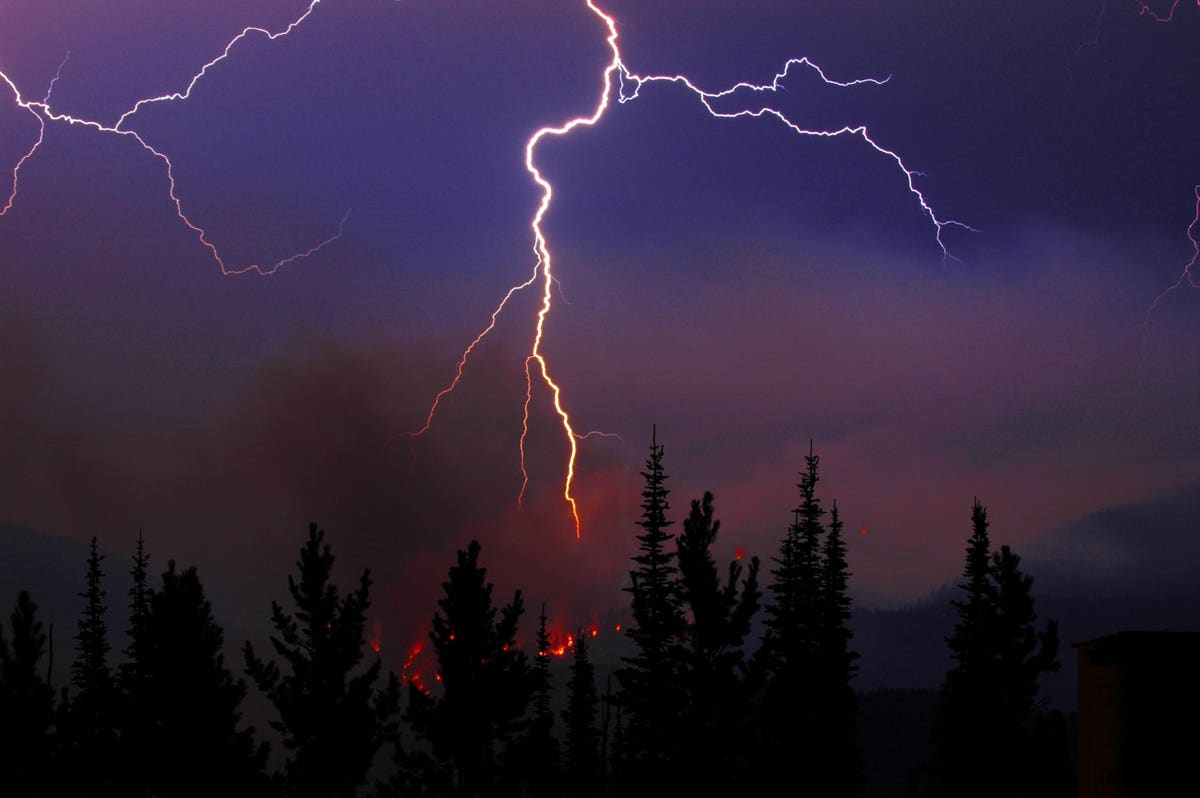
All the technology that we enjoy today —- from global Wi-Fi to air travel —- stems from the fact that we first harnessed fire. And the reality that our own planet seemingly has an environmental sweet spot that enabled it to maintain atmospheric oxygen over geologically long time periods.
Open air combustion (fuel burning) in the form of lightning-induced fires were likely first noticed by our hominin ancestors some two million years ago. It’s still debated as to exactly when our ancestors first harnessed fire. But this crucial first step enabled the evolution of today’s technology.
For researchers who spend their days wondering about the existence of technologically advanced space aliens, the first hurdle is finding an extrasolar earth with enough oxygen to ensure the onset of intelligent life. But any budding technological civilization will also need that oxygen to facilitate metallurgy (the ability to extract and purify metals from their ores).
In a paper being published in Nature Astronomy Commentary, Amedeo Balbi and Adam Frank argue that on Earth, “the development of technology required easy access to open air combustion, which is only possible when oxygen partial pressure, P(O2), is above 18%. This suggests that only planets with significant atmospheric concentrations will be capable of developing ‘advanced’ technospheres.”
You need the ability to have a fire start in the open air, because as a young civilization that’s going to be your first encounter with an energy source that you can harvest and use to do things like metallurgy, University of Rochester astronomer Adam Frank, the paper’s co-author, told me by phone.
Oxygen is essential to establish the kind of advanced technological civilizations that would be detectable by astronomical observations, Amedeo Balbi, the paper’s lead author and a cosmologist at the University of Rome Tor Vergata, told me by email.
Are We A Fluke?
The fact that we have an atmosphere made up of 21% or 22% oxygen may not be an accident, Frank, author of The Little Book of Aliens, told me. Maybe the biosphere self regulates the oxygen from getting much higher than that, so that the whole planet doesn’t catch fire, he says.
The Timing Also Has To Be Right
Given the history of oxygen concentrations here on our own planet, flammability on Earth could have been highly variable, “possibly switching off completely for a few tens of million years around 180 and 200 million years ago,” the authors write. During such periods, early tool users would not have been able to cast metals in the forms needed to produce advanced technologies like radiotelescopes, the authors note.
Crucially, the minimal amount of oxygen needed for complex life is less than that needed for combustion, says Balbi. This implies that you might have planets with the right amount of oxygen for complexity and even intelligence, but not enough for technology, he says.
How should this affect current search strategies for alien technosignatures?
If you only have so much telescope time, you’ll put it into planets that are already showing oxygen, says Frank.
It’s Also A Question Of Context
You look at not just the signal, but whether the signal is coming from a planet with oxygen in the atmosphere, says Frank. That can help you decide whether your technosignature is real, he says.
Did Earth Win The Oxygen Lottery?
We have no clear answer, says Balbi. The history of Earth oxygenation is very complicated and not completely understood, he says. It would be interesting to know whether having a 20% oxygen concentration is almost inevitable or just chance, says Balbi.
Read the full article here



