


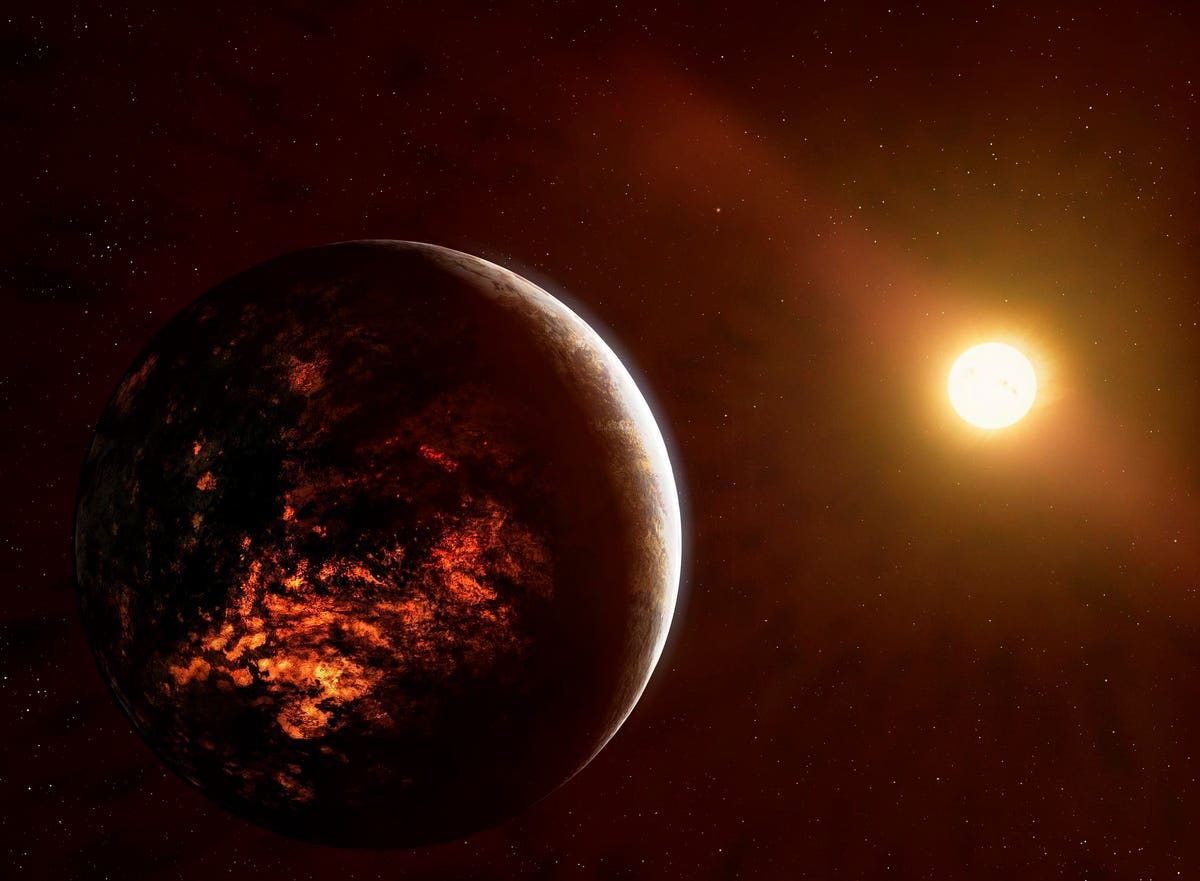
The search for exoplanets—worlds that orbit stars other than our sun—may be focused on discovering another Earth, but it continues to reveal just how bizarre our galaxy’s population of worlds really is.
It’s also underlining just how untypical our solar system is.
Large lava worlds with seas of liquid magma are unlike anything we have in our solar system.
Super-Hot Planets
They comprise almost half of all rocky exoplanets discovered so far and take fewer than 10 Earth-days to orbit their star. It’s these worlds’ closeness to their stars that make them super-hot and capable of having liquid magma on their surfaces.
However, given that these hot rocky “super-Earths” are inhospitable to life they’re largely ignored by planetary scientists.
A new study published in The Astrophysical Journal this week changes that with an in-depth look at how these planets’ molten oceans affect their size and evolution.
Odd And Interesting
“Lava worlds are very odd, very interesting things and because of the way we detect exoplanets, we’re more biased to finding them,” said Kiersten Boley, lead author of the study and a graduate student at The Ohio State University. Most exoplanets are detected by telescopes as they transit across their host stars, something that happens much more frequently for planets that orbit close to their star.
There is no lava world in the solar system. The closest analog is Io (pronounced “eye-oh”), one of Jupiter’s largest moons. Slightly larger than Earth’s moon, it’s being constantly tugged by the gravity of Jupiter and spews lava from volcanoes that pockmark its ever-changing surface. New images from NASA’s Juno spacecraft are revealing just how quickly its surface features change.
The Hellish World Of Janssen
Outside the solar system the most famous lava world is Janssen, a super-Earth that orbits sun-like star about 41 light-years distant in the constellation Cancer. It takes just 0.7 Earth-days to complete one orbit and is home to seas of lava.
It may seem like a world so bizarre that it’s barely worth knowing, but these planets can teach planetary scientists about Earth’s early history, said Boley. “When planets initially form, particularly for rocky terrestrial planets, they go through a magma ocean stage as they’re cooling down,” she said. “So lava worlds can give us some insight into what may have happened in the evolution of nearly any terrestrial planet.”
The study, which used a computer model to simulate these planets, revealed three probable types —those with a liquid molten mantle, those where a magma ocean lies on the surface and a third hybrid type. “It opens up exciting new questions about lava worlds,” said Boley.
Wishing you clear skies and wide eyes.
Read the full article here



