


Each Monday, I pick out the northern hemisphere’s celestial highlights (mid-northern latitudes) for the week ahead but check my main feed for more in-depth articles on stargazing, astronomy, eclipses and more.
The Night Sky This Week: December 25-31, 2023
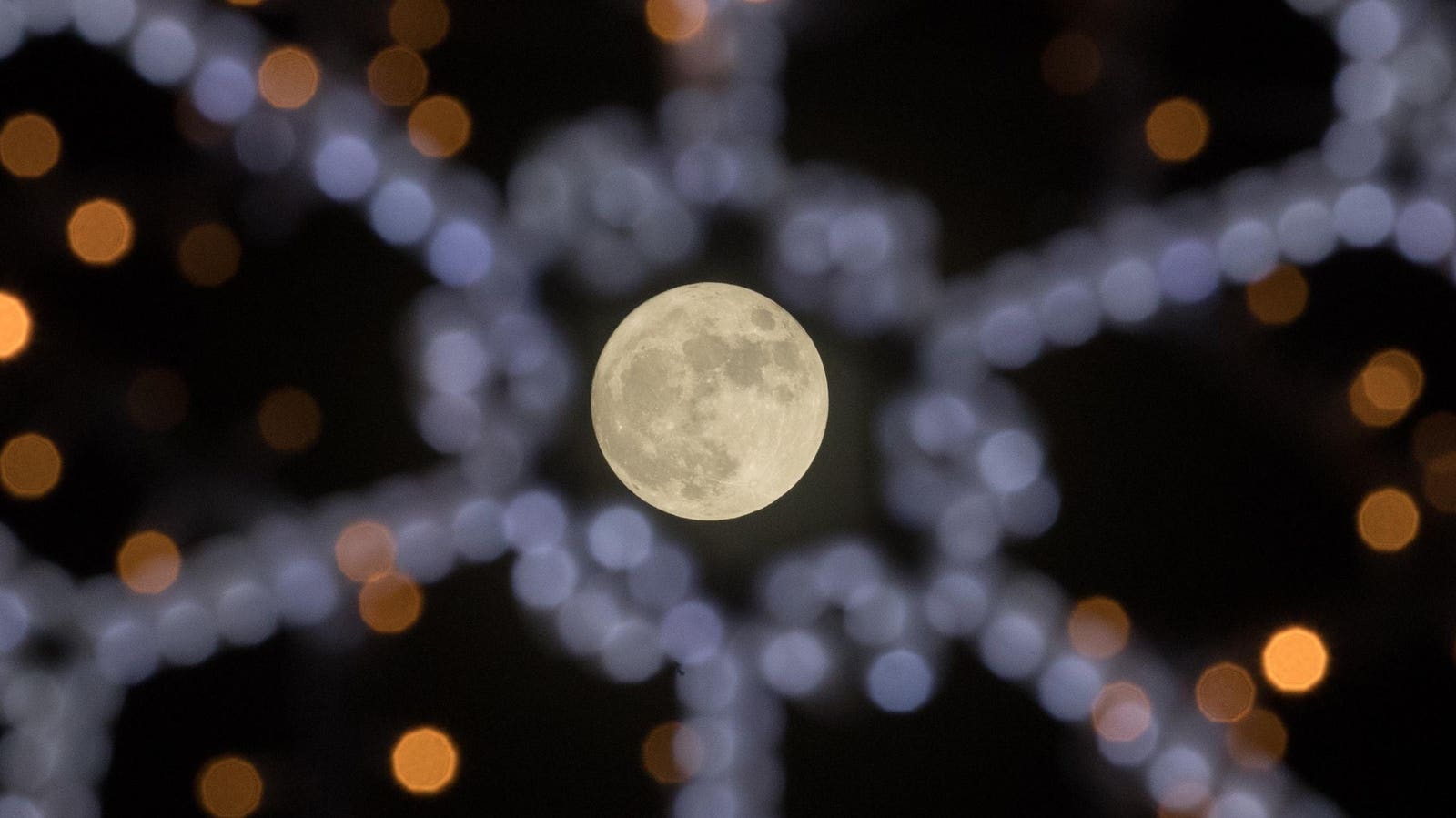
There are few better times of year to step outside and view the night sky at dusk than the holiday season. This year, there are two festive treats—a full moon and a bright planet masquerading at the “Christmas Star.” If you have a new telescope or binoculars, these two objects are among the most rewarding of all—but they’re also a feast for the naked eye.
Since the full moon is opposite the sun in the sky—hence it’s 100% illuminated—December’s “Cold Moon” hangs highest in the northern hemisphere’s night sky simply because it mirrors the sun, now tracking at its lowest in the day. In the southern hemisphere, it’s the other way around.
Here’s everything you need to know about stargazing, moon-watching and the night sky this week:
Monday, December 25: ‘Star of Bethlehem’ And A Waxing ‘Christmas Moon’
If it’s crisp and clear outside at night on Christmas Day, spend a few minutes with the night sky because this year, there are two beautiful objects in the east to look at. If you’re up before dawn breaks, glance to the west for a beautiful moonset.
As soon as dusk falls, the very bright planet Jupiter will this year make an argument that it was the mythical “Star of Bethlehem” as it shines high in the southeast above an almost full moon low in the northeast just a day from being December’s “Cold Christmas Moon.”
Come outside at dusk to see both brighten in the east as twilight takes hold.
Tuesday, December 26: ‘Cold Christmas Moon’ Rises
The 13th and final full moon of 2023 will today rise as the first of winter. The “Cold Christmas Moon” will officially be 100% illuminated at 7:33 p.m. EST, best seen as it rises in the east at dusk.
Check the time of moonrise where you are to watch it appear in the east before rising higher into the night sky than any other full moon of the year.
Wednesday, December 27: Moon In Gemini
Tonight the now waning gibbous moon, one day past full and still 99% illuminated, will rise in the northeast about 50 minutes later than last night while close to the two brightest stars of the constellation Gemini, Castor and Pollux. Orion’s Belt will shine brightly due east.
Saturday, December 30: Jupiter Turns Around
Since early September, the giant planet has been moving westward—backward—in our night sky. Earth orbits the sun much faster than the outer planets, often overtaking them. They, therefore, appear to us on Earth to be moving backward for a short time—much like if you overtake a vehicle on the highway.
Tonight, that ceases, with Jupiter, hence appearing to move eastward once again.
Sunday, December 31: Moon And Regulus
Look to the east about two hours before midnight tonight, and you’ll see a 76%-lit waning gibbous moon just below Regulus, the brightest star in the constellation Leo.
Stargazing Tip Of The Week: Start With The Moon
Stargazing can be daunting. All those stars! Learning their names and the constellations they sit within is time-consuming and difficult. It’s knowledge best learned over years, slowly letting the information soak in.
So when you’re new to stargazing, start with the moon. It’s easy to find, you can watch it change phase from night to night and it’s also one of the most beautiful objects in the night sky. If you have a new telescope or a pair of binoculars, there is no better target. It’s perfectly OK to spend as long as you want—hours, weeks, months or years—simply moon-gazing. The stars can wait.
The times and dates given apply to mid-northern latitudes. For the most accurate location-specific information, consult online planetariums like Stellarium and The Sky Live. Check planet-rise/planet-set, sunrise/sunset and moonrise/moonset times for where you are.
Wishing you clear skies and wide eyes.
Read the full article here



