


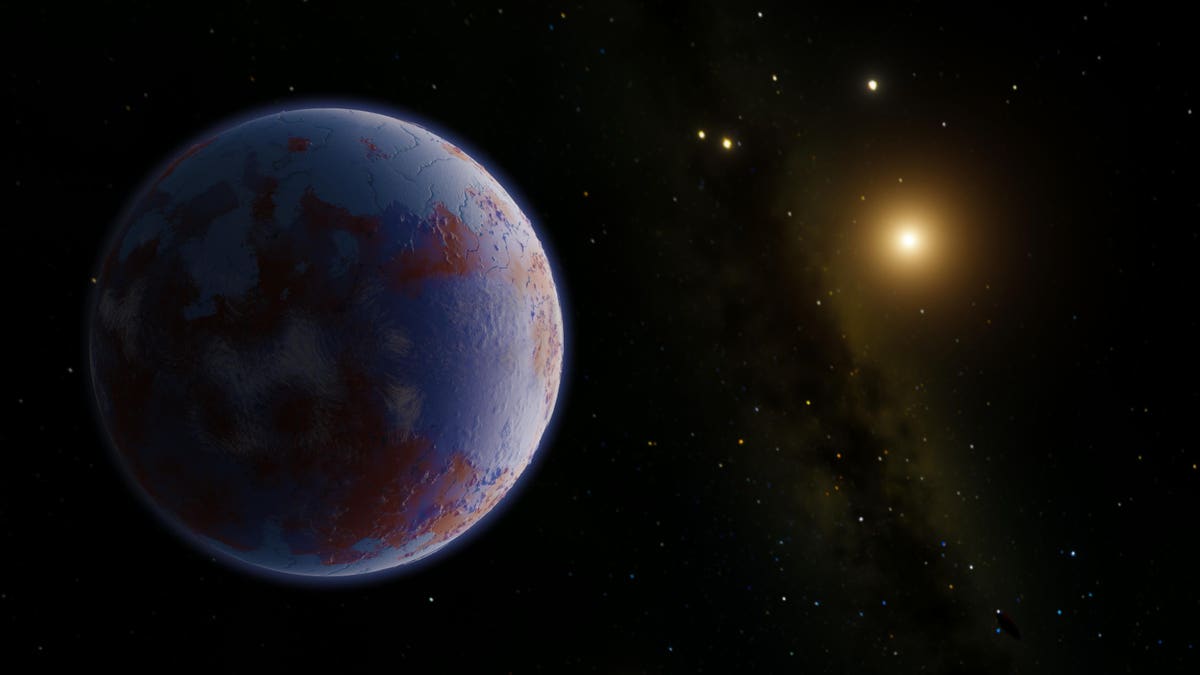
There may be an undiscovered planet in the outer solar system whose presence is revealed by the strange orbit of objects beyond the eighth planet Neptune.
The tantalizing prospect of a ninth planet is suggested by a paper published in The Astronomical Journal, which explores the orbit of objects in the distant Kuiper Belt.
The Kuiper Belt (also called the Edgeworth-Kuiper Belt) is a disc-shaped region beyond the orbit of Neptune’s in the outer solar system—50 Earth-sun distances—that’s home to dwarf planets like Pluto, Makemake and Eris. It’s also thought to be populated by comets and some odd objects that astronomers call Trans-Neptunian Objects.
Beyond Neptune
One of the TNOs is Sedna, an icy, reddish object that rotates every 40 Earth-days. It was discovered by American astronomer Michael Brown in 2003. It may be an ocean world. It has a highly eccentric and elongated orbit that sees it take 11,400 years to journey around the sun.
Sedna has been cited as possible evidence for so-called “Ninth Planet,” but this new claim is different.
Sedna’s orbit—as well as the inclined orbits of several other TNOs and, more generally, the existence of a cluster of large population of TNOs with orbits beyond Neptune’s gravitational influence—can be explained by the presence of an Earth-sized planet, according to the paper.
Earth-Like Planet
Computer simulations of the gravitational interactions of solar system bodies suggest that a hypothetical Earth-like planet explains all of those anomalies. It would need to be around 1.5–3 times as massive as Earth and about 250–500 Earth-sun distances from the sun, in an orbit inclined by 30° to the plane of the solar system, according to the paper. They call this the “Kuiper Belt Planet scenario.”
“We predict the existence of an Earth-like planet and several TNOs on peculiar orbits in the outer solar system,” write the authors, Patryk Sofia Lykawka of Kindai University, Japan and Takashi Ito of the National Astronomical Observatory of Japan. “The results of the Kuiper Belt Planet scenario support the existence of a yet-undiscovered planet in the far outer solar system [and] also predicts the existence of new TNO populations.”
Profound Implications
Aside from the solar system once again having nine planets—which it had before Pluto’s demotion in 2006—the discovery of a distant Earth-mass planet would have profound implications for planetary science. “We would need to refine the definition of a planet since an Earth-like planet located far beyond Neptune would likely belong to a new class of planets,” said Lykawka, who added that theories of solar system and planet formation would also need revision.
The theory is testable. If astronomers can find a cluster of TNOs at about 150 Earth-sun distances then they could be considered signatures of the existence of a ninth planet in the solar system, albeit one incredibly far away. Even a search for TNOs will likely turn up some extreme objects, which will provide valuable insights into the nature of the Kuiper Belt.
“Even the discovery of a single or a few such new TNOs could revolutionize our theories about how the solar system formed,” said Lykawka.
Wishing you clear skies and wide eyes.
Read the full article here



