


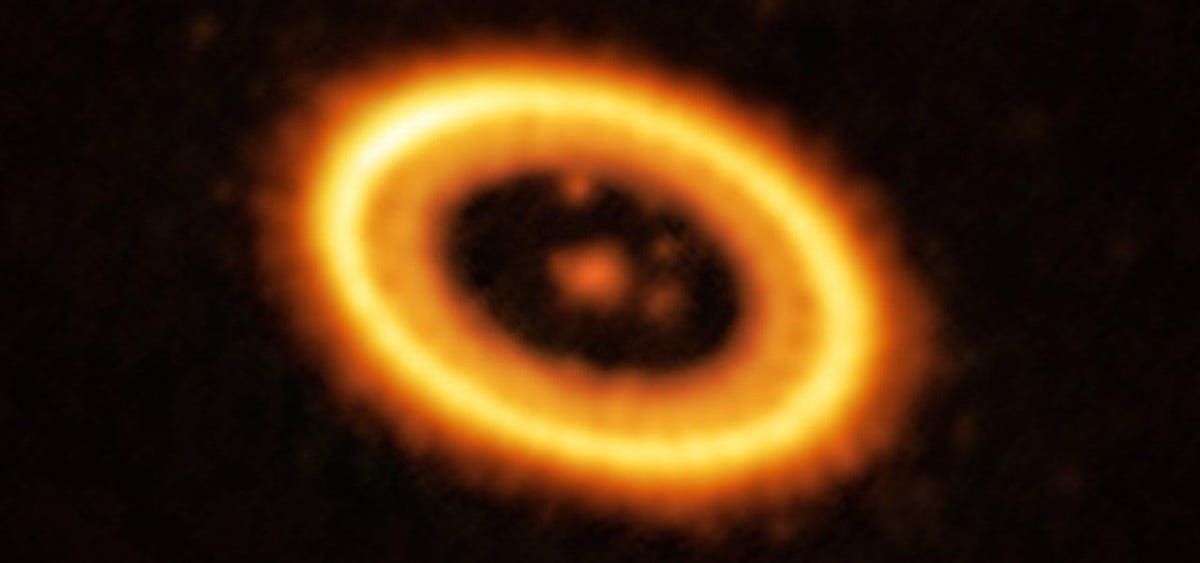
Astronomers using a massive telescope in Chile have found a star that has two planets sharing the same orbit.
Pairs of planets have been theorized before, but this is the first time that any evidence has been found, said the astronomers involved.
“Who could imagine two worlds that share the duration of the year and the habitability conditions?,” said Olga Balsalobre-Ruza, a student at the Centre for Astrobiology in Madrid, Spain, lead author of a paper published this week in Astronomy & Astrophysics. “Our work is the first evidence that this kind of world could exist.”
The star system, called PDS 70, lies in the southern hemisphere constellation Centaurus and is 400 light-years from the solar system. Its Jupiter-sized planets, PDS 70b and PDS 70c, were already known, but astronomers using using the Atacama Large Millimeter/submillimeter Array (ALMA) of radio telescopes detected another planet in the orbital path of PDS 70b.
Pair of Planets
ALMA’s images suggest it’s a second planet, but don’t provide enough detail to definitively say so. It’s therefore thought that one of the planets could be in the process of forming. Essentially that makes the second planet a cloud of debris and dust.
Something similar exists in our solar system, but has never before been detected around an exoplanet—Trojans.
Trojan asteroids are, in our solar system, about 12,000 small objects that orbit our sun in two clouds, some in front of Jupiter and some behind it.
Often called “Jupiter’s children,” they are thought to be fossils from the formation and evolution of the planets and the solar system.
‘Exotrojans’ Are Like Unicorns
The two planets orbiting PDS 70 together could be the first-ever example of a Jupiter-sized planet and a swarm of Trojans in another star system—“exotrojans.”
“Exotrojans have so far been like unicorns,” said co-author Jorge Lillo-Box, a senior researcher at the Centre for Astrobiology. “They are allowed to exist by theory, but no one has ever detected them.”
Upgrades on the ALMA array of radio telescopes scheduled for 2030 will make “exotrojans” easier to find and confirm, said the researchers.
“We can imagine that a planet can share its orbit with thousands of asteroids, as in the case of Jupiter, but it is mind blowing to me that planets could share the same orbit,” said Balsalobre-Ruza.
NASA’s Lucy Mission
Trojans in the orbit of Jupiter come in to two main groups—one ahead of Jupiter and the other behind. They orbit at Lagrange points around Jupiter where they’re stabilized by the gravity of the planet and the sun being in equilibrium.
Having launched in 2021, NASA’s Lucy mission is two years into a 12-year mission to flyby six of Jupiter Trojans, four of which are binary asteroids (two asteroids that orbit each other). It will also flyby an asteroid in the main Asteroid Belt between Mars and Jupiter.
The Lucy spacecraft—which will orbit the sun for eternity after its mission is completed—has on board a time-capsule containing messages from the likes of Albert Einstein, Carl Sagan, Martin Luther King Jr. and all four members of The Beatles.
Wishing you clear skies and wide eyes.
Read the full article here



