


Sharvan Patel’s Instagram account is a window into daily life in the vast deserts of western India: children fighting calves for camel milk, a grandmother drying pickles on top of a mud house, or a farmer eating under the only tree in a barren land. Patel’s passion for wildlife conservation has attracted more than 318,000 followers to his account, where he tells the story of the intricate binding of the Indigenous cultures with the ecosystem in the Thar desert. Sometimes, he also tells people who to vote for in upcoming elections.
In one of Patel’s posts from August, which has been played over 4.7 million times, dozens of women, from young to old, line up to get a smartphone under a government scheme. “Today, this mother has gotten a smartphone,” a woman says, pointing toward a frail woman. “She had never thought that Ashok Gehlot would give her the smartphone that her son could never get her.”
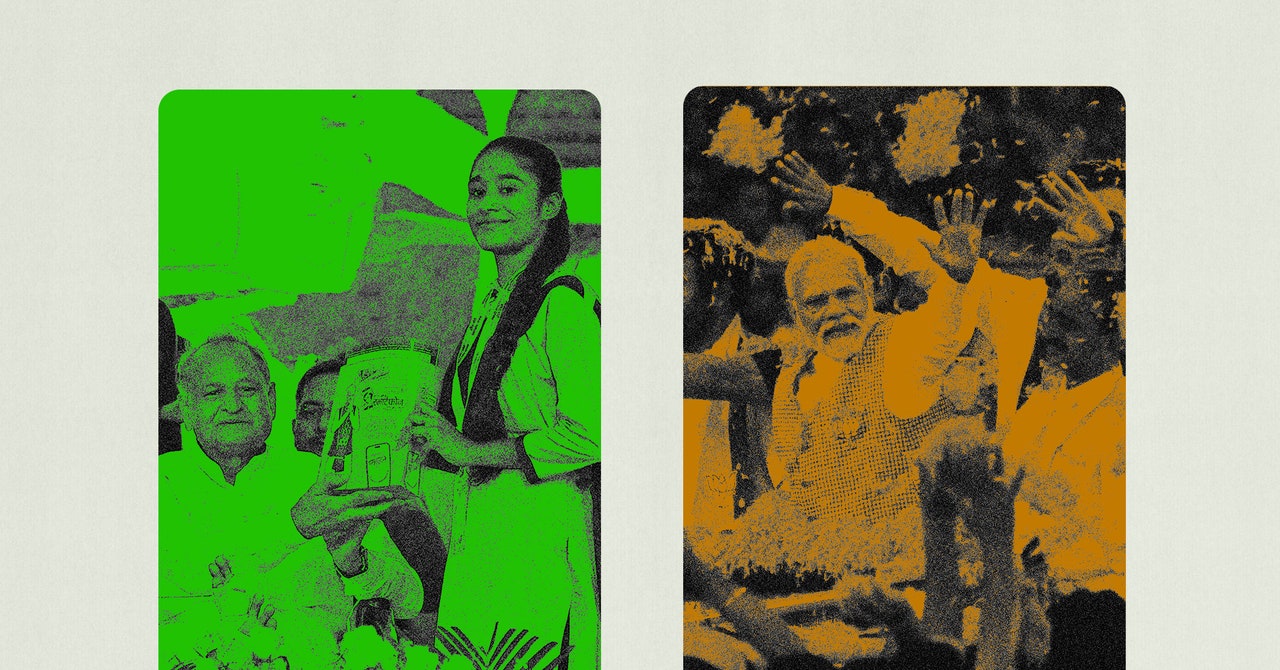
Gehlot is the chief minister of Rajasthan, standing for reelection in the state in late November. Patel is one of dozens of influencers hired by marketing firms working for the Congress Party and its main rival, the ruling Bharatiya Janata Party, as politicians look to use the vast reach of social media personalities. In October, Patel’s Instagram reached 30 million people. “My posts reach everyone from a government official to a laborer in half an hour,” he says. He charges nearly $100 per post. “It is not only advertising; that’s something politicians can do themselves. We create content that makes people believe that something nice is actually happening. It doesn’t look like we are promoting a political party—the post only shows a good, positive picture.”
From fluffy interviews on YouTube podcasts with millions of subscribers to subliminal attacks on Instagram Reels, the political parties in India are betting big on influencers to swing voting patterns, manage crises, and help them secure power as the world’s largest democracy gears up for state elections this month, and a national election in 2024. It’s a strategy that makes sense—622 million Indians are online, and with the cost of internet access falling, people from India’s harder-to-reach hinterlands are coming online fast. Two-thirds of the population lives in these areas, giving them enormous power to sway the results of national elections. And while the symbiotic relationship between political campaigns and influencers has allowed politicians to reach the electorate in new ways, and to influence how they vote, it’s also helped them to dodge media scrutiny during public engagement and to challenge the integrity of elections in India.
“Influencers are helping political parties skirt the laws [in the run-up to elections],” says Ravi Iyer, managing director of the USC Marshall School’s Neely Center. “They work together to alter the information ecosystem. And there is no way you can figure out who is being paid by whom to say what.”
India’s influencer industry is booming. The Indian population is the biggest market for Meta-owned Instagram, WhatsApp, and Facebook—which have 229 million, 535 million, and 315 million users, respectively—and for Google-owned YouTube, which has 462 million users. On the back of these enormous numbers, the influencer market is predicted to grow to more than $300 million by 2025.
Read the full article here





