


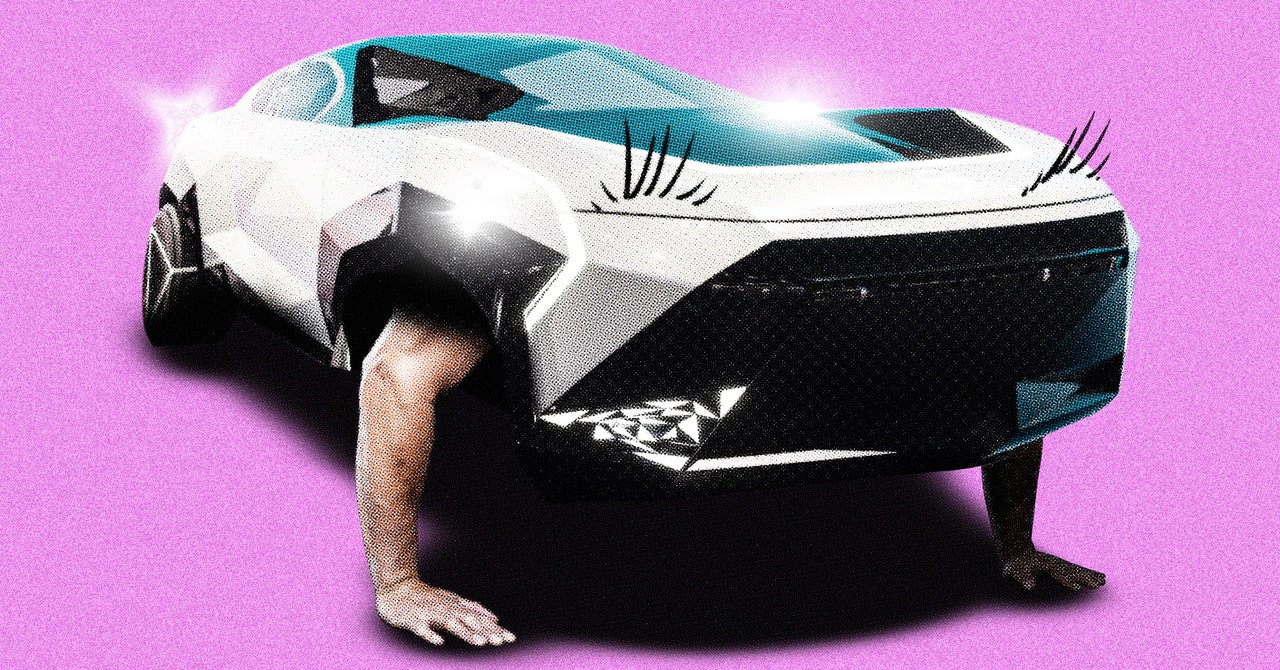
It is very hard to think of an automotive design in recent memory so testosterone-fueled, so overtly male as Tesla’s Cybertruck. British car designer Adrian Clarke has described the EV’s styling as a “low polygon joke,” one “that only exists in the fever dreams of Tesla fans.”
Indeed, on the initial reveal of the angular, sharp-edged, and aggressive Cybertruck concept, Paul Snyder, chair of the transportation design program at Detroit’s College for Creative Studies, was incredulous: “What is going on over there?”
Elon Musk, Tesla’s CEO, was, of course, unapologetic. “We want to be the leader in apocalypse technology,” he said in 2020 to Jay Leno. Clad head to toe in black, including black aviators, looking like a Matrix casting reject, he added that the truck bed was large enough to “mount a missile launcher.”
But Musk is not alone in preferring such a thunderously masculine automotive aesthetic. Tesla’s new flagship merely represents the current peak of male-oriented auto design. Shanghai-based electric carmaker HiPhi’s A hypercar is right up there as well. So is Nissan’s preposterous Hyper Force concept, which debuted at the Japan Mobility Show in October and looks like it’s driven straight out of Death Race 2000.
But there is clearly a market for the Cybertruck (just 15 percent of preorders would equal the annual US truck sales of Toyota), and the auto industry, despite the disruptive arrival of electric powertrains and a near 50/50 split in men and women drivers in the US alone, is doggedly continuing to favor a male perspective on how cars look.
Legendary industrial designer Dieter Rams famously said, “Limit everything to the essential, but do not remove the poetry.” The quote is often evoked in conversations about design with a capital D. (What does it mean? When is it good? When is it in danger? Who gets to decide?) One of the biggest “capital D” design questions unfolding right now involves a complete rethink of the automobile.
The car was certainly the most prominent invention of the 20th century, but now the combustion engine is headed grumpily out the back door (with the German government demanding a synthetic fuel loophole) with the coming ban, while EV architectures knock on the front and uncool hydrogen cells hope to be let in as a plus-one.
Traditionally, internal combustion engines (ICE) are loud, complicated, and take up a lot of space in the car’s body. Electric vehicles require no ICE and no transmission tunnel, leaving room for a flat floor and a focus on aerodynamics. Many aspects of car design can change with the shift to EVs, from wheel overhangs, to the exterior shape, to visible air intakes, interior layouts, and then some.
Read the full article here





