


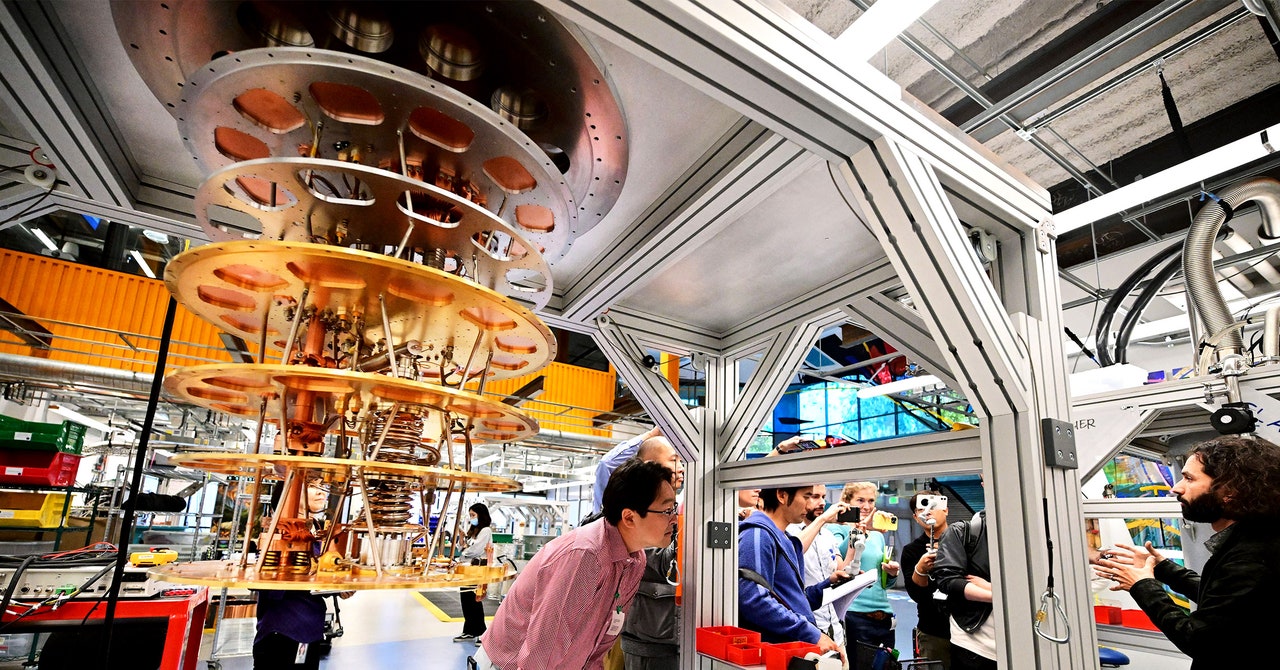
The world’s biggest computing companies and a raft of well-funded startups all agree: The future of computing is manipulating data with quantum mechanics. Over the past decade, governments, private companies, and venture capitalists have collectively invested billions of dollars into quantum computing, which aims to solve problems using a new type of logic enabled by harnessing quantum properties such as superposition and entanglement rather than ordinary 1’s and 0’s. Yet despite some prototypes capable of elementary operations, the hardware isn’t reliable enough to be practically useful.
Researchers from Google and Colorado-based startup Quantinuum independently announced results this year that advanced a long-sought idea tipped to solve quantum hardware’s flakiness. Both teams demonstrated a mechanism needed for a component called a topological qubit, which should offer a way to hold onto and manipulate information encoded into quantum states more robustly than current hardware designs. But did the two companies actually make the long-sought component? It depends who you ask.
Physicists developed the design of the topological qubit to reduce computational errors, enabling more complex algorithms and opening the door to the technology’s projected moneymaking applications, from drug discovery to financial modeling to more efficient AI. “This could well be a transistor moment for the quantum computing industry,” said Quantinuum founder Ilyas Khan in the company’s announcement. “We have used a quantum computer as the machine tool for building topological qubits.”
Google performed a similar demonstration to Quantinuum’s, using the company’s own quantum computer, but they refuse to label it in the same way. “We did not realize a topological qubit,” write Google researchers Trond Andersen and Yuri Lensky in an email to WIRED. To add to the multiplicity of interpretations of the experiments, one of Google’s collaborators holds a different view.
The disagreement over what exactly is happening inside some of the leading prototype quantum computers points to the hurdles faced by the nascent industry. Researchers have developed elegant designs and exciting potential applications for the budding machines, but they struggle to execute them in practice.
Under pressure to demonstrate progress to their financial backers, and in need of significant funding to continue developing the technology, some in the quantum computing community have a tendency of announcing milestones of ambiguous significance—triggering pushback from some disgruntled physicists. Others take the opposite tack and cautiously qualify their achievements in technical jargon. (Google has been accused in the past of spreading hype, being among the first to announce a disputed quantum computing milestone and kicking off the trend that led up to Quantinuum’s topological qubit claim.)
Read the full article here





