


As Alaska Airlines Flight 1282 neared 16,000 feet, a boom thundered through the plane as a chunk of the plane’s bodywork was ripped away. The rush of air as the cabin depressurized pulled mobile phones out of hands—an iPhone was found intact on the ground below—and a teenager sitting close to the door was left shirtless. “His shirt got sucked off of his body when the panel blew out because of the pressure, and it was his seatbelt that kept him in his seat and saved his life,” one passenger told the Associated Press.
The consequences of being unbelted at such a moment are unthinkable, but there is one group of passengers who are not required to wear a seatbelt during takeoff in the US: babies under the age of two.
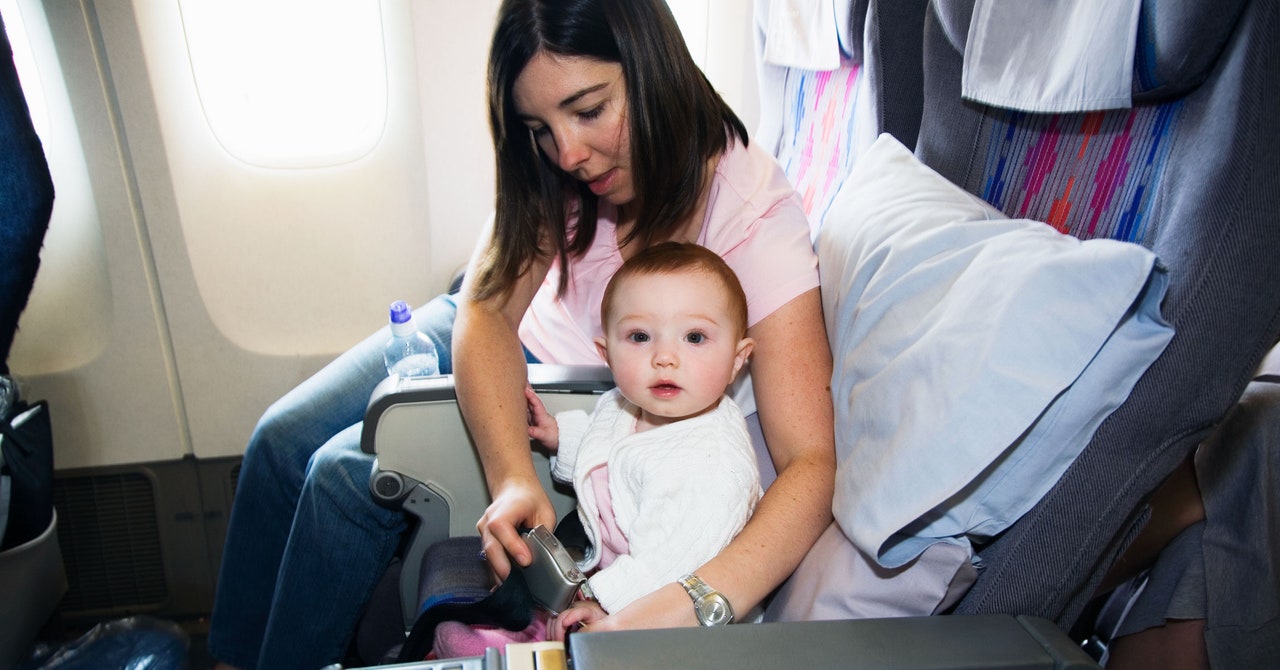
Infant safety is a weird quirk of aviation regulation. In the US, the Federal Aviation Authority (FAA) doesn’t require infants under the age of two to have their own seat, allowing them to be held on a parent’s lap without a belt. Aviation authorities in Canada and Japan follow the FAA’s lead, but the European Union Aviation Safety Agency (EASA) and the UK’s Civil Aviation Authority (CAA) take a different approach, requiring lap-held infants to be secured with an additional seatbelt that loops around their belly and links to the parent during takeoff and landing. That may sound safer, but those same belts are banned in the US and Canada on the grounds that they are riskier in a crash.
Though the FAA doesn’t require seats for infants, it does recommend them. “The safest place for a child under age two is an approved child-restraint system or device, not an adult’s lap,” a spokesperson for the FAA, Mina Kaji, said in an email. Last weekend’s Alaska Airlines incident reignites arguments over whether this policy needs to change.
Why isn’t seating for infants a requirement? Because it’s a bit of a faff and expensive—the costs are judged to outweigh the benefits. “This is a bit of a practical compromise—a separate seat would also need a child seat to be carried, and that should be approved for use on an aircraft,” says Graham Braithwaite, professor of safety and accident investigation at Cranfield University in the UK.
For the FAA, there’s a very specific reason. “For every rule, the FAA is legally required to conduct a cost-benefit analysis to show that the benefits of the proposal exceed the costs,” said Kaji, the FAA spokesperson. The costs of mandating that under-twos be placed in child restraint systems (CRS)—industry lingo for an approved car seat that can be added to a regular seat—aren’t just financials, but also, somewhat unexpectedly, road deaths: The FAA’s own modeling and academic research suggest that, in the US at least, requiring families to buy a ticket for infants two and under would push some to drive instead of flying, leading to an estimated increase in total transportation deaths by 72 over a decade. In comparison, requiring child-appropriate seating for under-twos would have prevented three child deaths between 1979 to 2010, a report from the US National Transport Safety Board (NTSB) notes.
Read the full article here





