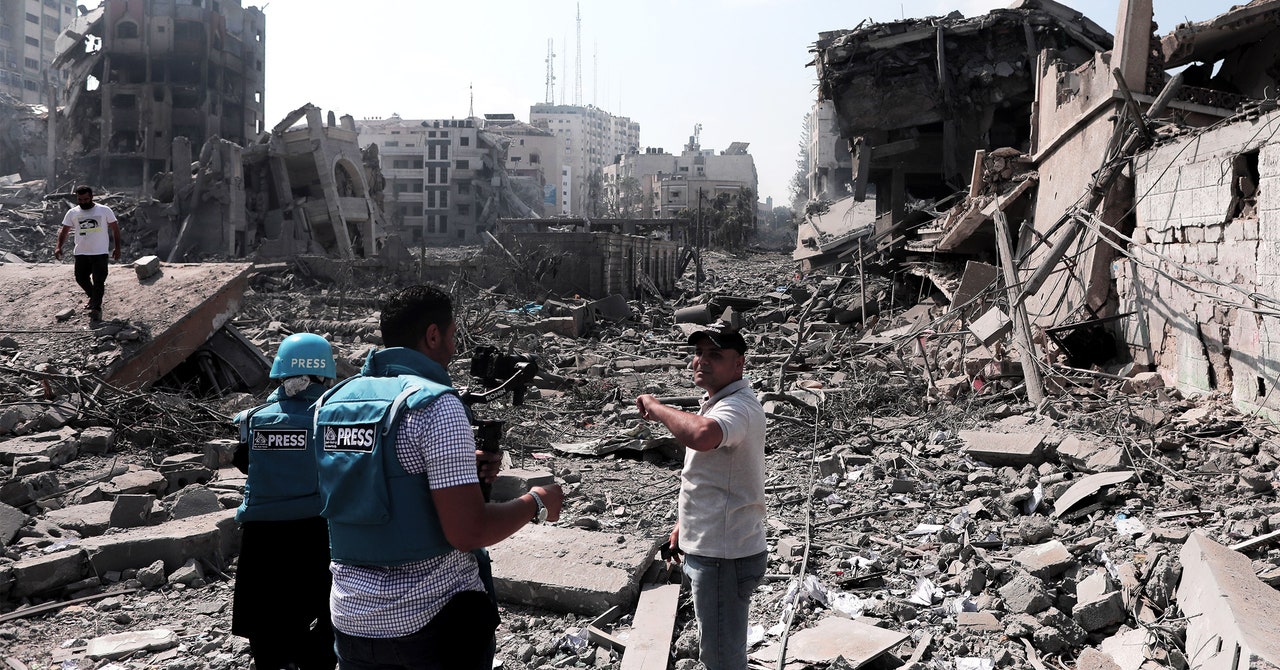
The bombs had rained down on Gaza for 19 hours straight. Wajeeh Abu Zarifeh, a journalist and manager of White Media, a reporting syndicate, had spent the first night of the war sheltering in his house, monitoring the news and trying to plot out the week’s coverage for his team of 15 journalists. On Sunday morning, as he arrived at White Media’s office on Al Wehda Street, he found the entire building had been bombed out. Steel ridges jutted from its side, warped by the shock of the blast. Rubble spilled across the road, giving up plumes of dust. Reams of office papers were strewn over the ground.
“We lost everything,” Zarifeh says. “Flak jackets. Sound system. Internet. Laptops. Computers. Everything we had. We lost it in one minute.”
But somewhere amid the wreckage, there was a ray of fortune: None of his staff were there when the building was bombed. Neither were their cameras.
Since the Israel-Hamas conflict began on October 7, at least 24 journalists have been killed, according to the Committee to Protect Journalists. The NGO says that’s more than in every previous war in Gaza since 2001. Over 5,000 people have died there since the conflict began. Services are collapsing, and many in the humanitarian sector fear an impending catastrophe. It is circumstances like this in which journalism is most urgently needed. With few international press able to enter Gaza, the responsibility for reporting has fallen on the shoulders of local Palestinian journalists. They are having to work amid electricity and internet outages, shortages of food and water, and constant fear of death. Most have had to flee their homes. Many have lost family members. And some have been directly targeted as a result of their work. But many journalists in Gaza have continued to work despite these pressures, figuring out ways to stay online and keep the news moving.
And for Zarifeh—who has lived in Gaza for 55 years and covered its conflicts for 30 of them—the destruction of White Media’s office was not going to put him off.
That first morning, his team set about rebuilding. The key requirement was power: Israel had begun to cut off Gaza’s electricity. So they got creative, harnessing solar energy, hunting down generators, and sourcing extra large portable batteries for on-the-go charging. Now, his journalists will often travel by foot across the 25-mile-long Gaza Strip in order to save fuel for their generators.
Read the full article here