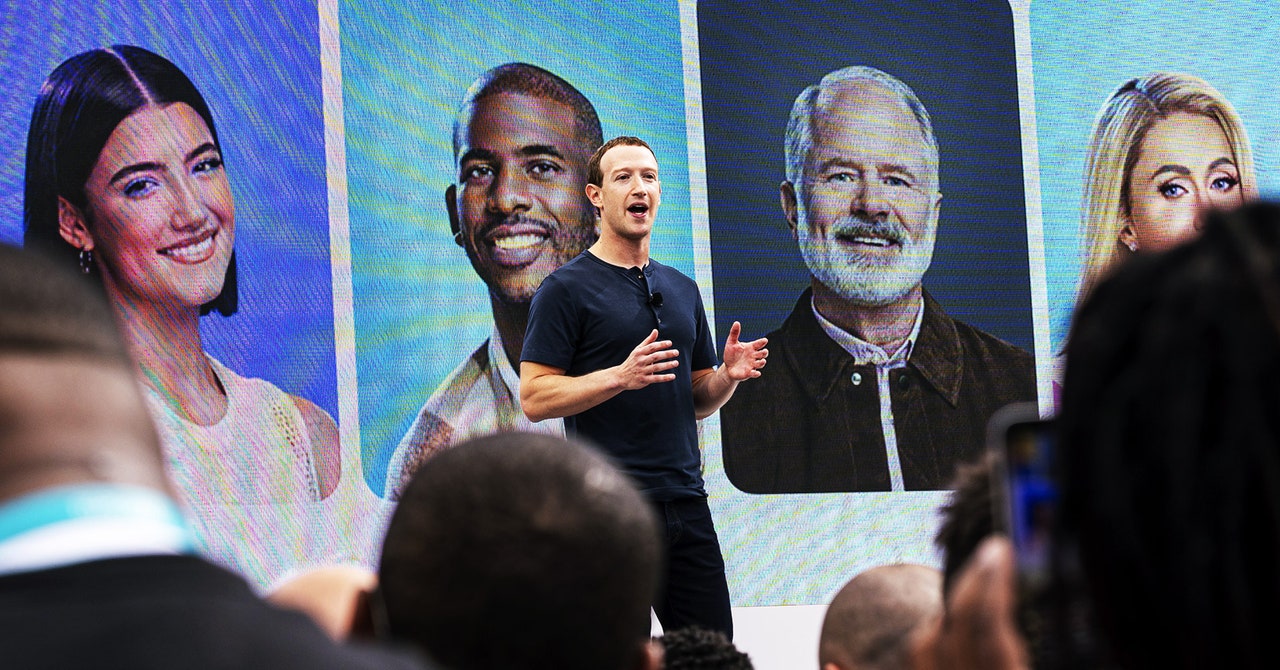
Mark Zuckerberg’s keynote presentation at the Meta Connect event this week started late. The delay was on-brand for the company’s decade-long project to make virtual reality mainstream. Back in 2014, a demo of the then-primitive Oculus VR headset hit Zuckerberg like a lightning bolt, and within weeks he owned the company. He started talking about how a digital version of reality was going to be the next computing paradigm in about, oh, five or 10 years. More than nine years since that first demo, we’re still waiting. For a time there was a lot of excitement about an impending Metaverse, but the buzz is now barely audible. These days everyone is enchanted by all-knowing AI chatbots, which are making their claim to be not just the future of computers but the future of everything. What’s a paradigm chaser to do?
The answer came in Zuckerberg’s bifurcated presentation at the Meta Connect event this week. Yes, he still believes in mixed reality. He started by formally announcing the Meta Quest 3, a $500 headset that is actually better than the $1,500 “Pro” helmet the company recently abandoned, not least because it can also provide a really good augmented reality experience. Zuckerberg promised a profusion of digital objects that will become layered into the physical world, for things like games and fitness programs—so many that before long every room we enter will have more holograms than physical objects. After that bold prediction, he made an awkward pivot to Meta’s AI efforts, turning from a technology that has left many consumers indifferent to one that no one can get enough of. This was the moment Zuckerberg unveiled his bold new AI strategy for the era of ChatGPT. The gist of it is to use Meta’s advanced large language models to create chatbots injected into it various social platforms, including Facebook, Instagram, WhatsApp, and Messenger.
I have serious questions about this path. The original point of Facebook, a mission that Zuckerberg has at no time repudiated even after his company’s name change, is connecting people. You know, humans. For years whenever Zuckerberg talked about VR he would emphasize that it was going to be a social medium. VR in his view was all about hangouts, meetings, and getting you-are-there experiences from afar, largely anchored by Meta’s Horizon Worlds app.
Recently that messaging has shifted. A couple of weeks ago I got a demo of the Quest 3. A bunch of product managers and execs talked for over an hour about the headset and the new applications. But there was not a single mention of any improved social experience. One might have expected at the least a ground-up makeover of Horizon Worlds, since reports coming out of Meta have shown executives complaining that even employees ordered to use the app have been avoiding it. When I asked about the omission, the executives hemmed and hawed. In this week’s keynote, Horizon Worlds and social experiences hardly got a mention.
Zuckerberg’s AI presentation this week departed even further from his original mission. Meta is deep into the race to create super smart chatbots, and the big idea is to put them into social feeds. Some will appear as avatars, posting stories just like humans do. You will also find that a new contact has elbowed in among your friends and others you may follow, in the form of a chatbot called Meta AI that answers questions like ChatGPT does. This electronic interloper can even join in on your group chats.
Read the full article here