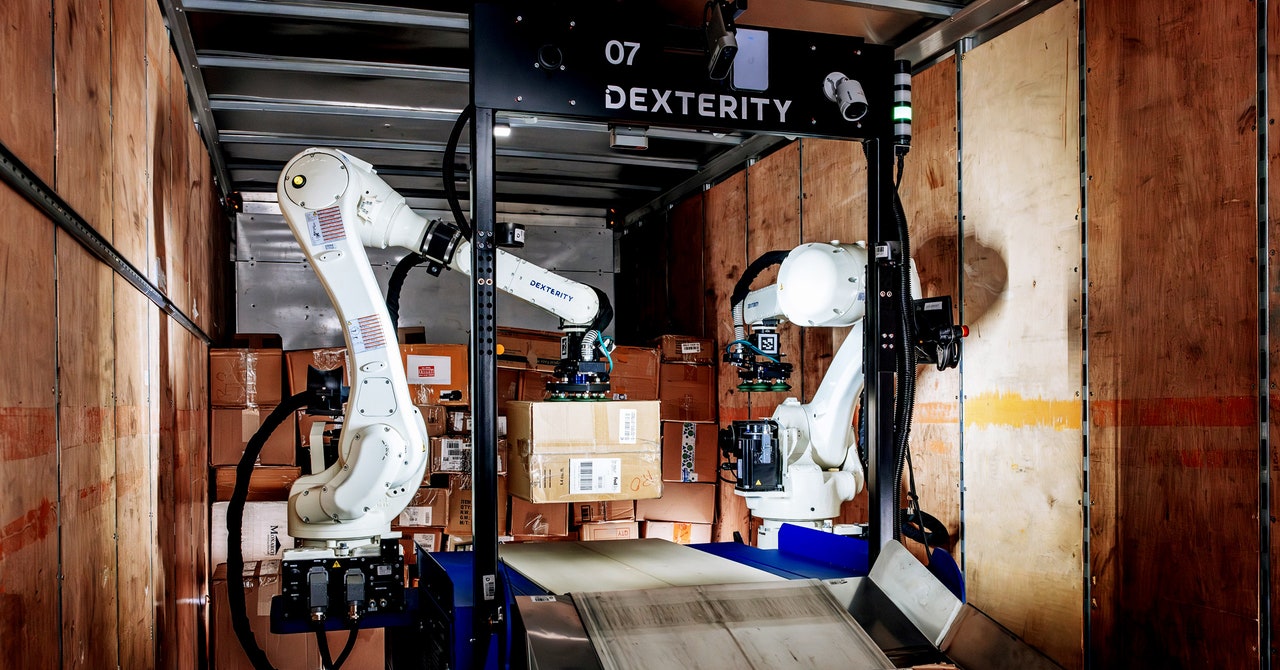
FedEx unveiled a two-armed robot called DexR this week that’s designed to automate one of the trickiest tasks facing the company’s human employees—loading a van with packages.
The new robot aims to use artificial intelligence to stack rows of differently sized boxes inside a delivery van as efficiently as possible, attempting to maximize how many will fit.
That task is far from easy for a machine. “Packages come in different sizes, shapes, weights, and packaging materials, and they come randomized,” says Rebecca Yeung, vice president of operations and advanced technology at FedEx. The robot uses cameras and lidar sensors to perceive the packages and must then plan how to configure the available boxes to make a neat wall, place them snugly without crushing anything, and react appropriately if any packages slip.
“A few years ago, AI was not at a stage where it was smart enough to handle this kind of complex decision-making,” Yeung says. DexR is currently in testing, ahead of a wider rollout at FedEx at some point in the future.
While generative AI tools like ChatGPT have created a sense in many industries that AI technology is ready to take on just about anything, handling objects in the messy, unpredictable real world still poses formidable challenges for algorithms. Most industrial robots are designed to carry out highly repetitive jobs with extreme precision, but no variation.
Roboticists are making progress. A growing number of machines now use AI to do things like recognize objects or determine how to grasp them. This can involve training algorithms inside a simulation where errors matter little before transferring that software to a real robot. But making the jump from simulation to the real world is notoriously difficult.
Better algorithms, new approaches to using machine learning for robots, and improved hardware and sensors have all started to open more commercial applications for advanced robots.
Read the full article here