


by KeAi Communications Co.
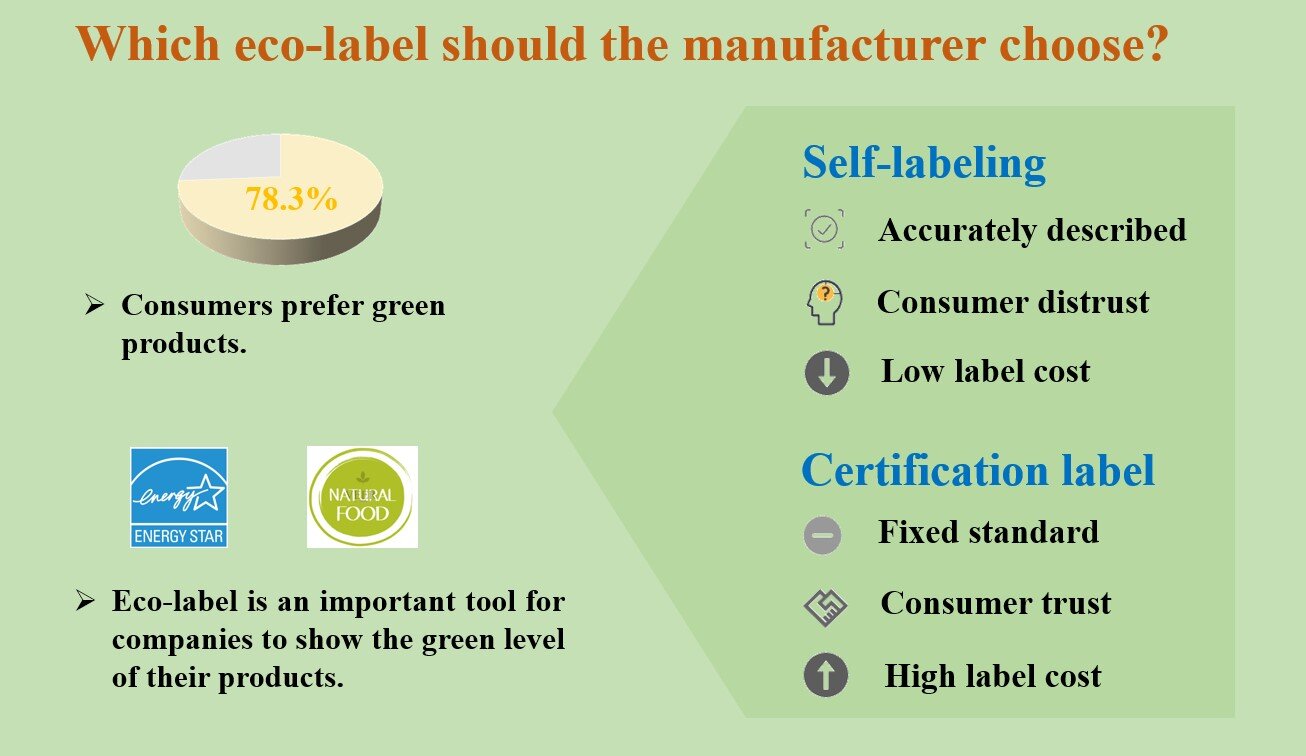
The green lifestyle has been increasingly popular in recent years. According to the 2023 China Consumption Trend Report, 73.8% of customers prioritize buying environmentally friendly products. Tools such as eco-labels are widely used by companies to show consumers how green their products are.
Eco-label comes in the form of a certification label or self-labeling, depending on the originator. The certification label is issued by third-party certification bodies, such as Energy Star and Organic Food. While consumers trust them, it is difficult to convey green attributes beyond the standard to consumers. Self-labeling, such as Wal-Mart’s natural label, is the manufacturer’s self-declaration of the product’s green status on the packaging, but consumers often have low trust in it.
In this context, a research team led by Professor Gaoxiang Lou of the East China University of Science and Technology and Professor Yi-Ming Wei of the Beijing Institute of Technology constructed a green supply chain game model that includes a manufacturer and a supplier. The supplier provides green raw materials, and the manufacturer carries out green manufacturing and chooses eco-labels for products.
The researchers found that upstream and downstream companies in the supply chain have conflicting eco-label selection preferences. The supplier prefers a certification label, while the manufacturer tends to choose self-labeling, although the social welfare under the certification label may be higher. According to this discovery, further coordination among supply chain members is needed to address conflicting preferences.
Further, the researchers expanded the certification label level from the original single level to multiple levels. For example, Cradle to Cradle Certified is divided into five levels. The results indicate that when consumers have low trust in self-labeling, and the difficulty of green investment is low, the manufacturer is more likely to choose multi-level certification labels. This gives a scientific basis for the formulation of multi-level eco-label.
Additionally, the researchers found an interesting result—when companies adopt single-level certification labels, consumers’ green preferences can be harmful to companies’ profitability. They explained, “As consumers’ green preferences increase, certification agencies will issue more strict certification standards. This will force companies to invest more in green innovation, thereby damaging their profitability.”
Finally, the researchers, who published their findings in Sustainable Operations and Computers, stated, “We simultaneously consider green supplying, green manufacturing, and eco-label selection behaviors in the green supply chain, and further extend to multi-level eco-label, which is rare in existing research.”
Their results can provide a reference for the green innovation practice and eco-label strategy selection in the green supply chain.
More information:
Gaoxiang Lou et al, Eco-label strategy selection for green product development in supply chain, Sustainable Operations and Computers (2024). DOI: 10.1016/j.susoc.2023.12.003
Provided by
KeAi Communications Co.
Read the full article here





