


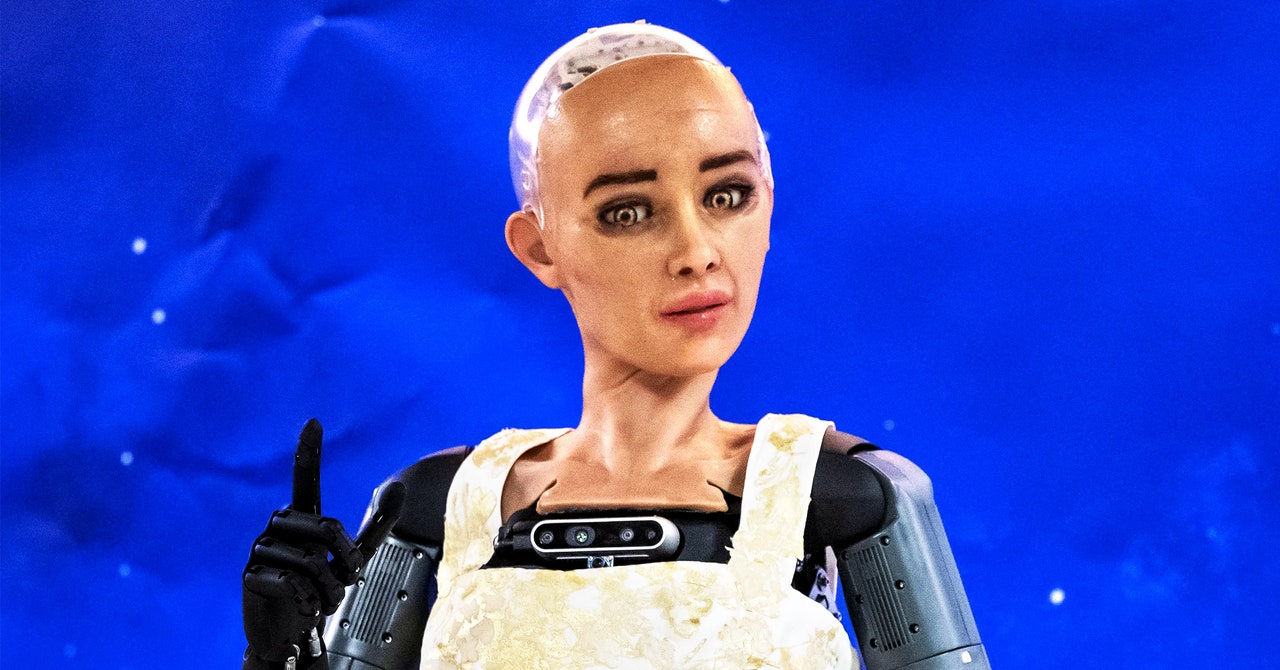
Earlier this month, several prominent outlets carried news that artificial intelligence will not pose a danger to humanity. The source of this reassuring news? A bunch of humanoid robot heads connected to simple chatbots.
The news stories sprang from a panel at a United Nations conference in Geneva called AI for Good, where several humanoids appeared alongside their creators. Reporters were invited to ask questions to the robots, which included Sophia, a machine made by Hanson Robotics that has gained notoriety for appearing on talk shows and even, bizarrely, gaining legal status as a person in Saudi Arabia.
The questions included whether AI would destroy humanity or steal jobs. Their replies were made possible by chatbot technology, somewhat similar to that which powers ChatGPT. But despite the well-known limitations of such bots, the robots’ replies were reported as if they were the meaningful opinions of autonomous, intelligent entities.
Why did this happen? Robots that can visually mimic human expressions trigger an emotional response in onlookers because we are so primed to pick up on such cues. But allowing what is nothing more than advanced puppetry to disguise the limitations of current AI can confuse people trying to make sense of the technology or of recent concerns about problems it may cause. I was invited to the Geneva conference, and when I saw Sophia and other robots listed as “speakers,” I lost interest.
It’s frustrating to see such nonsense at a time when more trustworthy experts are warning about current and future risks posed by AI. Machine learning algorithms are already exacerbating social biases, spewing disinformation, and increasing the power of some of the world’s biggest corporations and governments. Leading AI experts worry that the pace of progress may produce algorithms that are difficult to control in a matter of years.
Hanson Robotics, the company that makes Sophia and other lifelike robots, is impressively adept at building machines that mimic human expressions. Several years ago, I visited the company’s headquarters in Hong Kong and met with founder David Hanson, who previously worked at Disney, over breakfast. The company’s lab was like something from Westworld or Blade Runner, with unplugged robots gazing sadly into the middle distance, shriveled faces flopped on shelves, and prototypes stuttering the same words over and over in an infinite loop.

Read the full article here





