Ethan Surgenavic was excited to begin work at a new electric vehicle battery-cell plant in Ohio’s Mahoning Valley last summer. The Ultium Cells plant is a joint venture of General Motors and South Korea’s LG, and he grew up in the area when GM was known for well-paid, unionized jobs. “I thought this might be my opportunity to get in on the ground floor of something great,” the HVAC technician says of his job on the leading edge of the EV boom. Then he started work.
The lithium in EV batteries can react violently with water, and Surgenavic’s job involves controlling humidity in the battery plant’s rooms to precise levels. But he says wages are too low to attract enough qualified workers to maintain the huge building. When Ultium opened, production workers started at $16.50 an hour and maxed out at $20 an hour, a level far below GM’s own plants and one that 28 US senators called “a national disgrace” in a July letter to battery plant owners. Ultium staff voted to unionize with the United Auto Workers (UAW) in December, but are still bargaining their first contract. Chemical spills, exposures to toxic substances, and other safety problems have landed Ultium with $31,000 in fines from US federal regulators, with six investigations still open. Ultium spokesperson Katie Burdette says the company prioritizes safety and works with UAW-appointed safety representatives, but Surgenavic and others say the shiny green EV revolution isn’t looking so good for workers so far.
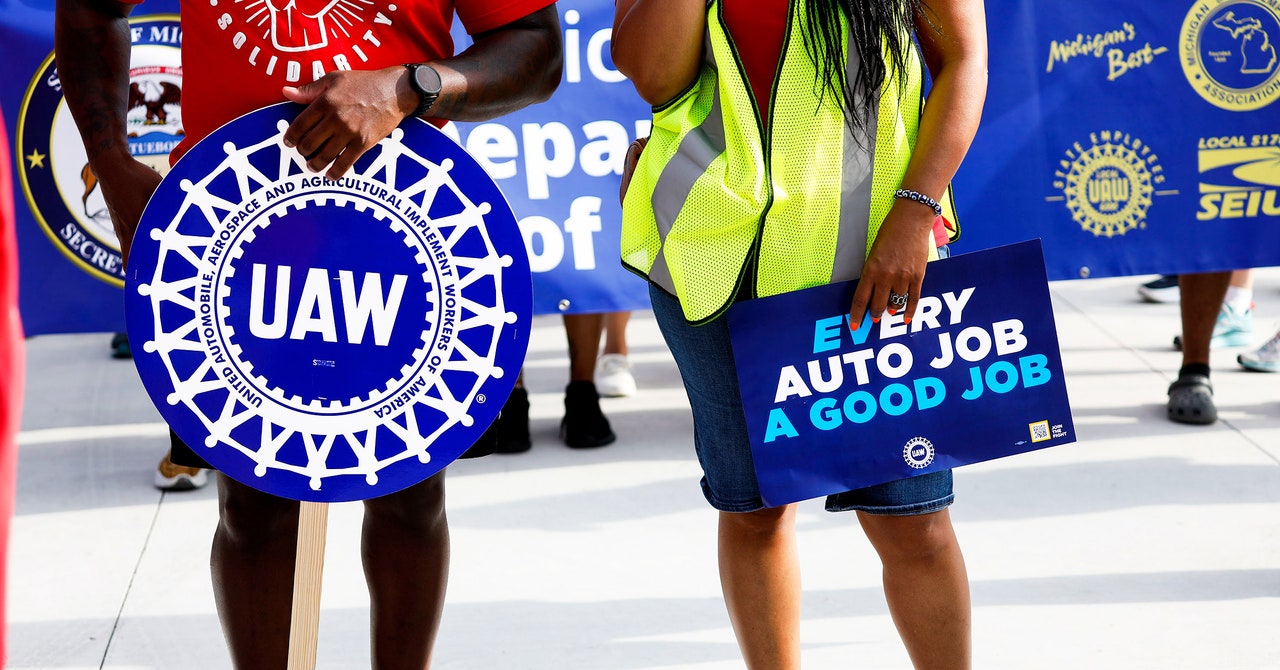
The fate of workers as the auto industry decarbonizes is part of tense negotiations this week that could see 150,000 autoworkers go on strike. The UAW’s four-year-old contract with the Big Three US automakers—Ford, GM, and Stellantis—was forged before drivers embraced EVs, and expires at 11:59 pm on Thursday, September 14.
Autoworkers aren’t natural allies of work on climate change, but that’s changing as the industry electrifies and more workers like Surgenavic move to the EV supply chain. UAW has vocally supported climate policy, including tougher fuel economy standards, and it and other unions are embracing the concept of a just transition, credited to ideas developed by labor leader Tony Mazzocchi in the 1990s and mentioned in the 2015 Paris Climate Agreement.
As society shifts away from unsustainable industries, the philosophy goes, workers and their communities shouldn’t shoulder the burden. J. Mijin Cha, an assistant professor of environmental studies at UC Santa Cruz, says research shows that the just-transition approach has wider benefits by decreasing opposition to new sustainable industries. “By making a more just society overall, we can actually accelerate an energy transition,” she says.
The automakers have argued that they need to control labor costs to invest in electrification while staying competitive with non-union competitors that include overseas rivals such as Toyota and Honda and domestic EV makers like Tesla and Rivian. The UAW says its members deserve their fair share of the Big Three’s soaring profits—$21 billion in the first half of 2023. Their demands, self-admittedly “audacious,” include a mid-30 percent raise over four years in line with increased executive salaries, restored pensions, a 32-hour work week for 40 hours of pay, and good jobs for the next generation of EV workers.
Read the full article here