


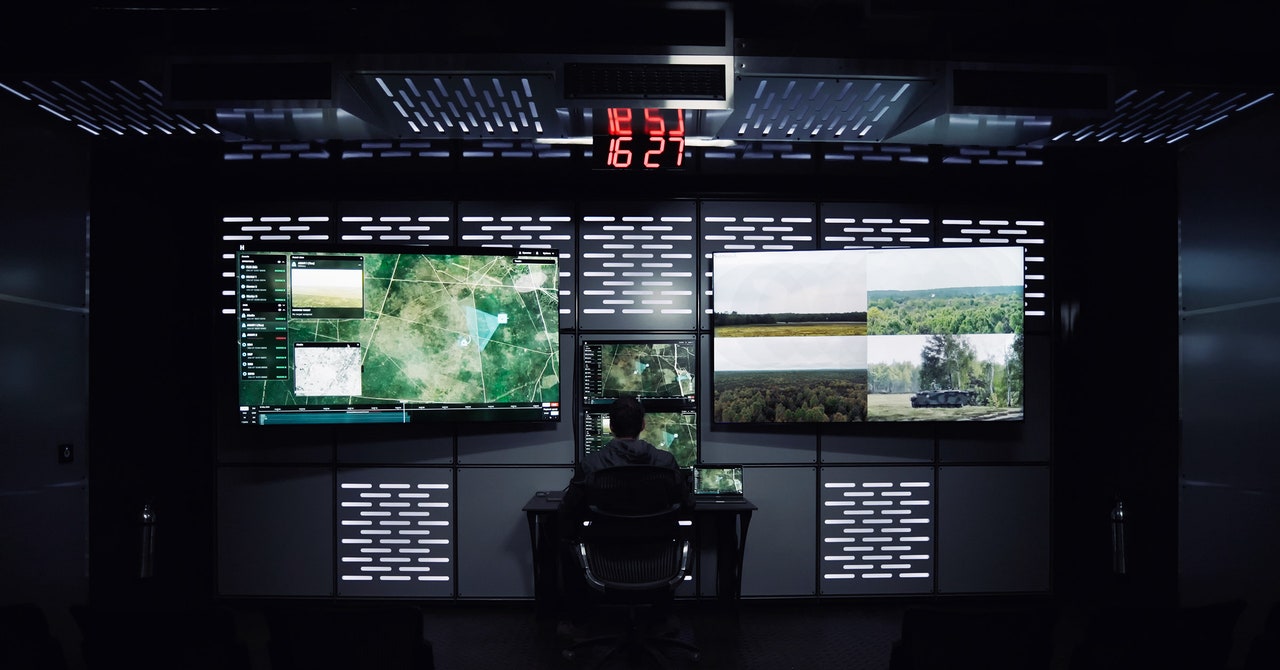
On the screen in front of me is a mountain range. Moving toward my troops from the top-right corner is an ominous yellow dot. I suspect it’s an enemy drone, but it could be a bird or a civilian aircraft, so I ask my long-range camera to home in on it. Within seconds, it returns a snapshot of a wide-winged military drone. The incoming dot turns from yellow to red, signifying a threat.
This might sound like a video game, but it’s not. This is technology designed to be used by real militaries. And it is the first time defense-tech company Helsing AI has shown a journalist what the software it is selling actually looks like. Helsing’s flagship system absorbs huge amounts of data generated by the sensors (electro-optical, infrared, sonar) and weapons systems (fighter jets, drones, helicopters) used in modern warfare. Algorithms then distill that information into a video-game-style visualization to show how events are unfolding in real time on the battlefield. What I’m looking at is a simulation of what I would see if I worked for a military that used Helsing’s system.
In the room with me, explaining how this works, are Helsing’s three founders. Torsten Reil is the company’s 49-year-old CEO. With a background in gaming—he previously founded development studio NaturalMotion—Reil is preoccupied with the user experience and making the platform intuitive for its military clientele. Then there’s Gundbert Scherf, 41, a former special adviser to Germany’s military of defense, who talks fluently about how European militaries work and what he feels they need to do to modernize. And finally there’s the in-house AI expert, 31-year-old Niklas Köhler, the youngest of the three. Köhler was using machine learning to solve medical problems when he started to be approached by figures in the defense sector—prompting him to change direction. “Applications like detecting drones are, in terms of methods, not so dissimilar from how you would find cancer in large CT scans,” he says.
In modern warfare, every second counts. And the Helsing founders say their software can give Western militaries an information edge. Its system, they claim, will help soldiers make faster, better-informed decisions and will be accessible on a variety of devices, so soldiers in frontline trenches can see the same information as commanders in control centers. “Now, all of this is done manually: phone calls, reading things, drawing stuff on maps,” says Köhler. “Understanding how many systems are there, what they are doing, what is their intent—this is an AI problem.”
Helsing is not the first company to try to build an operating system for war. Military types have been advocating for the idea since the 1990s. But traditional defense firms have struggled to deliver, creating an opportunity for tech companies to step in. California-based Anduril, the company launched by Oculus cofounder Palmer Luckey, has developed software that connects multiple military systems. And Palantir, headquartered in Colorado, has been using the war in Ukraine to release details about its own military AI. But Helsing is the only visible European startup making this type of software. Experts say what’s notable about the company is the way it maps the electromagnetic spectrum, the invisible space where different machines send electronic signals between one another to communicate.
“Using artificial intelligence applications to help analyze what part of the electromagnetic spectrum frequency to use, and what part to jam, is an extremely powerful technique,” says Ben Jensen, a senior fellow for future war at the Center for Strategic and International Studies, a think tank.
Read the full article here





