


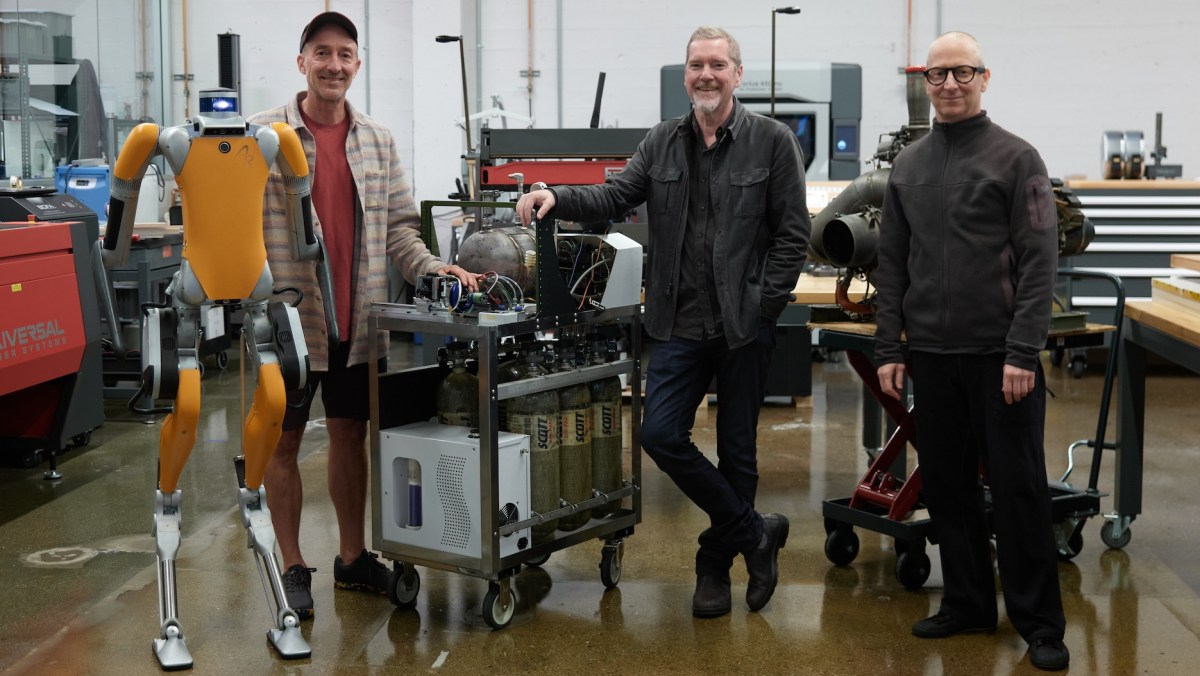
Playground Global, the storied early-stage venture capital firm, brought in $410 million in capital commitments for its Fund III to invest in early-stage deep tech and science companies. The new fund gives Palo Alto–based Playground over $1.2 billion in assets under management.
Before co-founder and general partner Peter Barrett became a venture capitalist, he started his career as an engineer (a video game engineer, to be exact). Fun facts about him — he still codes daily and is touted for giving Elon Musk his first job.
Barrett has surrounded himself with equally tech-loving general partners, Jory Bell, Matt Hershenson, Bruce Leak and Laurie Yoler, all with similar deep scientific and operational backgrounds.
Together, they are attracted to companies creating the next generation of technologies across the computing, automation, infrastructure, logistics, decarbonization and engineered biology industries.
With Fund III, similar to its $500 million Fund II raised in 2017, capital deployments in Fund III will focus on seed and Series A companies with initial investments ranging from $1 million to $20 million.
Playground is often an early or first investor, and Barrett told TechCrunch that the firm “believes there are only a few transformative companies created each year.” Some of its portfolio exits include MosaicML, acquired by Databricks in June for $1.3 billion, and Velo3D, a company that allows Elon Musk to print the Raptor engines to power Starship, which went public in 2021.
TechCrunch spoke with Barrett via email to discuss how the fundraising environment has changed since its last fund raise, lessons learned while investing in deep tech and what it looks for in a startup.
The following was edited for length and clarity.
TC: Playground last raised a fund in 2017. What was the fundraising environment like this time around?
PB: The macro-environment has been challenging for all, but as we met with investors from around the world, they told us they are looking to avoid fads and trends and instead focus on companies and verticals where there is real, lasting value being created. Durable and defensible companies.
The new fund and the fundraises of several of our companies have demonstrated that investors, especially in down-markets, are flocking to quality and there’s never been a bad time to invest in great companies.
We had great support from existing investors and also used the opportunity to invite new investors into the fold. For Fund III, we broadened our LP base to include endowments, foundations, and single and multifamily offices.
What’s unique about what Playground offers to startups?
We are an early-stage venture capital firm and a true partner to our companies from their formation. If you speak with our entrepreneurs, you’ll find they think of us as co-founders as much as investors. We have a unique superpower in being able to underwrite and retire technical risk and can take advantage of the roadmaps we’ve developed to identify best-in-class emerging technologies.
We also do not invest in competing companies, so there is true camaraderie within the portfolio. We have had several new portfolio companies introduced to us by Fund I and Fund II founders. In addition to our platform services, our 70,000-square-foot studio is home to many of our own portfolio companies and other non-competitive startups in the deep tech space.
Tell me about your pivot from consumer to deep tech. What led to that decision?
When we founded Playground, our team was purpose-built to help develop both consumer technologies and deep tech companies. Early on it was clear that our superpower was underwriting technical risk, not reading the tea leaves of market risk. By focusing on deep tech and investing in the roadmaps that guide our investment decisions, we’ve captured an unfair share of the world’s most transformative companies.
What have you learned from diving into deep tech?
We’ve been investing in deep tech companies since we founded Playground, with PsiQuantum being one of our very first investments. We’ve learned that everything is impossible until it isn’t, and a combination of thoughtful capital and brilliant, tenacious people can move civilization forward.
What sectors within deep tech excite you, and which do you tend not to invest in?
Our first principle underwriting of chemistry, biology, and computation allows us to invest in breakthrough companies across next-gen compute, AI/automation, infrastructure, engineered biology, and decarbonization.
There is no conflict between investing in consequential technologies and strong returns. We’re drawn to companies that can build large technical moats and enter markets where they are the clear category leader. We follow our roadmaps and don’t surf the zeitgeist.
What are you looking for in a startup?
We’re looking for testable hypotheses that tackle important problems with plausible paths to success. We’re not looking for a potential solution to a problem; we’re looking for the solution that brings together the right idea, the right people, at the right time.
How many investments have you made from Fund III so far?
Playground has already made several investments from Fund III, including d-Matrix, Ideon Technologies, Amber Bio, Infinimmune and Atomic AI, along with other portfolio companies operating in stealth.
We believe our companies operating in stealth are in prime position to revolutionize green metal production and provide the foundation of next-generation semiconductor manufacturing.
d-Matrix, for which Playground led the Series A, has already raised its next round with an oversubscribed $110 million Series B round announced in September. The company is building the next generation of AI HW through an in-memory-compute platform that focuses on inference in the data center.
Given your previous relationship with Elon Musk, what is your opinion of his stewardship of X, Tesla, etc.?
We all wish Elon would focus more time on electrifying the planet and sending rockets to space.
Read the full article here