


It’s no secret that alternative protein companies and others leveraging fermentation technology have an issue scaling to commercial production. Founders say that this is perhaps the number one challenge to taking their products from expensive to cost parity with traditional meat.
Meet Pow.bio, a company founded by Ouwei Wang and Shannon Hall (no relation to the author) in 2019, that aims to help synthetic biology companies manufacture their products at cost parity amid a market of biomade products estimated to reach $4 trillion by 2040.
“Biology is the technology of today,” Hall told TechCrunch. “We see that in lots of consumer-facing goods, and lots of biomedicines and in Impossible Foods products. More importantly, it’s behind our aspirations for how we’re going to deal with some of the biggest challenges in the world. For example, climate change impacts, population growth impacts and our aspirations to live and travel in space. All of that is predicated on having biology technology working.”
While companies like No Meat Factory, Planetary and Prolific Machines raised capital to build production facilities, Hall said the solution to the scaling problem won’t come from building large-scale bioreactors, even if the funding comes from the government.
“The real true story here is that most of the biology design stuff just is too damn expensive to take to the market,” Hall added. “Building bigger bioreactors doesn’t make that better, and as a result, what you see made are things you either need very tiny amounts of, like the heme protein in the Impossible Burger, or things that are crazy expensive, like lactoferrin, or human collagen, which is also nice to have alternatives.”
She explained that prototyping, a necessary step in synthetic biology production, is where the time and cost factor come into play. For example, involving a six-month wait and $50,000 investment each time.
Pow.bio intends to bring down biomanufacturing costs by unlocking the potential of synthetic biology via a “broader palette of wins,” that involves the reimagining of fermentation facility operations, Hall said.
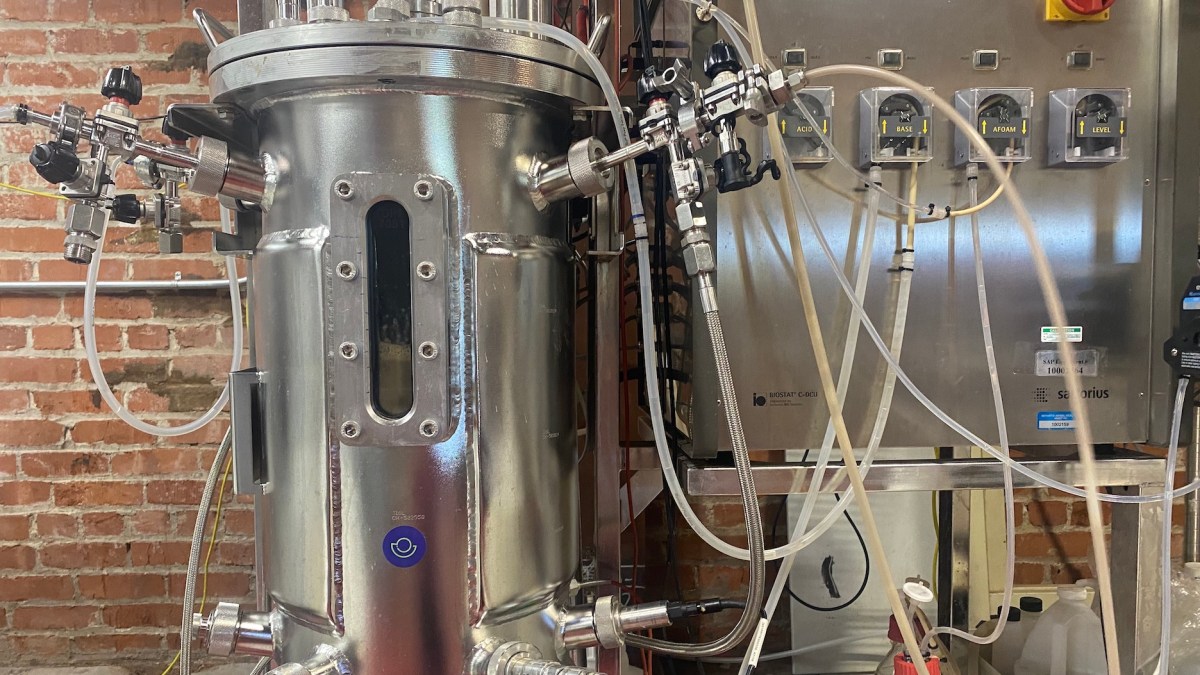
And that’s what Pow.bio is doing: Building more efficient bioreactor capacity through its continuous fermentation technology. Anchoring the technology is artificial intelligence-controlled software called SOFe that is designed to accelerate process optimization and drive autonomous operation.
Simply put, Pow.bio’s hardware and software combination has the capability to allow for a steady pace of inputs and outputs that is 5x faster for a fraction of traditional capital expenses, Hall said.
“Let us be your rapid prototyping partner,” she added. “You can get stuff in two or three months, at the most, and you’ll be able to turn quickly.”
Pow.bio is still in the early stages; however, it is already working with multiple clients and bringing in revenue. The company has seen “at least 50% year over year growth in demand,” Hall said.
It is also now buoyed by $9.5 million in Series A capital. Re:Food and Thia Ventures led the round and were joined by Hitachi Ventures, Possible Ventures, XFactor, iSelect, Climate Capital, Vectors, Better Ventures and Cantos. The new investment gives Pow.bio around $13 million in total funding.
Much of that new funding will be deployed into a demonstration facility in Alameda, California. Once it opens in the summer of 2024, it will be able to transition from gram-scale experimentation to the production of hundreds of kilograms of finished products.
“It will demonstrate our system at scales above where we’re at today, which will enable more partners — we think 20 to 50 partners — to drive product through there, as well as be the blueprint for taking that to multiple locations,” Hall said. “With this proof, we can copy/paste it anywhere. That’s what we think is needed.”
Read the full article here