


Each Monday, I pick out North America’s celestial highlights for the week ahead (which also apply to mid-northern latitudes in the northern hemisphere), but be sure to check my main feed for more in-depth articles on stargazing, astronomy, eclipses and more.
The Night Sky This Week: March 4-10, 2024
With a Last Quarter Moon on Sunday rising after midnight, this week is the best of the month for stargazing. Without much moonlight to bleach the night sky, stars will be brighter, and so will distant, open clusters, nebula and galaxies. It’s the perfect time to take out a telescope, but also a pair of binoculars, or just your naked eyes. Nevertheless, the events of the week, such as they are, revolve around the waning crescent moon as it appears to glide past Earth’s closest planets. When its reaches its new moon phase it will be the biggest “supermoon” of 2024—so watch for extreme tides.
Here’s everything you need to know about stargazing and astronomy this week:
Wednesday, March 6: A Waning Crescent Moon With Mars And Venus
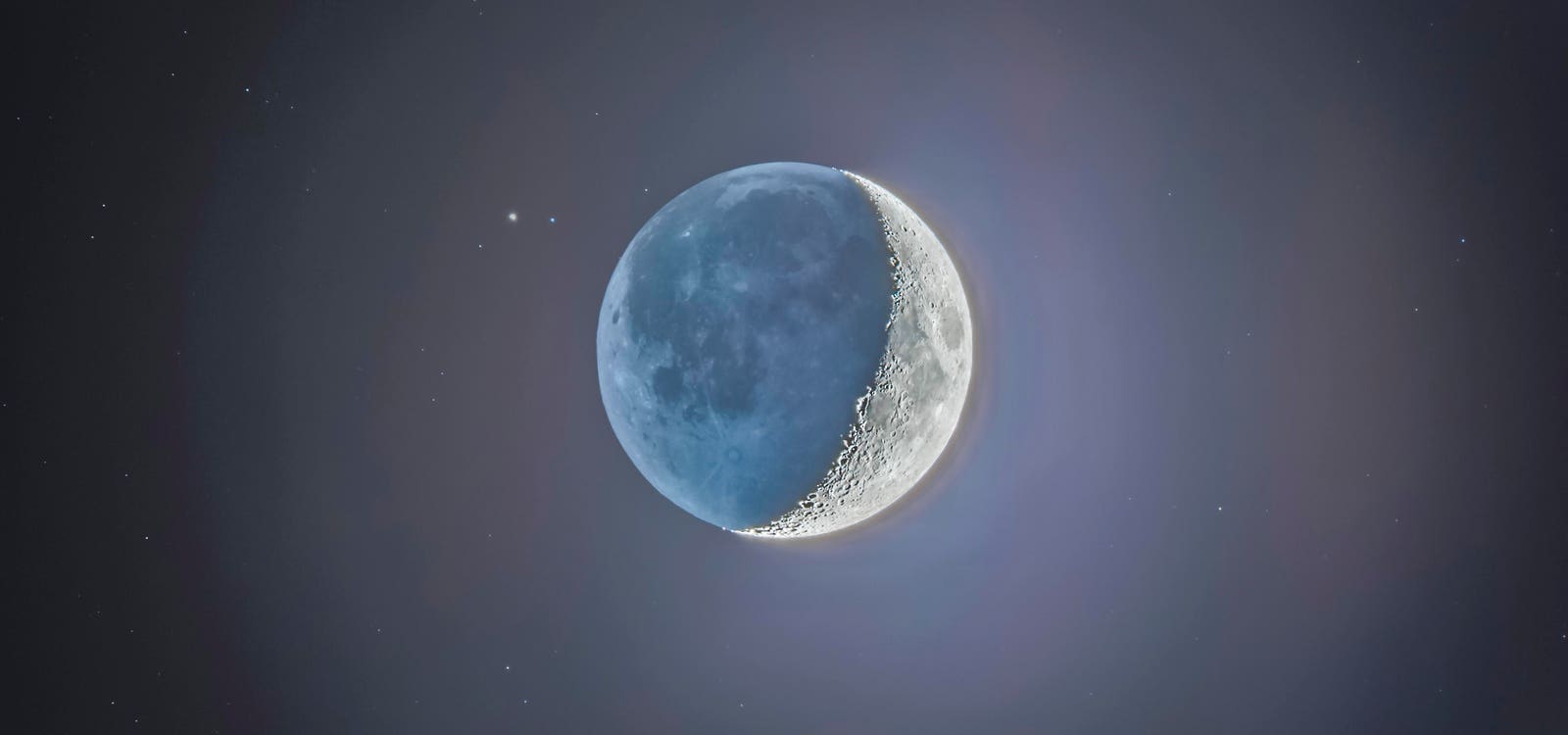
Get up before sunrise and look east-southeast to see a 21%-lit waning crescent moon, with Venus shining brightly close to the horizon and Mars close by. You’ll also see “Earthshine” on the crescent moon—sunlight reflected from Earth’s ice-caps and clouds onto the moon’s surface.
Thursday, March 7: A Waning Crescent Moon With Mars And Venus
Repeat yesterday morning’s early rise and you’ll see a slender 12%-lit waning crescent moon just over three degrees from Mars and about 5 five degrees from Venus. Look out for “Earthshine” again.
Friday, March 8: An Old Moon With Mars And Venus
Look to the southeast before sunrise this morning, and you’ll see the beautiful tableau of a 5%-lit “old” crescent moon with Mars and Venus, though it will be a difficult spot. Use binoculars, but be careful not to point them at the rising sun.
Friday, March 8: Eclipse Countdown
Today it’s just a month until the “Great American Eclipse,” a total solar eclipse in North America for the last time until 2033 (Alaska) and 2044 (Montana and the Dakotas). The 115 miles-wide path of totality will pass across three states in northwest Mexico, 15 U.S. States from Texas through Maine, and five Canadian provinces. It will be possible to view the sun’s corona naked-eye, for up to 4 minutes 28 seconds, only from this path—from everywhere else in North America a partial solar eclipse will be seen.
Sunday, March 10: New ‘Worm Moon’
The moon will today be a “supermoon,” but it will be impossible to see from Earth. With our natural satellite between Earth and the sun the latter illuminates only the moon’s far side. According to Timeanddate, this new moon will be 221,764 miles (356,895 kilometers) away, the closest of 2024. Expect big tides in its wake as its gravitational pull is maximized.
What Is A Supermoon?
A supermoon occurs when a full moon is closer to Earth than on average. The moon’s orbital path around the Earth is elliptical, so there’s a day each month when it’s at it closest. An astrological, not astronomical term, a supermoon refers to a full moon that occurs within 90% of the moon’s closest approach to Earth in a given orbit. The proper astronomical term for a supermoon is a perigee moon.
Constellation of the week: Ursa Minor
Ursa Minor, also known as the “Little Bear” or the “Little Dipper,” is visible throughout the year in the northern hemisphere. It’s opposite Ursa Major, which contains the Big Dipper asterism (shape) you’ll probably already know well.
Ursa Minor is most easily identifiable by its brightest star, Polaris, also known as the North Star, but it’s one of the smallest constellations. It contains only a few bright stars in addition to Polaris, including Kochab and Pherkad. However, unless your sky is very dark you’ll struggle to find anything other than Polaris.
The times and dates given apply to mid-northern latitudes. For the most accurate location-specific information, consult online planetariums like Stellarium and The Sky Live. Check planet-rise/planet-set, sunrise/sunset and moonrise/moonset times for where you are.
Wishing you clear skies and wide eyes.
Read the full article here