


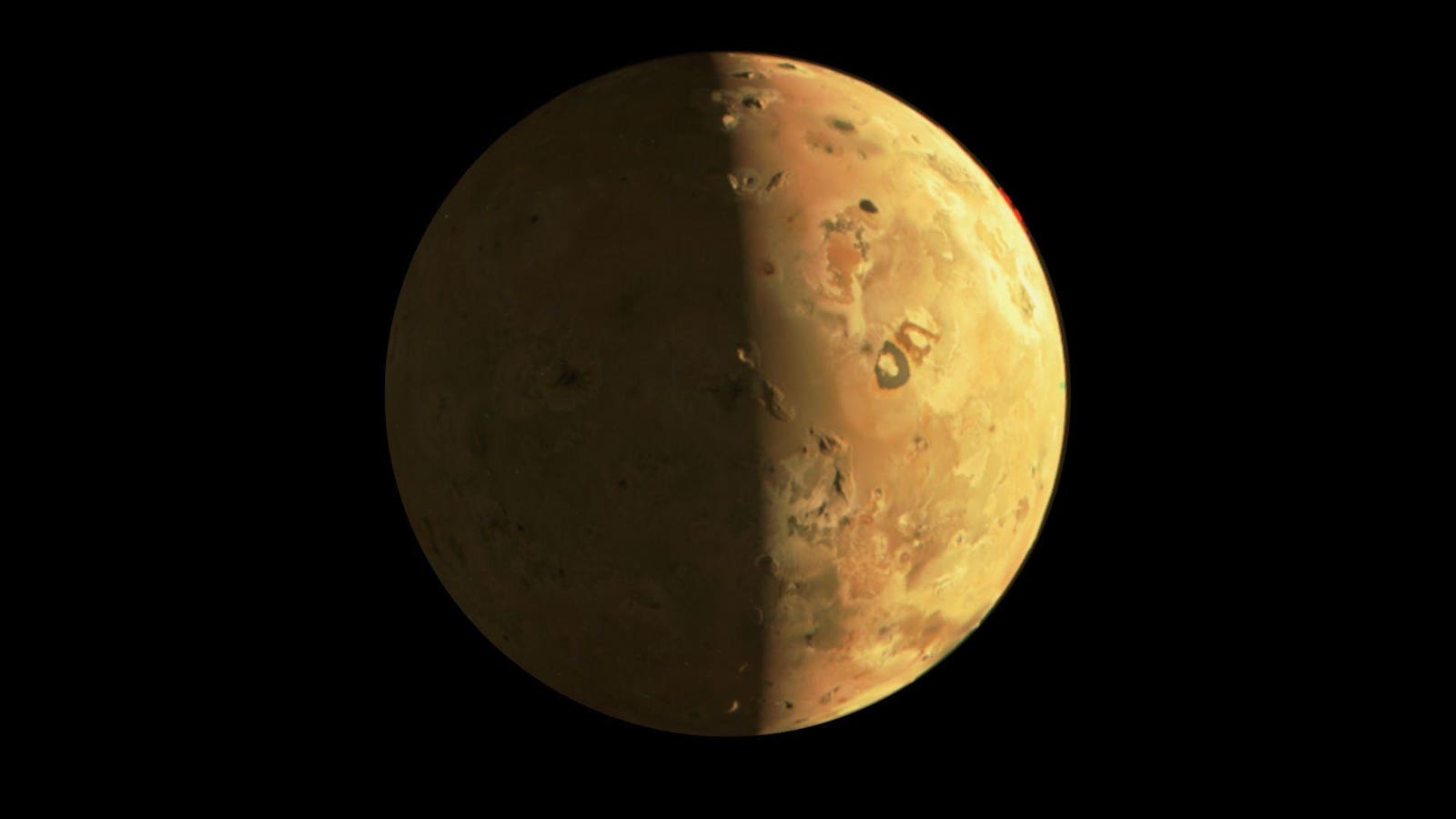
Jupiter’s fiery and chaotic moon Io has been imaged in detail by NASA’s Juno spacecraft after another super-close flyby—and this time it caught a volcano or two.
Juno, which has been in the Jovian System since 2016 and orbits Jupiter every 38 days, conducted a close flyby of Io on February 3, during which it got to within 930 miles (1,500 kilometers). It comes in the wake of a similarly close flyby on December 30, 2023 during which spectacular close up images were sent back.
The two flybys are the closest any spacecraft have made of Io in over 20 years, according to NASA.
Here are the stunning first images—including one that shows plumes coming from its hellish surface:
Slightly larger than Earth’s moon, Io has a rocky surface and a tenuous sulfur dioxide atmosphere. Its prominent features include its Pele volcano and Loki Patera, a massive volcanic depression that hosts an ocean of magma.
Io is the most volcanic world in the solar system, with eruptions significantly larger than Earth’s. The root cause is its orbit of Jupiter.
Io is the innermost of Jupiter’s four so-called Galilean moons—the others being Ganymede, Callisto and Europa—and takes just 42 days to complete an orbit.
The gravitational pull of the gas giant planet and its other large moons results in immense heat and frictional tidal heating. That heat creates high volcanic activity and an ocean of magma beneath its rocky surface.
In the image, above, you can see two potential plumes, probably of sulfur and sulfur dioxide, being ejected from one or two of Io’s many volcanoes.
Juno’s next perijove (close pass of Jupiter), its 59th, is scheduled to occur on March 7, continuing its exploration of Jupiter. During each perijove, Juno’s elliptical orbit brings it far from Jupiter but then swings it just a few thousand miles from the planet’s poles, allowing it to study the cloud tops closely.
Juno is the first mission to orbit an outer planet from pole to pole.
Due to Jupiter’s intense radiation belts, Juno is equipped with a titanium radiation vault to protect its sensitive scientific instruments, which include a magnetometer, a gravity science system and a microwave radiometer. They help scientists measure Jupiter’s magnetic and gravitational fields and its atmospheric temperature, pressure and composition.
Notable scientific findings since the mission began in 2016 include:
Wishing you clear skies and wide eyes.
Read the full article here