


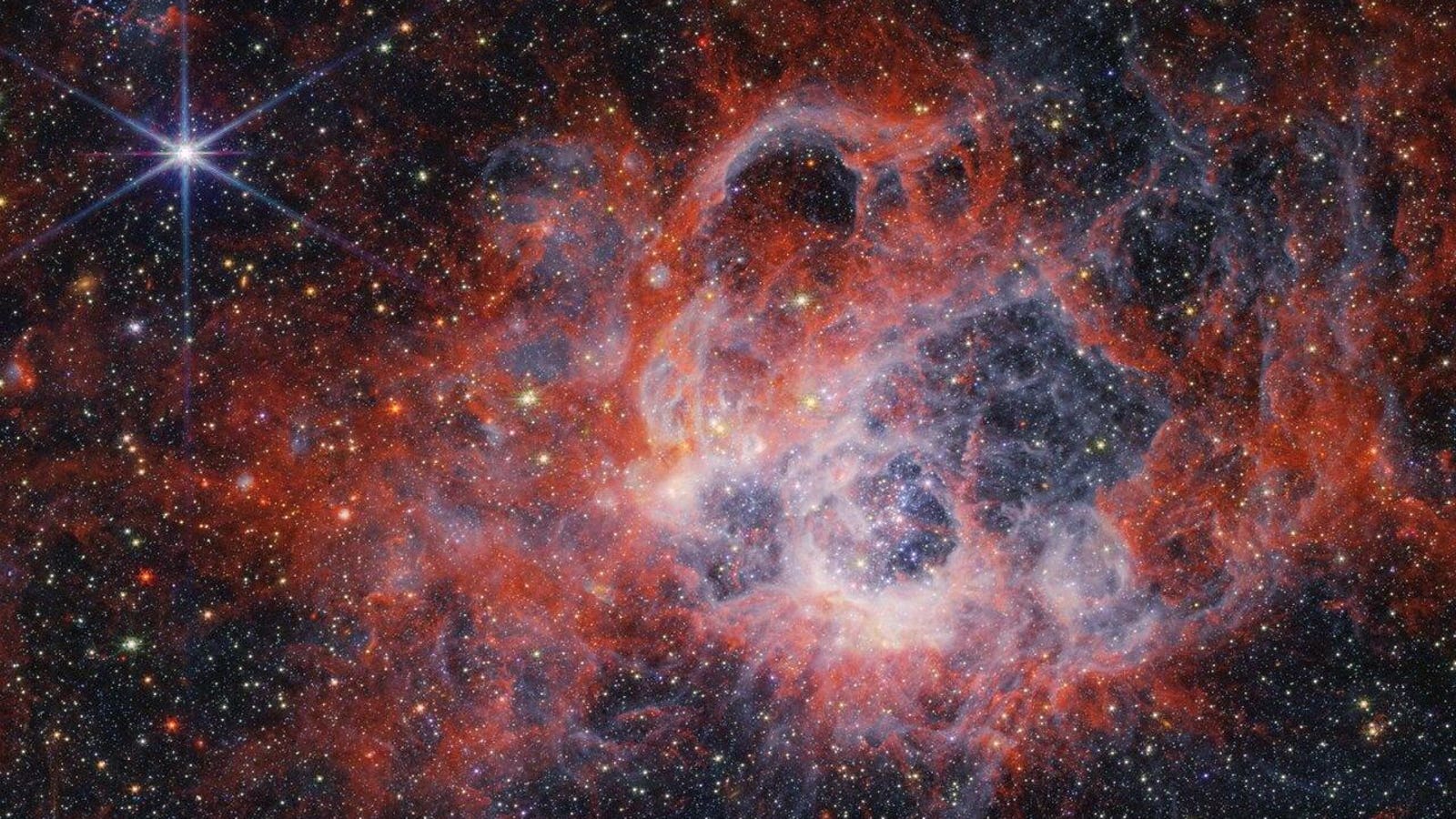
It’s been some months since beautiful images of space have been seen from the James Webb Space Telescope, but the $10 billion tennis court-sized has returned to form with a stunning treatment of a nearby galaxy.
Published today by NASA, ESA, and the Canadian Space Agency (CSA), the image shows a star-forming region in the Triangulum Galaxy—also called M33—which can be seen next to the much more famous Andromeda Galaxy (M31).
It’s about 2.7 million light-years distant. So JWST’s image is of how it looked 2.7 million years ago—that’s how long it’s taken for its light to travel into the space telescope’s cameras.
Massive Stars
The colorful image shows NGC 604, a nebula containing over 200 stars that are around 3.5 million years old. That makes them very young stars.
These are among the most massive and hottest stars it’s possible to find in the night sky. Some of these B-type and O-type stars are over 100 times the mass of the sun. Rarely in the universe are such huge stars found in such dense concentrations. NGC 604 is about 1,300 light-years across.
New Details
The data was captured using JWST’s two imagers—the Near-Infrared Camera (NIRCam) and Mid-Infrared Instrument (MIRI)—and NASA and ESA have published the images separately as well as one composite.
NGC 604 has been imaged before, of course, but JWST’s data reveals new details. Filaments of diffuse red gas and huge bubbles within the gas can be seen. It’s this gas that the stars are being formed from. But the stars’ gravity also carves out gaps in the gas. The image also shows molecular hydrogen and carbon-based molecules (called polycyclic aromatic hydrocarbons), two of the building blocks for stars.
JWST was launched on Christmas Day in 2021 and watches the universe from a point called L2 where the gravity of Earth and the sun combine to create a stable location. It’s a million miles from Earth—about four times the distance of Earth to the moon.
Wishing you clear skies and wide eyes.
Read the full article here