


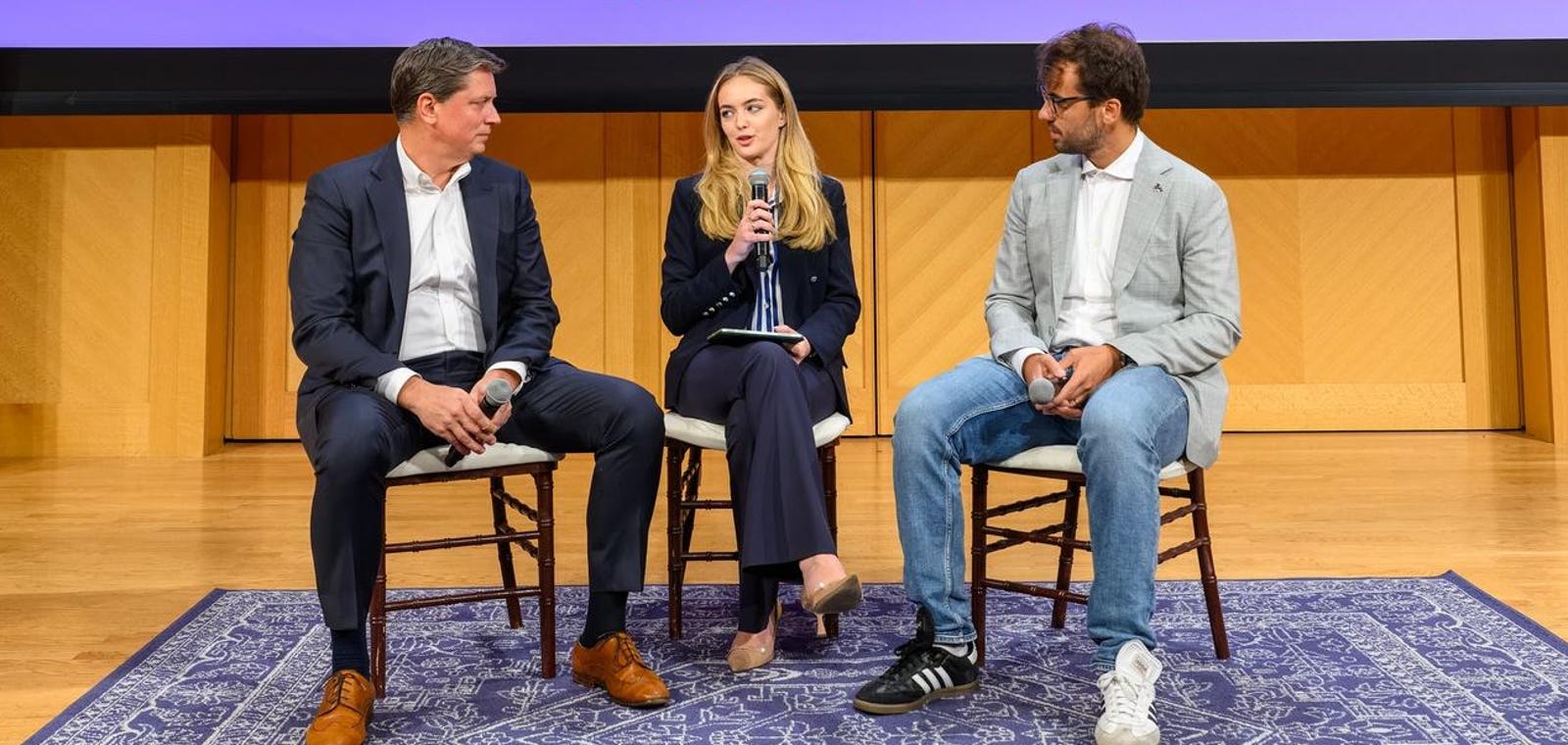
Speakers at the second annual Georgetown University Venture in the Capital in January provided candid insight into the challenges and opportunities of investing in defense and space innovation. They shed light on the evolving landscape of defense, space exploration, and commercialization in the future of defense and space technology.
One prevailing theme was the inherent difficulty for startups in working with government entities, particularly the Department of Defense. Sarah Hess, West Coast Director of Silicon Valley Defense Group, pointed out the DOD’s historical inefficiencies in procurement, citing their tendency to favor cost-plus contracts. Don Burnette, founder and CEO of Kodiak Robotics, echoed this sentiment: “Being a founder is hard enough, and really frustrating if you work for the government.” He pointed to the government’s familiarity with large procurements such as tanks, planes, and weapons systems, but said “They don’t know how to buy software and digital solutions” (an opinion shared by Rear Admiral Lorin Selby when he was Chief of Naval Research). Despite some progress, there remains a considerable gap in understanding and accommodating the needs of startups within government procurement frameworks.
Compounding the procurement issue is one of regulation. Tim Hughes, senior vice president for global business at SpaceX, noted the regulatory hurdles still present in the space sector despite technological advancements. “The regulatory structure does not match the pace of innovation and is slowing things down,” Hughes said. “We are building rockets faster than they can be regulated.” A related risk is the capacity of the Federal Aviation Administration to keep pace with the exponential increase in space launches made possible by reusable rockets.
Neil Keegan, co-founder and CEO of national security technology investor Marlinspike, highlighted the urgency for government and startups to work together to innovate in critical areas such as space technology and autonomous systems. With the International Space Station facing end of serviceable life and geopolitical competition intensifying, there is a growing recognition of the need for private sector involvement in space exploration and defense. “Voyager Space is bidding to build a privately-owned, privately-operated space station,” Keegan said, referencing the model of leveraging private capital to fill these gaps, mirroring the disruptive approach pioneered by companies like SpaceX in the space industry.
J.D. Englehart is an Investment Director at not-for-profit In-Q-Tel. “In-Q-Tel was chartered in 1999 to invest in commercial innovation, so we look and feel like a traditional VC firm. Yet rather than a financial motivation, our focus is to invest in companies that advance the national security mission.” This approach addresses the adoption challenges prevalent within government agencies and provides critical funding and support for innovative startups.
That is key, as funding is another significant obstacle faced by startups navigating the defense and space markets. “It’s clear that the way it’s always worked is not the way that early-stage companies need to operate,” Burnette said, highlighting the anxiety felt by companies subject to the uncertainty of the funding cycle caused by short-term contracts and non-recurrent funding. Despite these challenges, there is a consensus that the future of defense innovation lies in the hands of agile startups willing to disrupt traditional paradigms and collaborate with government partners to ensure national security in an increasingly complex world.
Panelists emphasized their belief that the future of defense is autonomous technology, particularly ground-based vehicles. “We need to think about how to make these devices smaller, remove people, and make them more intelligent,” Burnette said. “We have to get there because if we don’t, our enemies will,” he stated. Englehart agreed, adding “One of the highest casualty rates in recent wars is with truck drivers. Autonomy can be a solution.”
Delian Asparouhov is co-founder and president of Varda Space Industries, which manufactures products for the government, biopharma, and other sectors in microgravity and returns them to Earth. He emphasized the economics of long-term space exploration, saying “We need to be able to generate more value from sending people to celestial bodies than it costs to put them up there,” noting that the benefits must outweigh the costs if the Artemis mission to the moon is to be enduring. Hughes pointed to the benefits of reusable rockets, which lower cost and make space exploration more feasible, and the proliferation of low-orbit satellites that allow broadband available worldwide as outcomes that make the financials more promising.
“The primary mission of Varda Space is to bring value to Earth,” Asparouhov said. “We are a space company that connects to the rest of the economy, and our customers include the top twenty pharmaceuticals.” His sense of urgency in winning this new space race is evident. “Part of why I wake up every day and do what I do is because I want people on the moon to speak English and live in a democracy – not an authoritarian dictatorship.”
“Defense, hard tech, and space industries serve as prime examples of the coordination required between regulatory bodies and innovative companies,” Georgetown VITC founder and student Phoebe Martin said. “America’s continued growth and technological advancement require important conversations about what is slowing down progress.” While challenges exist, it is clear that the future of defense and space is one of government and private partnership.
Follow me on LinkedIn or check out my other columns here.
Read the full article here