


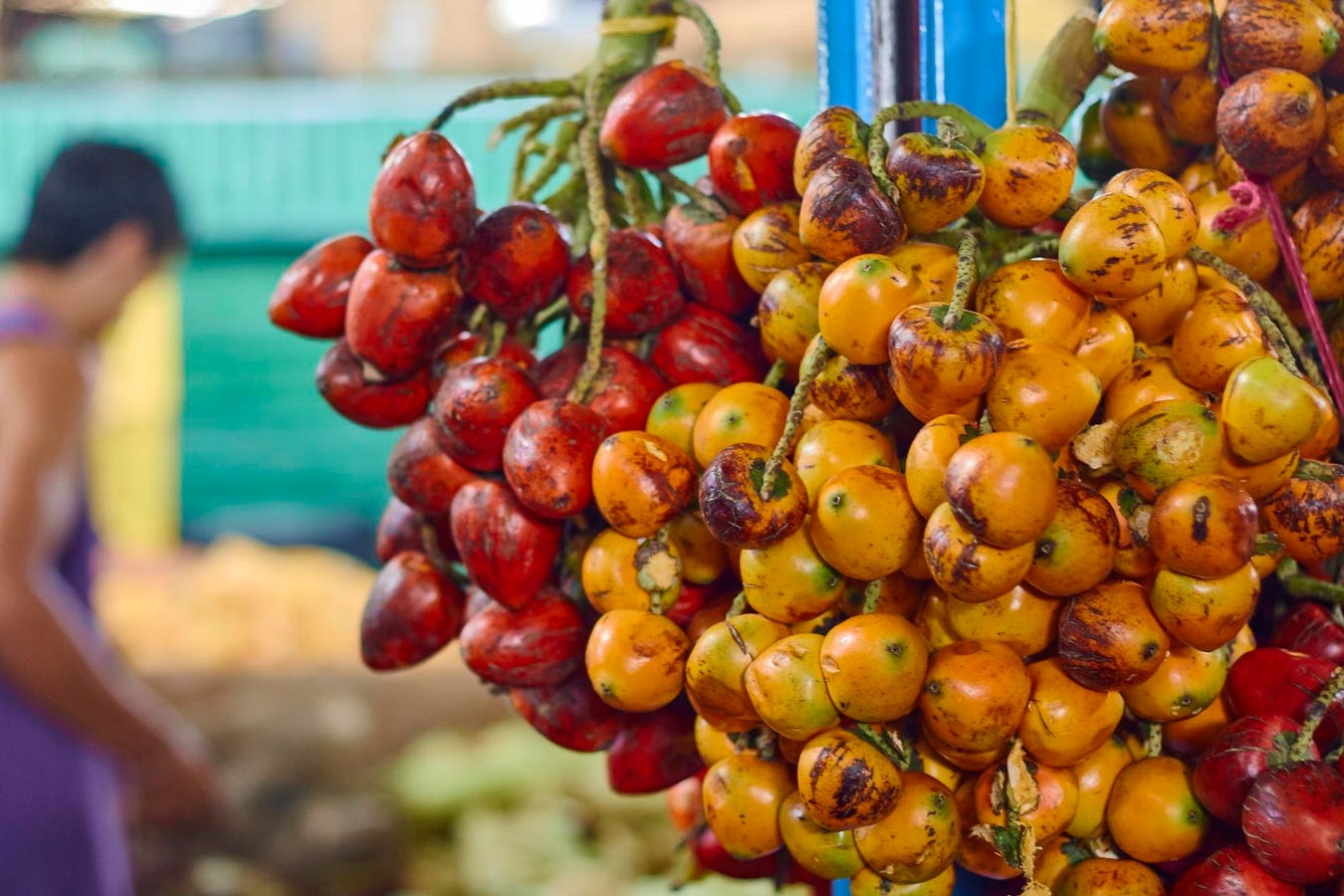
Colombia has a tenth of the world’s palm species and scientists aim to preserve two key food species: Taparo palm (Attalea allenii) and Chontaduro (Bactris gasipaes).
Colombia has the third highest number of palms of any country, with around 260 species — but over 200 Colombian species are in serious danger of extinction.
Of these Taparo, whose seeds are used to make sweets and Chontaduro or peach palm (a fruit eaten with either honey or a lemon and salt mix) are culturally and economically important, especially in the central and southern regions of the country.
Alberto Gomez Mejia, a botanist and founder of the Quindio Botanical Garden explains that his team aims to establish a gene bank to protect the palms’ genetic diversity, reintroduce some examples into wild areas and developing schemes for sustainable commercial plantations.
“We have the largest collection of palms in Colombia,” he says, “With new resources, we are going to work with two native food palms that are in danger of extinction.”
Gomez says that his team will work with locals to help save wild populations; collect population data on the palms and explore how the palm reproduce in their home in Colombia’s central Andes.
In 2005, UK charity Whitley Fund for Nature honored Gomez-Mejia with a Whitley Award and in 2023 was awarded $63,000 native palm species to train members of his team and support the development of palm gene banks.
Growing up in Colombia
Gomez was born in a small town in the department (state) of Caldas called Belalcazar, where his father was on his rural rotation as a doctor, but they had to move because of the region’s political violence at the time.
He explains that his road to conservation was an unconventional one, studying law, teaching philosophy and then in 1972 becoming interested in ecology after the first Stockholm Conference on the human environment was held and the subject was all over the news.
“A student told me that he would like one of the topics to be ecology and I confessed that I knew nothing about the subject, that we would study it with the group and that we would all learn,” he says, adding that this changed his life and he was elected twice as mayor of Armenia, at 27 and 29 years of age, earning the moniker of the “Ecologist Mayor.”
Gomez went on to become a university professor and has now attended more than 40 national and international events on conservation and says that it is important that the Global South harness its riches of biological diversity.
“This flora is unknown to the vast majority of the Latin American population and the economic system has not directed the eye to create enterprises for food, medicinal, handicrafts or ornamental plants,” he says, adding that more than half of Colombian families live in food insecurity, “in the midst of an enormous biodiversity.”
“We do not know the nutritional power of our plants,” he says, “Education leads to knowledge; knowledge leads to love; and love leads to the preservation of life.
A Weird, Pink, Endangered Flower
Elsewhere in Colombia, another Colombian researcher has found a plant species new to science which faces a very specific threat: periodic roadside maintenance.
In a paper called “Glossolomamagenticristatum (Gesneriaceae), a new species from the Cordillera Oriental of the Colombian Andes”, published in the journal Phytokeys researchers found that the new Glossolomamagenticristatum species is at risk from periodic disturbance due to the removal of roadside vegetation by maintenance staff on the Florencia–Guadalupe road and globally by the ongoing decline of Andean forests from colonization and agriculture.
“Understanding what we have in terms of biodiversity, how it is distributed in the Colombian territory, what factors have been fundamental in their evolution, and whether they are at risk of extinction, as well as working together with the local communities to reach this understanding, is essential to develop adequate conservation and management strategies to ensure the survival of our native species,” Laura Clavijo, an assistant professor at the Universidad Nacional de Colombia, and one of the authors of the study says, “This is an ambitious project, but still, it offers the opportunity to explore these beautiful plants’ mysteries and advance our knowledge of biodiversity.”
Read the full article here