


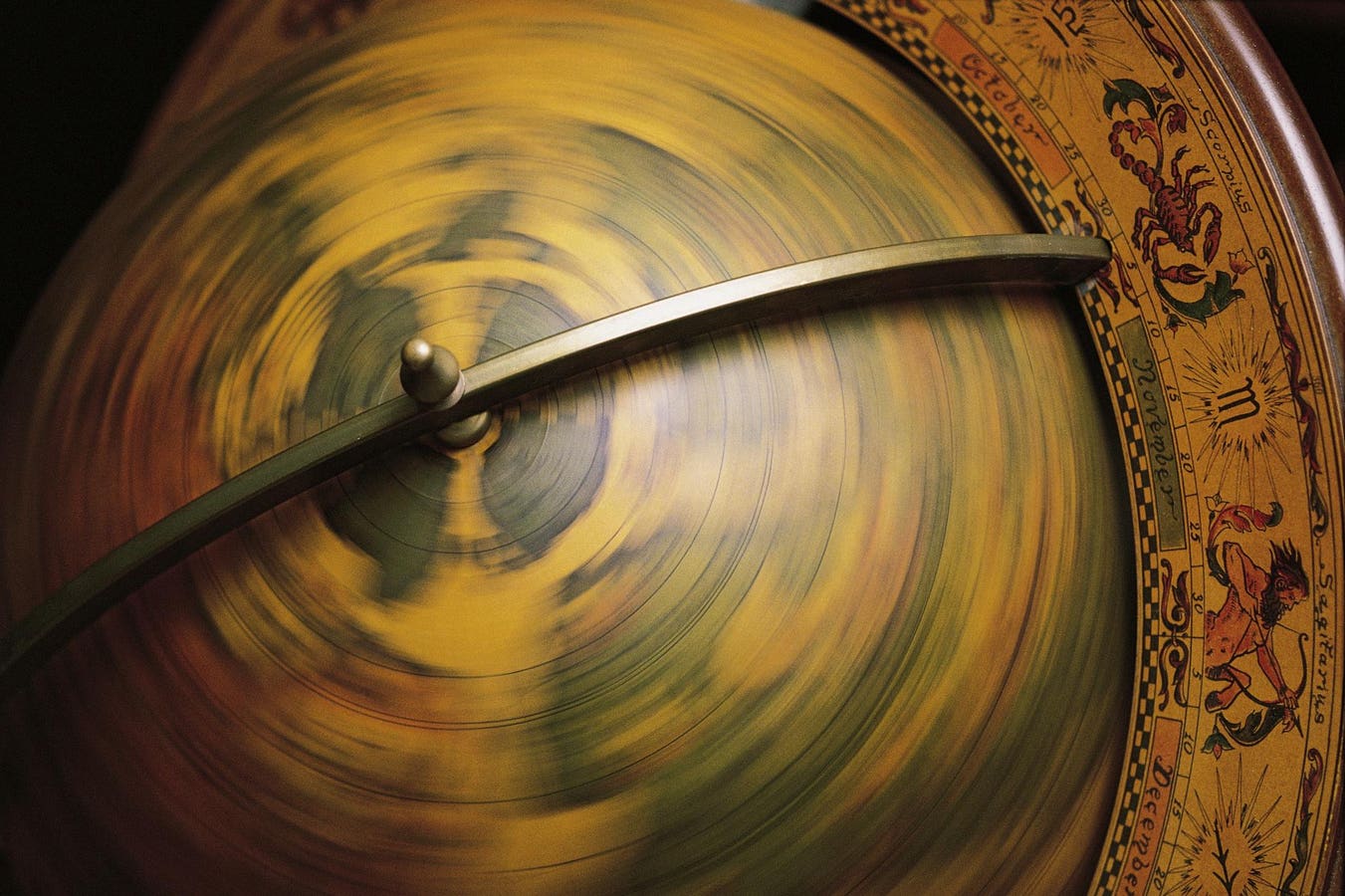
Earth is speeding up. In the coming years, a second will need to be removed from global time. That “drop second” will be a first for international timekeepers, but according to new research, it will be delayed by climate change.
On June 29, 2022, Earth rotated 1.59 milliseconds less than 24 hours, the fastest rotation that scientists had ever previously recorded, according to TimeAndDate.com. But the melting of ice caps at the poles is putting the brake on the rate of increase in the planet’s rotation rate, meaning the drop second now won’t be needed until 2029—not 2026, as previously thought.
Time On Earth
Time on Earth is based on Coordinated Universal Time (UTC), which closely follows this rotation. As Earth’s rate of rotation changes, “leap seconds” are added or taken away every so often. So far, leap seconds have only ever been added, with a slight slowing of Earth’s rotation observed by atomic clocks.
The last time the International Earth Rotation and Reference Systems Service (IERS) added a leap second was at 23 hours, 59 minutes and 59 seconds UTC on December 31, 2016.
Increased Melting
A new paper published in the journal Nature this week claims that the increased melting of ice in Greenland and Antarctica is redistributing mass, acting as a drag factor on Earth’s rotation. Changes in the Earth’s molten core also contribute to variations in the rate Earth spins.
“Enough ice has melted to move sea level, enough that we can actually see the rate of the Earth’s rotation has been affected,” said the paper’s author, Duncan Agnew, a geophysicist at Scripps Institution of Oceanography at the University of California San Diego, to Nature.
If Earth spins faster, then it gets to the same position a little earlier, so one rotation takes less time. If it slows, the opposite is the case.
Changes In Rotation
“Even a few years ago, the expectation was that leap seconds would always be positive and happen more and more often,” said Agnew. “But if you look at changes in the Earth’s rotation, which is the reason for leap seconds, and break down what causes these changes, it looks like a negative one is quite likely.”
However long it’s delayed, the use of a “drop second” has unknown consequences for the interconnected world. Smartphones, computers and communications systems synchronize using Network Time Protocol (NTP) servers. They define the current time as the number of seconds since 00:00:00 UTC on January 1, 1970. “One second doesn’t sound like much, but in today’s interconnected world, getting the time wrong could lead to huge problems,” said Agnew.
Wishing you clear skies and wide eyes.
Read the full article here