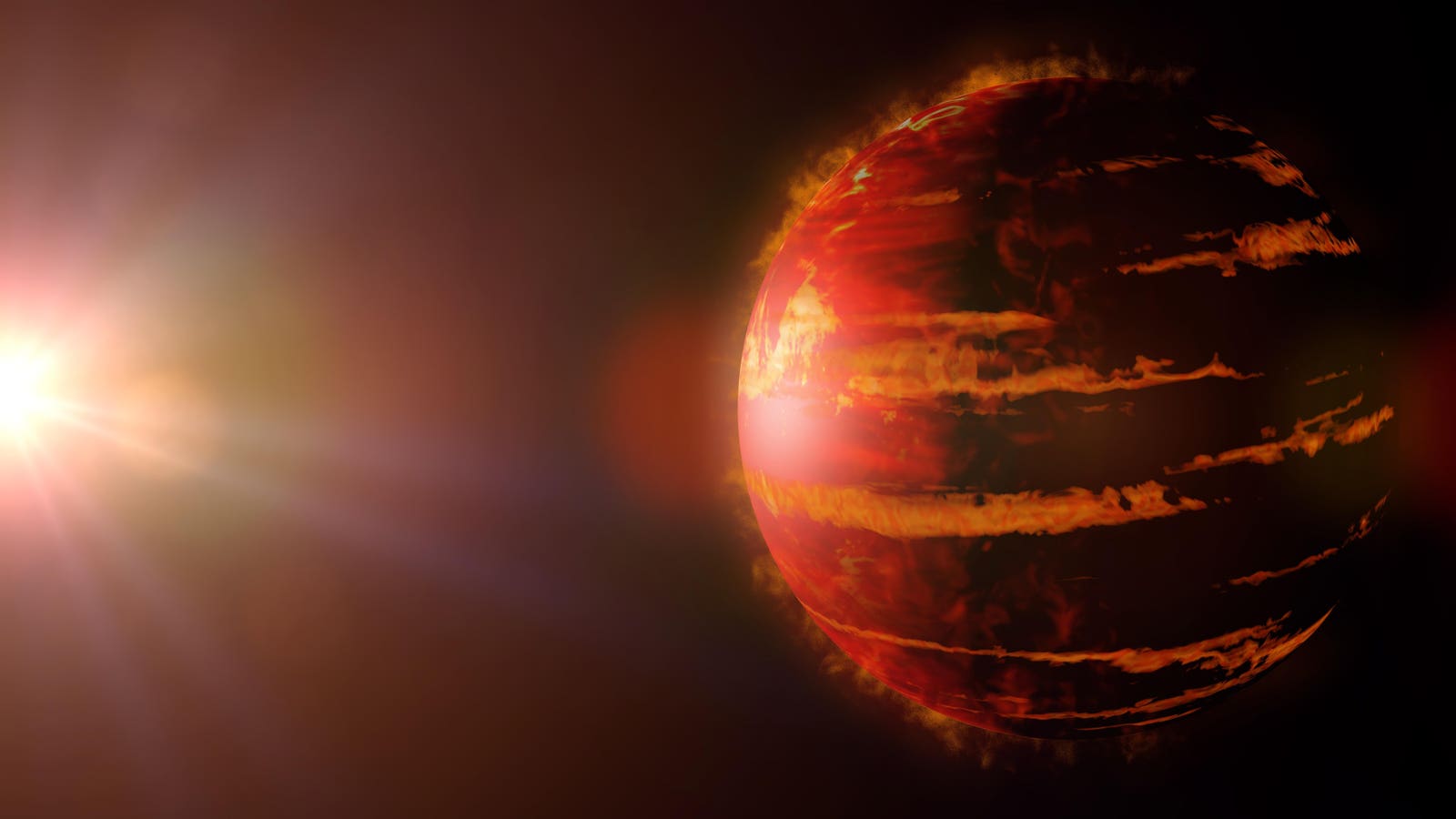
The existence of the 5,000 exoplanets found so far is mostly inferred. Astronomers mostly see a star’s light dip ever so slightly as a planet transit across the disk.
Just 15 planets orbiting other stars have actually been imaged.
So the imaging of a Jupiter-like planet orbiting a sun-like star about 87 light-years away in the constellation Lepus is a big event.
New Technique
Astronomers using the Keck II telescope on Maunakea, Hawaiʻi Island found AF Lep b—one of the lowest-mass planets ever imaged—and were able to see that its orbit is similar to Jupiter’s in our own solar system. AF Lep b is about three times the mass of Jupiter and orbits a star called AF Leporis, a young sun-like star.
Published this week in Astrophysical Journal Letters, the researchers found the planet using a new technique called astrometry—the measuring of subtle movements of a host star over many years in an effort to detect the gravitational tug of orbiting planets.
Moving Target
They zeroed-in on the star AF Leporis because it appeared to have moved during 25 years of observations from the Hipparcos and Gaia satellites. That’s despite AF Lep b being about 10,000 times fainter than its host star and around eight times the Earth-Sun distance from its host star.
“This is the first time this method has been used to find a giant planet orbiting a young analog of the sun,” said Brendan Bowler, senior author on the study and an assistant professor of astronomy at UT Austin. “This opens the door to using this approach as a new tool for exoplanet discovery.”
Webb Telescope
It’s hoped that this new technique could help astronomers find and image low-mass exoplanets, exoplanets orbiting their stars from far out as well as exoplanets that telescope don’t have an edge-on view of.
“This will be an excellent target to further characterize with the James Webb Space Telescope and the next generation of large ground-based telescopes like the Giant Magellan Telescope and the Thirty Meter Telescope,” said Bowler. “We’re already planning more sensitive follow-up efforts at longer wavelengths to study the physical properties and atmospheric chemistry of this planet.”
Wishing you clear skies and wide eyes.
Read the full article here