If you think you’ve seen a total solar eclipse, you’re wrong.
This is a saying among eclipse chasers, and it’s very rarely incorrect. In the run-up to a total solar eclipse, entire nations read about the coming rare celestial event and collectively utter, “I think I’ve seen one of those.”
None of them are correct. All of them are misremembering. What they witnessed was a partial solar eclipse, the kind which occurs twice every year across vast swathes of the planet.
Never Forget
How can we be sure? Nobody only thinks they saw a total solar eclipse. If you’re one of the one in 10,000 people who ever experience totality—when the sun is blocked entirely by the moon—it’s not something you ever forget. It’s not something you vaguely remember years later. It’s something you cherish for the rest of your life.
Besides, seeing a total solar eclipse usually requires making a big effort. To witness one, you must be on the path of totality, the area on Earth where the moon completely blocks the sun. If you’re not within the path of totality, you’ll only see a partial solar eclipse.
So if you only think you saw one, every eclipse chaser immediately suspects that you didn’t actually see one at all.
‘Great American Eclipse’
Lots of people in North America have seen a total solar eclipse. The continent is living through a golden age of eclipses at the moment, with the most recent being the “Great American Eclipse” in 2017, which brought totality to 12 U.S. states from Oregon to South Carolina. About 12 million people lived on that path, and about a million traveled to be in it. Were you on that path? If you were, you’d know it. You’ll remember the beautiful twilight-like sky, the silhouette of the moon and the achingly beautiful sight of the sun’s spiky white corona shining all around it. Witnessing that will be one of your most cherished memories.
How To Check
“I think I saw one of those in school/work” is a common belief. Ask a few questions, and you’ll quickly discover that the memory involves solar eclipse glasses, perhaps pinhole cameras. It’s a safe bet that the memory is from 2017—when North America as a whole witnessed a partial solar eclipse—though there have been other solar eclipses on the continent in living memory.
A quick way of telling is to find out the location of the memory and use the Solar Eclipses Visibility Database to check for sure.
American
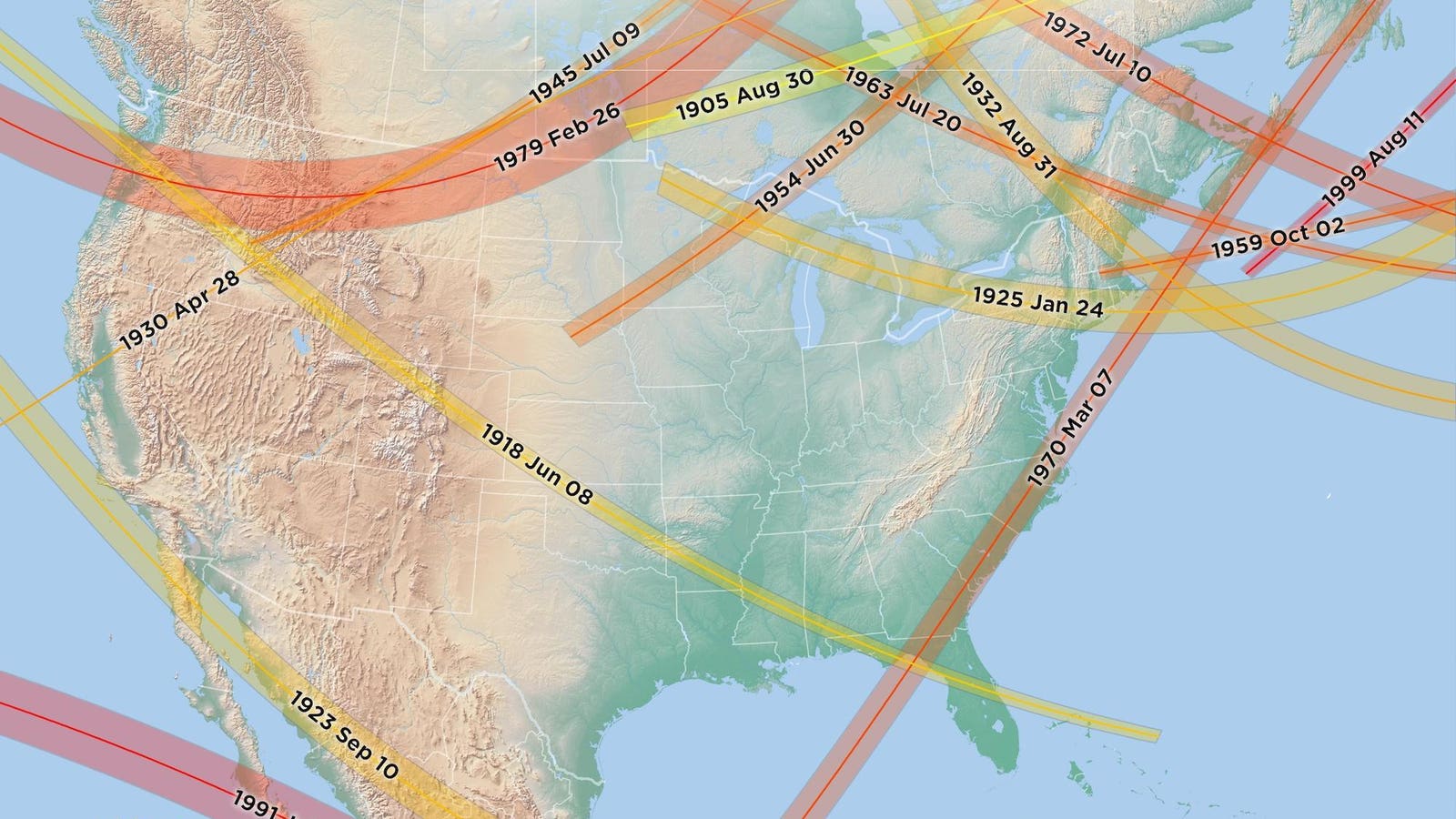
Here’s a list—each linking to an interactive map—of all the total solar eclipses that have fallen in North America in the last 70 years, according to GreatAmericanEclipse.com. If you weren’t inside “the stripes” on these specific days, you didn’t experience a total solar eclipse. If the dates aren’t here, it was a partial solar eclipse.
Once In A Lifetime
Next time you meet someone who only thinks they saw a total solar eclipse, ask them when and where it was and what they remember. Ask them to describe totality. Then, break the news to them gently by telling them about what’s about to happen on April 8—a once-in-a-lifetime total eclipse of the sun where they can finally experience totality and achieve something so few humans ever do.
This time, however, it will be a shared experience for a whopping 42 million people—including 32 million Americans—who already live in the path of totality.
Path Of Totality 2024
Everyone in North America will see a partial solar eclipse on April 8, but only those from within a narrow 115-mile path through parts of Mexico, 15 U.S. states and Canada will be able to experience totality.
It will cross parts of five states in Mexico (Sinaloa, Nayarit, Durango, Coahuila and Chihuahua), 15 U.S. states (Texas, Oklahoma, Arkansas, Missouri, Illinois, Kentucky, Tennessee (northwest corner), Michigan (southeast corner), Indiana, Ohio, Pennsylvania, New York, Vermont, New Hampshire and Maine) and six Canadian Provinces (Ontario, Quebec, New Brunswick, Prince Edward Island, Nova Scotia and Newfoundland).
For the very latest on the total solar eclipse—including travel and lodging options—check my main feed for new articles each day.
Wishing you clear skies and wide eyes.
Read the full article here