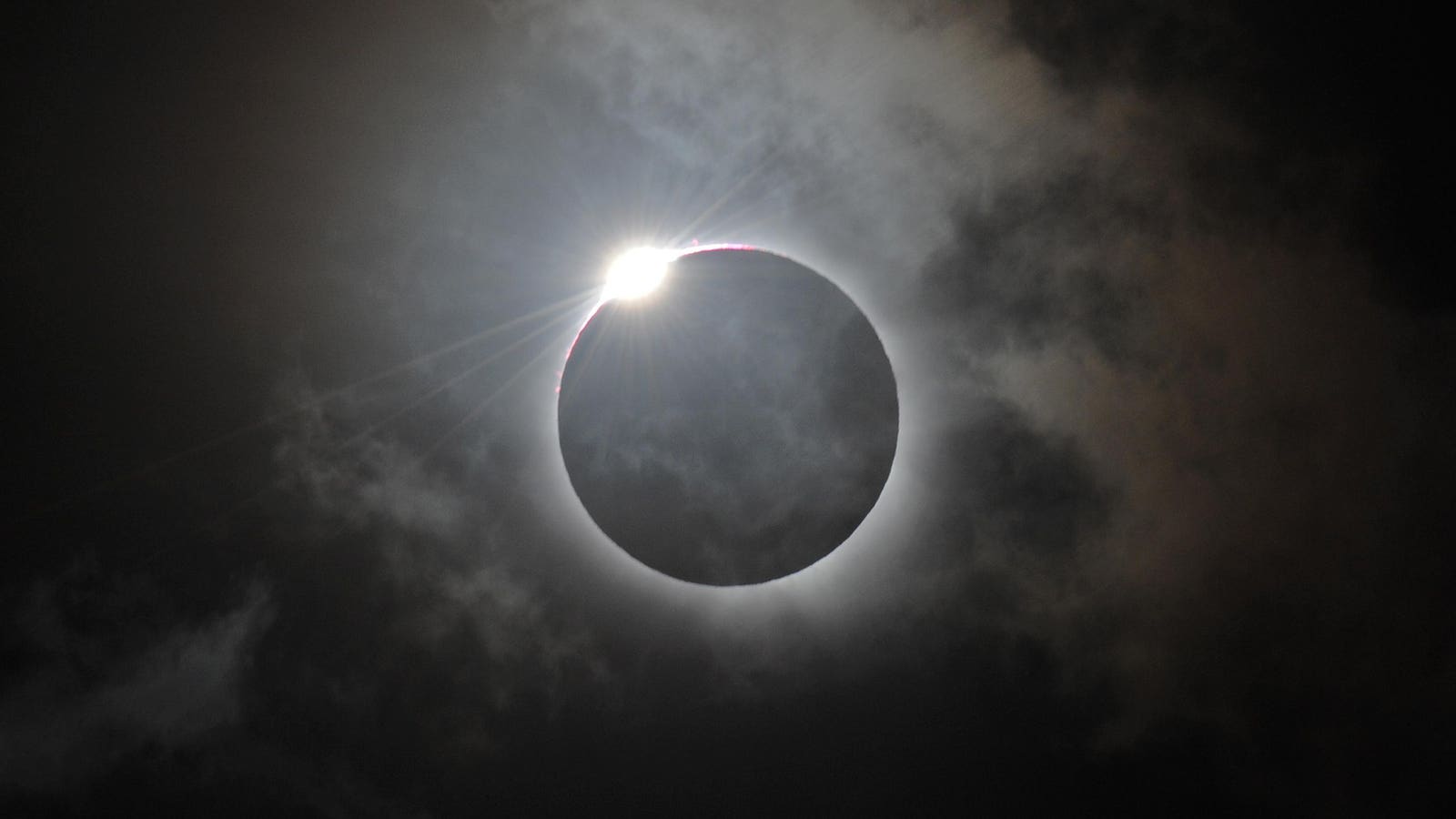
Accurate weather forecasts for the path of totality on April 8 won’t be available until a few days before, but scientists have confirmed that cumulus clouds over land begin to disappear almost instantly when a partial solar eclipse begins.
It’s something eclipse chasers have known for at least 40 years. Still, the publication of a paper in Nature Communications Earth and Environment gives extra credence to the long observed phenomenon.
However, how eclipse-induced cloud evolution works will likely have enormous consequences for those traveling into parts of 15 U.S. states—as well as Mexico and Canada—to see the final total solar eclipse in the contiguous U.S. until 2044.
Eclipse Cooling
Although solar eclipses’ effect on clouds has been observed for centuries, this is the first time the strength of the “eclipse cooling” effect has been measured.
The science is elementary. The heating of the ground drives convective clouds. So if the ground cools, they disappear. The vanishing of cumulus clouds during a partial solar eclipse was confirmed by researchers using satellite images taken during three partial solar eclipses across Africa between 2005 and 2016. They calculated the percentage of the sun obscured for each location and time on Earth.
Anecdotal Evidence
“From Earth, you can count the clouds and watch them disappear, but that only provides anecdotal evidence,” said Victor Trees, lead author, at the Delft University of Technology in the Netherlands. “By far, most of the solar eclipse consists of a partial eclipse, where there is still plenty of light outside,” he said. “In this partial eclipse, satellites receive enough reflected sunlight, after correcting for the obscuration, to measure clouds reliably.”
The 15% Rule
Cumulus clouds over land are very sensitive to solar eclipses and start to disappear on a large scale once the sun is about 15% eclipsed by the moon. The researchers also simulated the disappearance and appearance of clouds, revealing that rising air is almost immediately affected when a partial eclipse starts. However, above sea, the clouds remain unaffected during a solar eclipse, because the seawater does not cool down that fast.
Surprising Speed
“It’s been well known to eclipse chasers for 30 years that convective clouds dissipate during an eclipse—and it works everywhere,” said meteorologist Jay Anderson, who plans eclipse expeditions and whose climatological analysis of eclipse tracks on Eclipsophile is avidly read by eclipse chasers. He was not involved in the research. “What surprises people is how rapidly they can disappear during a total solar eclipse—it can go from 70% cloud cover to 1% in the space of five to 10 minutes.” Small convective clouds only have a lifetime of 10 minutes at the most, “so if you cut off their heating, they’re done,” said Anderson.
For eclipse chasers in the northeast U.S. and Canada looking at 60%+ chance of cloud cover, according to historical weather maps, “eclipse cooling” is a reason to ignore naysayers and get to the path of totality.
Path Of Totality
While everyone in North America will see the partial phases through solar eclipse glasses, only those within the 115-mile-wide track of the moon’s shadow will enjoy a brief totality. That will last up to 4 minutes and 26 seconds in Mexico and Texas, reduced by a minute or so as the path of totality tracks southwest to northeast across the U.S. and Canada.
This path of totality will cross parts of five states in Mexico (Sinaloa, Nayarit, Durango, Coahuila and Chihuahua), 15 U.S. states (Texas, Oklahoma, Arkansas, Missouri, Illinois, Kentucky, Tennessee, Michigan, Indiana, Ohio, Pennsylvania, New York, Vermont, New Hampshire and Maine) and six Canadian Provinces (Ontario, Quebec, New Brunswick, Prince Edward Island, Nova Scotia and Newfoundland).
For the latest on all aspects of April 8’s total solar eclipse in North America, check my main feed for new articles each day.
Wishing you clear skies and wide eyes.
Read the full article here