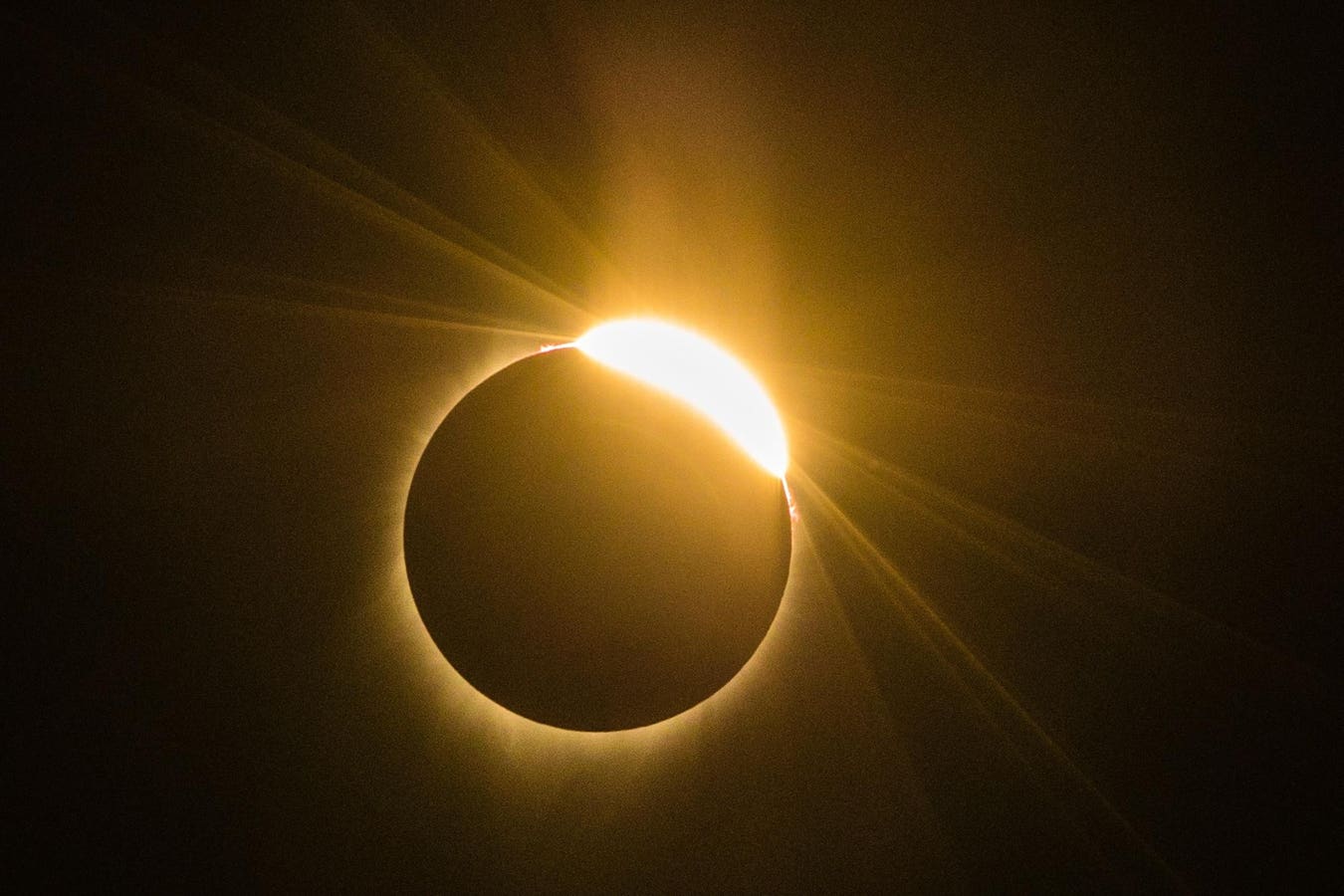
With an earthquake shaking the U.S. East Coast just ahead of a total solar eclipse, one may wonder if the position of the Moon has anything to do with this seismic event.
In ancient times, the sky was seen as a perfect clockwork. Stars and planets move along fixed paths and any changes in this apparent harmony, it was believed, must also affect Earth. Moon and solar eclipses were blamed for various natural disasters, including earthquakes. On social media it is easy to spot (supposed) predictions of seismic events or even volcanic eruptions based on the position of the Sun, the Moon, and even the other planets. Serious research is harder to find.
Research published in 2016 suggests a possible correlation between earthquakes and the Moon. Studying the frequency of large quakes in Chile, California, and Japan, the authors discovered that quakes with a magnitude over 5 are more likely to occur during a new or full Moon when the Sun, Moon, and Earth align. The alignment, in theory, pulls Earth’s tides over the sea and changes the mass distribution in an oceanic basin. This additional mass of water can put extra stress on fault systems located along the edges of continents, like the Cascadia region, the Andean subduction zone, and islands like Japan.
The effect is, as even the researchers admit, extremely weak and acts more likely only on shallow faults. Based on their calculations, only one in 10,000 quakes occurring during a time of increased tidal stress can be linked to the Moon’s position.
The gravitational pull of the Moon—or even the Sun—is far too weak to trigger an earthquake if compared to the forces driving plate tectonics. Tectonic movements and the presence of faults or layers of weak rocks underground are still the main factors controlling an earthquake.
Read the full article here