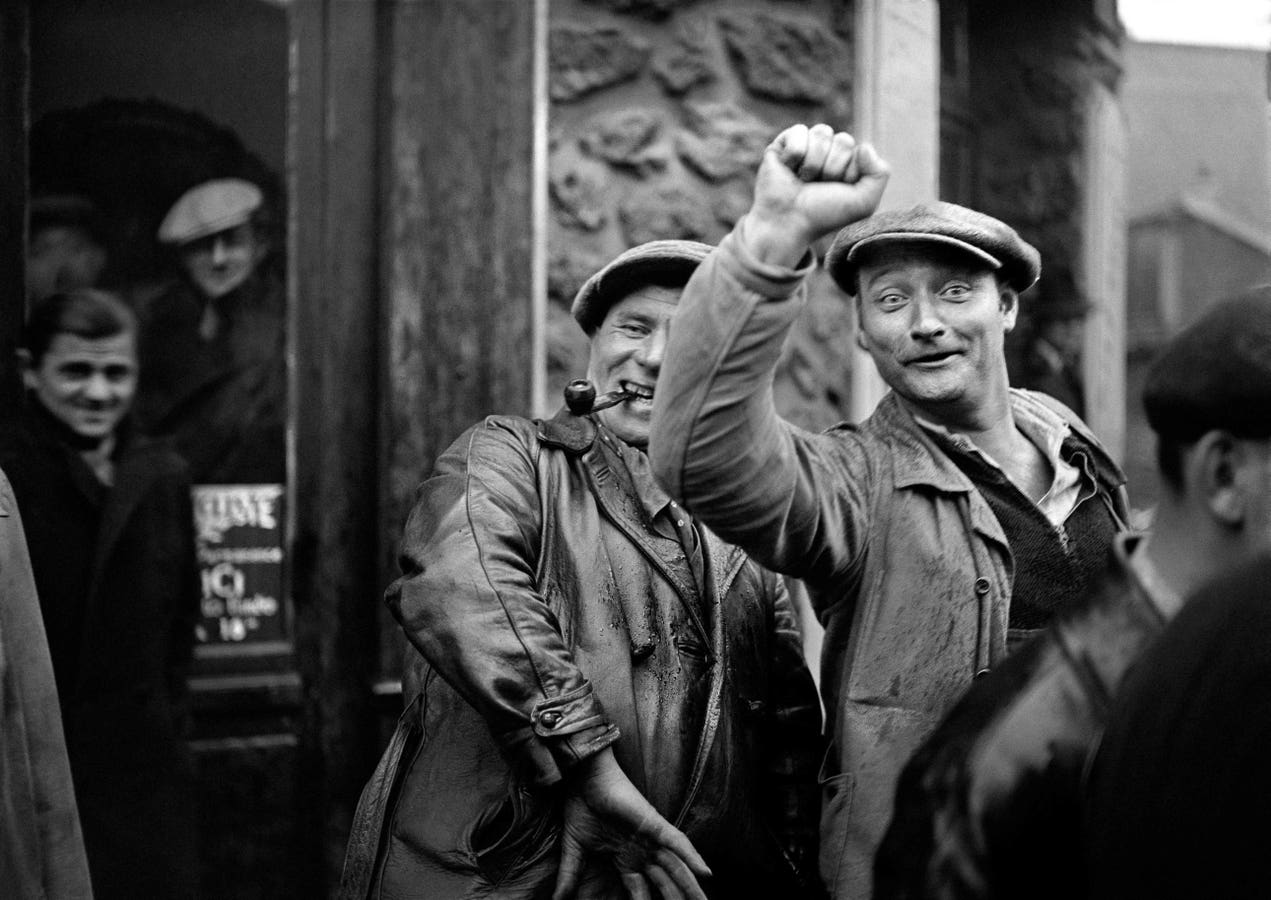
What if to understand the real stakes of artificial intelligence, we had to reread The Communist Manifesto? In this foundational text of 1848, there is of course no question of artificial intelligence and the revolution underway was then industrial and not digital. However, the sociological analysis of society proposed by Karl Marx and Friedrich Engels is more relevant than ever.
What do the two German thinkers tell us? Above all, that “The history of societies has been nothing but the history of class struggles,” which applies perfectly to what we observe today within companies with the rise of AI.
Thus, one of our recent studies conducted in 18 countries with 13,000 people highlights a growing divide around AI between leaders and employees, or the “dominant class” and the “proletariat” as the two philosophers would say. Two camps are clashing: that of employees worried about their jobs and that of executives, much more serene about their future. In terms of optimism towards AI, there is a 20 point difference between these two populations!
This “class struggle” of AI crystallizes around four issues.
First of all, the use of AI. Thus, if 80% of leaders claim to use generative AI several times a week, this is only the case for 20% of employees.
Then, in terms of training, the gap is also significant. While 86% of respondents believe they need to be trained on the impacts of AI on their jobs, only 14% of employees feel they have been trained. This figure is three times higher among executives.
Likewise, employees are very concerned about how their company uses AI. Only 29% believe that their company uses AI responsibly. This figure is 69% for executives.
Finally, faced with these fears, 75% of employees are calling for more regulation and therefore an increased role for the State, reminiscent of Marx and Engels’ recommendations.
So “what is to be done?” to take up Lenin’s fundamental question?
In a knowledge society, a large part of the answer lies in training. And let’s be clear, the need is not for two or three days of training on ChatGPT or DALL-E per year, it is about continuous training on tools that are constantly evolving.
Generative AIs are indeed an opportunity to train all teams how to talk to (“prompt”) these systems. The good news is that our study also shows that when teams use AI, the proportion of optimists doubles, while that of the worried is halved.
It is urgent to act together to avoid a crisis between the “bourgeoisie” of artificial intelligence – those whose capital is their training and knowledge, and its neo-proletariat. Inequalities are increasing at a dizzying rate between an elite that benefits from more and more job opportunities or profitable investments and the rest of the population who only see prospects for downward mobility – being “enslaved” by digital systems like their elders were by machines.
The challenge is therefore to create the conditions for the emergence of a “middle class of AI.” Some companies are already using generative AI to train technicians for positions that were previously inaccessible to them.
However, a utopian resolution will not simply occur naturally. It will require a concerted effort from all sectors of society, particularly in ensuring accessible education and responsible, democratic control over AI.
The class struggle that AI seems to be fueling is a counterpoint to Fukuyama’s “end of history,” which held that humanity’s ideological evolution ended with the widespread acceptance of Western liberal democracy. The Marxist class struggle was largely resolved.
But as we transition from the industrial revolution to the digital revolution, the potential democratization of AI technology through comprehensive education and training could lead to a new equilibrium, where everyone, regardless of their class, has equal access to AI. The resolution of AI’s class struggle could potentially represent a new “end of history.”
By providing equal opportunities to learn and harness the power of AI, we can uphold the values of liberal democracy and potentially mitigate the widening socioeconomic divide observed today.
Read the full article here