


Offshore wind is becoming an increasingly important part of the world’s renewable energy portfolio–with countries such as China, Germany, the United Kingdom and the United States investing heavily in their development.
Most offshore wind farms are pile-driven, meaning that each individual turbine is hammered into the seabed. While the energy produced from a pile-driven wind farm is almost entirely “clean,” construction of these windmills is not, and poses a host of ecological problems.
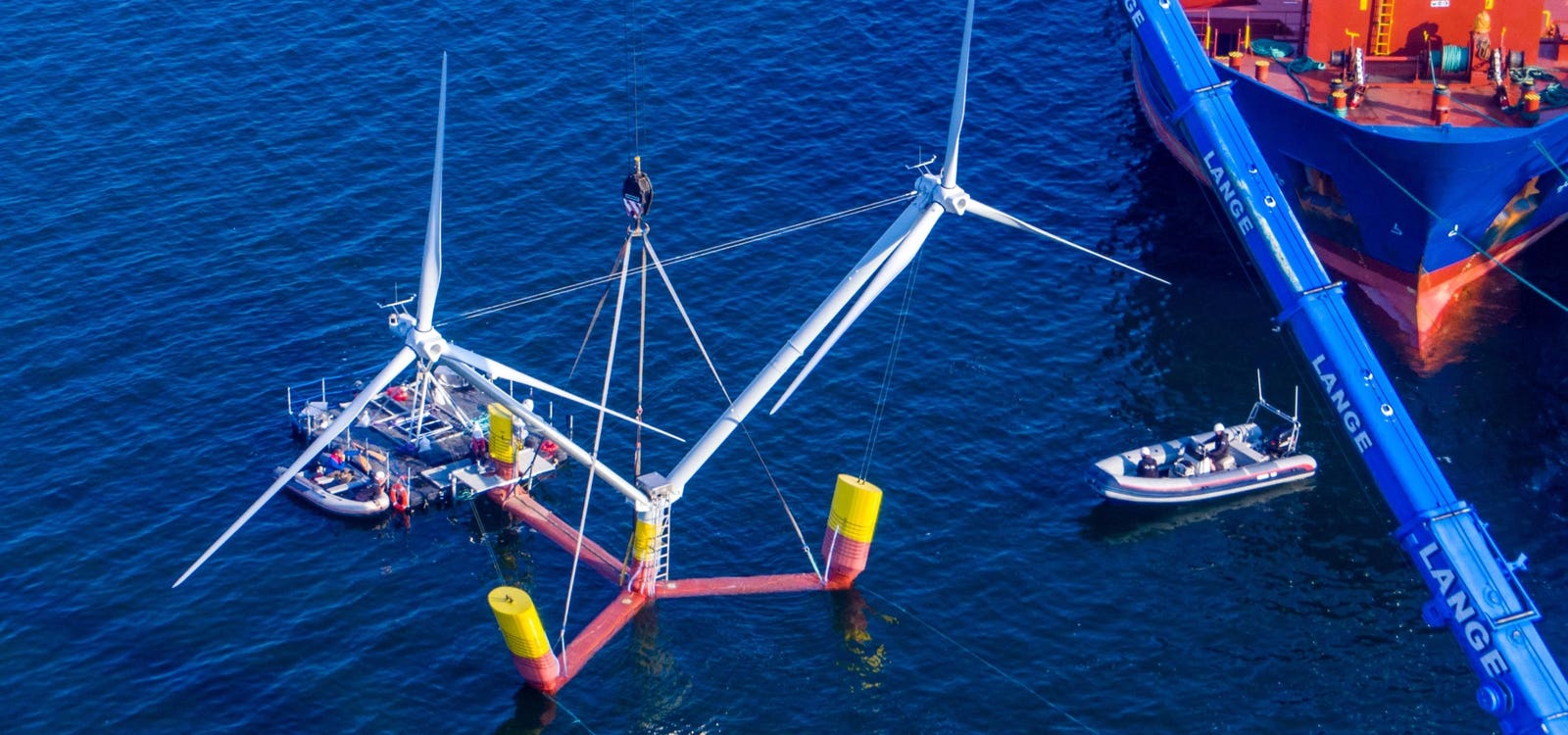
Newer designs, however, allow for windmills to float on the ocean’s surface. They are tethered to the seabed with cables–making for a less invasive construction phase. Not only is this design potentially better for the surrounding aquatic environment, it allows for windmills to be placed in deeper water–opening up new siting opportunities further from the coast and in areas where wind speeds may be higher.
Currently, floating offshore wind farms can be found off the coasts of Scotland, Norway, Portugal and the United Kingdom, with dozens more in the works.
What is the environmental impact of this seemingly less invasive technology? Recent research published in the Journal of Environmental Management holds some answers. Here are three takeaways from the research that speaks to the environmental promise of floating wind turbines.
1. Collisions With Marine Life May Decrease
Floating offshore wind farms may decrease the risk of construction and maintenance vessels colliding with marine mammals–whales, in particular–compared to pile-driven sites. The researchers believe this to be the case for a couple of reasons.
For one, much of the construction of floating windmills can be done on land. This reduces the need for construction vessels to ferry back and forth between land and sea during the construction phase. Floating windmills can also be installed in a relatively short amount of time compared to fixed-foundation turbines.
Second, some floating windmill designs make space for helicopter landing pads. So, instead of using boats to maintain the windmills, which means increased maritime traffic, repairs can be done by helicopter.
2. Aerial Collisions May Decrease
Floating wind turbines are generally sited farther from shore than fixed-foundation turbines. The researchers note that the density of seabirds generally decreases as one travels farther from the coastline–suggesting that floating windmills, at least those that are placed farther offshore, may cause less of a disturbance to marine bird populations.
This, however, is only part of the story. The researchers also speculate that floating offshore wind turbines, unlike pile-driven turbines, could create more perching opportunities for marine birds, due to their wide floating bases. This could cause bird activity to increase around the sites, thus heightening the likelihood of birds being struck by turbine blades.
3. Underwater Noise Levels From Construction Will Likely Be Lower
Pile driving construction creates dangerously high noise levels in the surrounding aquatic environment. (Keep in mind that sound travels faster in water than in air, making it appear louder.)
Research shows that the noise emitted during turbine pile driving could cause significant hearing damage to marine mammals in the construction area. Large whales are considered to be particularly sensitive to the low frequency sound produced from pile driving.
Floating windmills obviates this problem. “Pile-driving base components for any marine structure, including fixed turbine foundations, results in significant noise levels harmful to marine life,” state the researchers. “In most instances, floating offshore wind turbines do not require pile driving, thus removing that impact entirely.”
The researchers, however, highlight the need for additional research to clear up many of the unknowns that remain.
“Our review underscores additional research and mitigation techniques are required for floating technology, beyond those needed for pile-driven offshore or inshore turbines, and that understanding and mitigating the unique impacts from this technology is critical to sustainability of marine ecosystems,” they conclude.
Read the full article here