


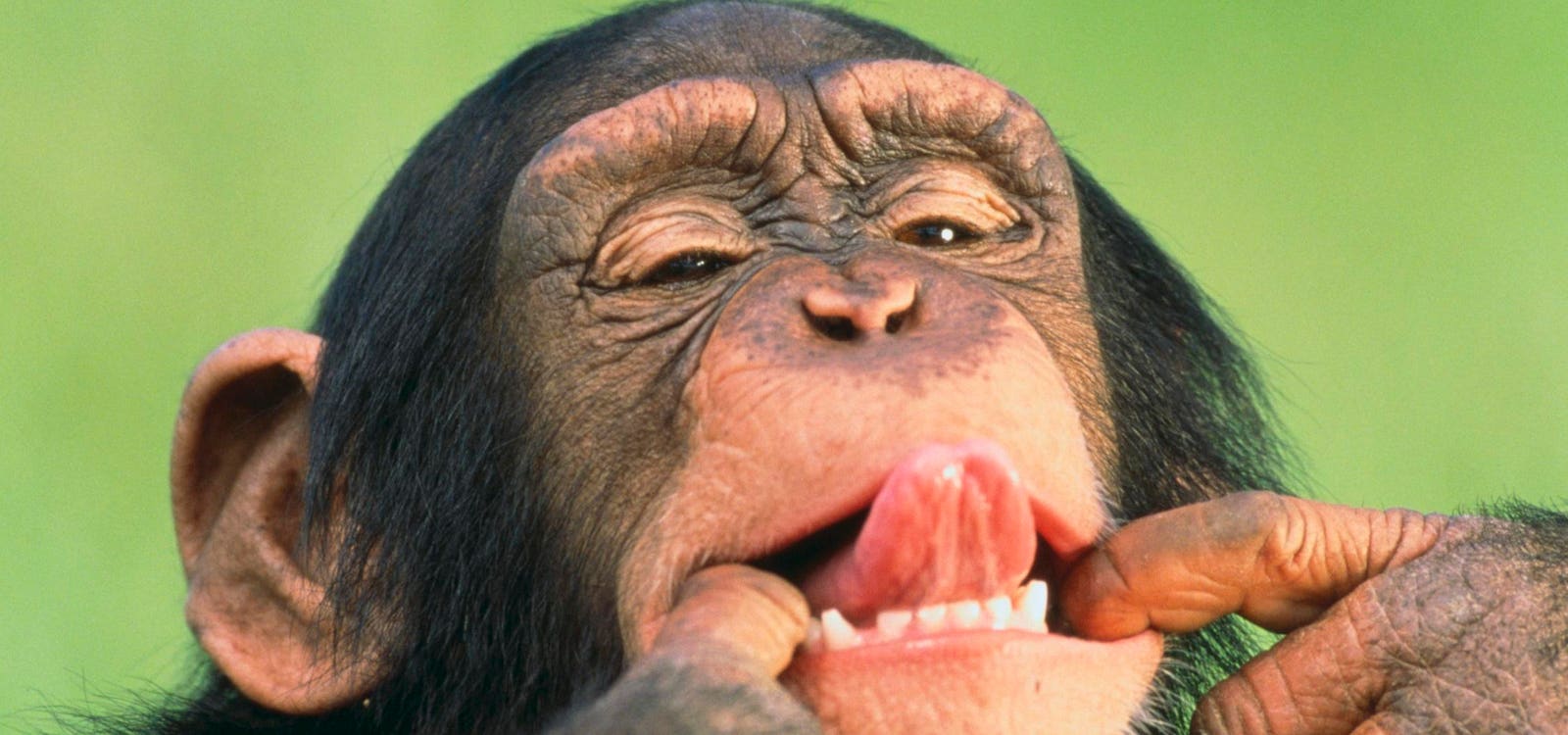
Great apes—specifically younger chimpanzees, bonobos, gorillas and orangutans—enjoy engaging in “teasing behaviors” aimed at their elders, according to a study published last month in the journal Proceedings of the Royal Society B.
Since we evolved from a common ancestor roughly 13 million years ago, humans and great apes share many behaviors, including the capacity for laughter, engaging in social object play and demonstrating sophisticated social understanding. These characteristics make them excellent candidates for us to study how and why humor and teasing evolves in species other than ourselves.
Combing through 75 hours of zoo footage, scientists looked for unignorable behaviors directed from one animal toward the other. These actions, which the scientists refer to as “teasing behaviors,” often involved direct physical contact, manipulating the other animal’s body, or engaging in behaviors that dominated the other animal’s field of vision through repetitive movements.
These differ from play in that they don’t typically include clear signals of playfulness, such as reciprocity, a play face or other gestures that indicate the behavior is meant in jest. Instead, these actions may be more ambiguous, leaving room for different interpretations by the receiving animal. The study found that only 26% of these behaviors developed into play.
What Do We Now Know About Teasing And Great Apes?
In the 75 hours of raw footage, there were 142 instances of teasing “events.” Sometimes, these events were made up of various teasing behaviors.
There were 18 specific teasing behaviors observed in baby great apes. These include body slamming, hiding, hindering others’ activities and movement, playful and aggressive hitting, using objects in interactions, offering and withdrawing objects or body parts, poking, pulling on body parts or hair, stealing items, swinging close or with objects, tickling, tug of war and violating personal space.
Poking is the most common teasing behavior across all the great apes, with the highest instances observed in chimpanzees. Chimpanzees are also the most frequently recorded species engaging in hitting, which is the second most common behavior. Meanwhile, orangutans stand out in pulling on hair and swinging close or with objects, indicating species-specific preferences in teasing behaviors.
The findings suggest that while some teasing actions may be common across all great apes, others are more prevalent or preferred in certain species, possibly due to varying social structures or communication styles. Through such interactions, young apes learn the boundaries of social norms, teasing each other in ways that reflect their species’ unique social dynamics and physical traits.
So How Do The Elders Respond?
Adult great apes respond to the teasing behavior of younger members in a variety of ways. Typically, they ignore the teasing or engage in a mild aversive behavior such as ducking or moving away. Occasionally, they might respond with playful or affiliative actions. When adults themselves tease the younger ones, they may moderate their behavior, a process known as self-handicapping, to maintain a playful atmosphere and encourage the young to engage socially.
In teasing interactions among great apes, there’s an asymmetry often stemming from size differences, unlike the more balanced exchanges seen in play. You can think of this as the way human children may sometimes be seen as “annoying” by adults. As teasing is viewed as a cognitive precursor to joking and humor, the presence of these “annoying” behaviors in great apes suggest that joking may be deeply rooted in our evolutionary history. These exchanges in great apes reinforce social bonds and teach the young about societal norms in a manner that’s strikingly similar to human social learning.
Read the full article here