


The push for renewable energy is critical in addressing climate change, with wind power at the forefront. As the leading emitter of greenhouse gases, China has embarked on a transformative journey towards greener alternatives, aiming for carbon neutrality by 2060.
This ambitious goal is propelled by the rapid growth in wind power, driven by technological advancements and cost reductions. China’s proactive stance not only showcases its commitment to environmental sustainability but also positions it as a potential leader in the global shift towards renewable energy sources.
In a study published in Environmental Science and Ecotechnology, a joint research group led by Prof Xi Lu from School of Environment and Institute for Carbon Neutrality at Tsinghua University presents an innovative method for assessing the economic feasibility and market advantage of onshore wind energy in comparison to conventional energy sources.
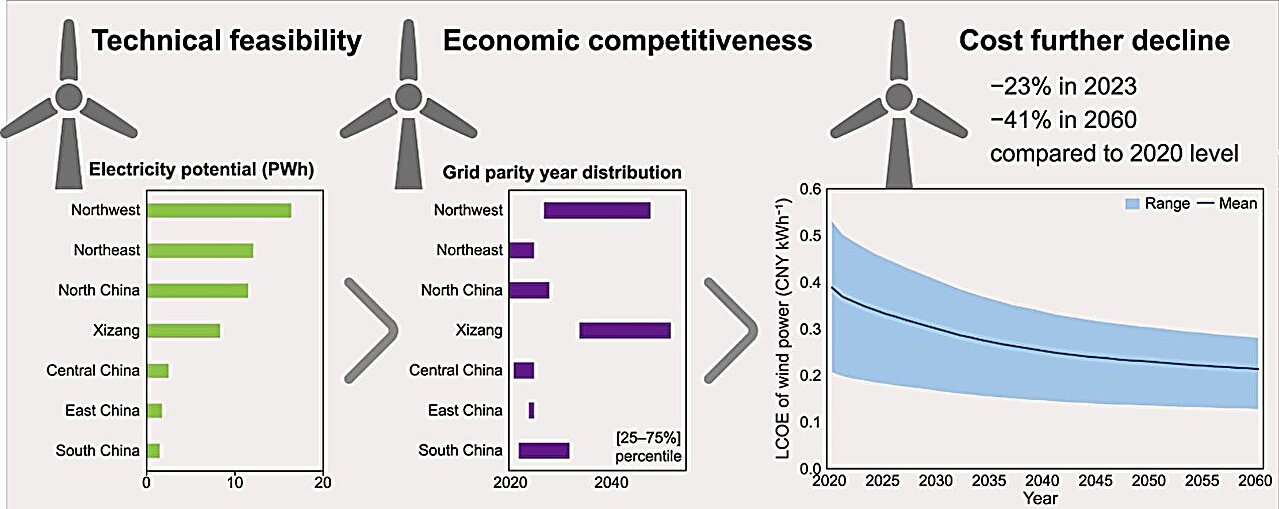
This study highlights China’s significant strides in adopting wind power, crucial for its 2060 carbon neutrality goal. Wind energy’s share in China’s power mix has surged, reaching 6.1% with 466.5 TWh produced, and aims for a 2,500 GW capacity by 2060.
The urgency in power system planning has intensified, necessitating models that accurately forecast the future dynamics of cost reduction and supply potential for wind power, aiming for carbon neutrality by 2060. Many existing analyses have not adequately accounted for the swift decrease in wind power generation costs observed in recent years, often offering forecasts of cost declines that are more conservative than actual trends.
Given the increasing significance of spatial and temporal dynamics in the economic competitiveness of wind energy for China’s decarbonization strategy, this research developed a comprehensive model to assess the technical and economic viability of onshore wind power within the country. The evaluation was performed with a high spatial resolution of 0.0625° longitude by 0.0625° latitude, covering a period from 2020 to 2060.
Results reveal vast wind power technical potentials as high as 53.9 PWh nationally, equivalent to approximately 7.2 times the electricity consumption in 2020. The average levelized cost of wind power is expected to decline from CNY 0.39 kWh-1 in 2020 to CNY 0.30 and CNY 0.21 kWh-1 in 2030 and 2060. 28.3%, 67.6%, and 97.6% of the technical potentials hold power costs lower than coal power in 2020, 2030, and 2060.
From the perspective of spatial and temporal precision in evaluation, the study represents a significant leap forward in our understanding of wind power’s potential in China. The innovative approach not only sheds light on the evolving economics of wind energy but also provides a robust framework for integrating renewable energy sources into national carbon-neutrality strategies. This research is a vital contribution to the ongoing renewable energy research and climate action.
This breakthrough underscores the feasibility of integrating wind power into the energy mix at lower costs, paving the way for sustainable energy solutions. The findings highlight the importance of advancing renewable energy technologies and policies, contributing significantly to global environmental sustainability efforts.
More information:
Shi Chen et al, Cost dynamics of onshore wind energy in the context of China’s carbon neutrality target, Environmental Science and Ecotechnology (2023). DOI: 10.1016/j.ese.2023.100323
Provided by
TranSpread
Read the full article here


